The Secret Mr. Vance Kept Hidden From His Own Family
PART 3 (FULL STORY)
Noah read the first line again.
“My name is not Vance. I have spent most of my life making sure no one discovered who I really was.”
For a few seconds, neither of us spoke.
I looked at the attorney, waiting for him to explain what that meant, but he only nodded toward the letter.
“Mr. Vance wanted the two of you to hear this from him first,” he said. “Everything I know is contained in that letter.”
Noah swallowed and continued.
“My real name is Daniel Mercer.”
The name meant nothing to me.
The next paragraph explained that Daniel Mercer had grown up in another state and had changed his name decades earlier after a series of events he believed could have destroyed more than one family.
He had not been hiding because he was ashamed of who he was.
He had been hiding because, in his words, “sometimes a secret is not kept to protect the person carrying it.”
Noah frowned.
“Mom?”
“I’m reading.”
The letter continued.
Daniel had once had a younger sister named Evelyn.
She was twenty-two years younger than him and, according to the letter, was the person he had loved most in his family.
Their father had been difficult and controlling, and their mother had spent most of her life trying to keep peace between them.
When Evelyn was nineteen, she became pregnant.
The father of the child disappeared before the baby was born.
Evelyn refused to tell Daniel everything, but she told him enough to make him understand that she was frightened.
Then, shortly after giving birth, she disappeared.
Daniel spent years trying to find her.
He eventually learned that Evelyn had died.
But the baby had survived.
That was where I stopped reading.
I looked at Noah.
He was already looking at me.
“No,” I said before he could speak.
The attorney leaned back.
“Please keep reading.”
Noah looked down again.
Daniel wrote that the child had been placed with another family and that he had been told the adoption was permanent.
He had tried to accept that.
For years, he did.
Then, much later, he discovered that the records surrounding the adoption had been altered.
Someone had deliberately hidden the child’s identity.
Daniel spent the next several years trying to uncover the truth.
He eventually found a name.
Then an address.
Then a photograph.
I felt my hands go cold.
“Noah,” I whispered.
My son stared at the page.
Daniel had written that he had found the child.
He had also written that by the time he found him, the boy was already grown.
And Daniel had made a decision.
He would not suddenly appear in his life.
He would not claim a relationship that had never been offered.
He would watch from a distance.
He would make sure the boy was safe.
And if the boy ever needed him, Daniel would be there.
The next line made my vision blur.
“The child is Noah.”
Noah dropped the letter onto the table.
The attorney said nothing.
I couldn’t speak either.
My son looked at me.
“Mom, what does that mean?”
I shook my head.
“I don’t know.”
But even as I said it, a memory surfaced.
A man.
Years earlier.
Standing outside the hospital after Noah was born.
I had never seen him before.
He had asked whether I was Claire Bennett.
When I said yes, he had looked toward the maternity ward and asked whether the baby was a boy.
I had told him it was none of his business.
He apologized and left.
I had never seen him again.
At least, that was what I thought.
I looked back at the letter.
Daniel wrote that he had watched Noah from a distance for years.
He knew about his school.
He knew when he played baseball.
He knew when Noah struggled after his father disappeared.
But he never interfered.
Then Noah became fourteen.
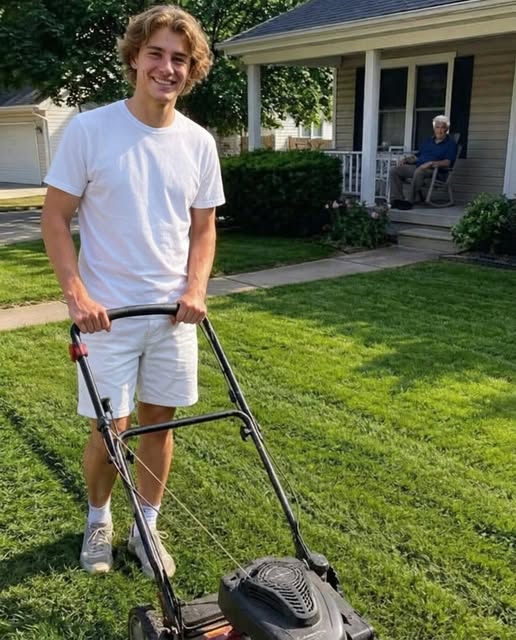
One Saturday morning, he crossed the street carrying a lawn mower.
Daniel wrote that he had been sitting on the porch that morning.
He had watched Noah struggle with the mower.
He had watched him finish the entire yard.
And when Noah refused the money Daniel offered, something changed.
“He reminded me of Evelyn,” the letter said.
“Not because he looked like her, but because he helped without calculating what he would receive in return.”
Daniel wrote that he began waiting for Saturdays.
Not because he needed his lawn cut.
Because Saturdays gave him a reason to see the grandson he had never been allowed to know.
Noah read that paragraph twice.
Then he whispered, “Grandson?”
The attorney nodded.
“Yes.”
Noah stood and walked to the window.
For the first time since we entered the room, he looked like a fourteen-year-old again rather than the seventeen-year-old who had spent the last four years mowing a dead man’s lawn.
“I thought he was just lonely,” he said.
“He was,” I answered.
Noah looked back at me.
“But he knew who I was.”
“Yes.”
“And you didn’t?”
“No.”
He nodded slowly.
I could see the disappointment forming before he spoke again.
“Why didn’t he tell me?”
The attorney finally opened his briefcase again.
“He believed telling you would force you to carry a history you never asked for.”
Noah sat down.
“That doesn’t make sense.”
“It did to him.”
The attorney removed another document.
“There is something else.”
He placed it on the table.
It was a photograph.
Daniel stood beside a much younger woman.
I recognized the woman immediately.
I had seen her face before.
Not in person.
In the only photograph I had ever been given of Noah’s biological father.
The attorney noticed my expression.
“You know her?”
“No.”
I pointed at the photograph.
“But I know the man standing beside her.”
Noah turned toward me.
“Who?”
I couldn’t answer.
The attorney did.
“His name was Michael Reed.”
Noah went completely still.
That name was the reason his father had disappeared.
Michael had left before Noah was born and had never contacted us again.
I had spent seventeen years telling myself that he had simply chosen not to be a father.
The attorney looked at me carefully.
“Daniel discovered that Michael was Evelyn’s son.”
My mouth went dry.
That meant Evelyn was Noah’s grandmother.
Daniel was her brother.
And Michael was the man who had abandoned Noah.
The pieces were finally fitting together.
But there was one part I still didn’t understand.
“If Daniel knew Michael was the father,” I said, “why didn’t he ever tell me?”
The attorney lowered his eyes.
“Because Daniel believed Michael had been lied to.”
Noah’s face tightened.
“About what?”
The attorney handed him another page.
“This is where the second part of the secret begins.”
The document explained that Michael had not disappeared because he didn’t want Noah.
He had been told that Claire had decided to give the baby up.
He had been shown paperwork suggesting that the adoption had already been arranged.
But those papers were false.
Someone had convinced Michael that his son would be better off without him.
Someone had also convinced Claire that Michael had abandoned them willingly.
For seventeen years, both sides had lived with a lie.
Noah looked at me.
“You never gave me away.”
“No.”
“And Dad thought you did?”
“That is what Daniel believed.”
The attorney nodded.
“Daniel spent years trying to find out who created the false documents.”
“Did he?”
“Yes.”
The room became quiet.
“Who?” I asked.
The attorney looked at Noah.
“Daniel’s own father.”
I felt something inside me sink.
Daniel’s father had been controlling.
He had wanted Evelyn’s pregnancy hidden.
He had wanted the baby placed with another family.
And when Michael tried to stay involved, he had interfered.
Daniel had spent decades trying to uncover the truth, but by the time he had enough proof, his father was dead.
Michael was already gone.
And Daniel had decided that dragging seventeen years of pain into Noah’s life would accomplish nothing.
Until he met Noah.
Until four Saturdays became four years.
Until the boy across the street became the family Daniel thought he had lost forever.
Noah looked at the photograph again.
“Where is my father now?”
The attorney hesitated.
“He’s alive.”
Noah’s head lifted.
“Where?”
“He lives at the address in the letter.”
I looked at the page.
The address from earlier.
The house I had remembered seeing once.
“You knew this before the funeral?” I asked.
“I knew Daniel had arranged for you to meet him,” the attorney said. “I did not know whether you would want to.”
Noah folded the letter carefully.
“I want to.”
I reached for his hand.
“Are you sure?”
He nodded.
“I’ve spent seventeen years wondering why he left.”
The attorney gathered the documents.
“There is one final instruction.”
“What is it?”
“Daniel did not want you to meet Michael because of money.”
Noah looked almost offended.
“I don’t care about the money.”
“I know,” the attorney said. “That is why Daniel chose you.”
The estate turned out to be more modest than any of us had imagined.
Daniel had left his house to a local community organization.
He left some personal belongings to relatives.
But he left Noah a small savings account and one other thing.
The old porch chair.
Noah laughed when the attorney told him.
“The chair?”
“The chair,” he confirmed.
Daniel had written that he wanted Noah to have it because it was where he had spent the longest hours watching him grow.
Noah didn’t know what to say.
We left the church with the chair’s future still sitting somewhere between us.
The next afternoon, we drove to the address in the letter.
Noah sat beside me in silence.
When we stopped outside the house, neither of us moved.
A man eventually opened the front door.
He was older than the photograph.
Thinner.
Gray-haired.
But there was no mistaking him.
Michael.
Noah stepped out of the car.
Michael looked at him.
Then at me.
His face changed.
“You’re Noah.”
Noah nodded.
“I am.”
Michael gripped the doorframe.
For a long moment, he couldn’t speak.
Then he whispered, “Daniel found you.”
“Yes.”
Michael closed his eyes.
“I wondered if he ever would.”
Noah stood on the walkway.
“Why did you leave?”
Michael looked at me.
I didn’t rescue him from the question.
He had seventeen years to answer it.
“I didn’t leave because I didn’t want you,” he said.
“Then why?”
“Because I was told your mother didn’t want me involved.”
I shook my head.
“I never said that.”
“I know that now.”
Michael’s voice broke.
“I found out the truth three years ago.”
Noah stared at him.
“Three years?”
Michael nodded.
“Daniel contacted me.”
“Why didn’t you come?”
Michael looked down.
“Because by then you were fourteen.”
He wiped his face.
“I thought walking into your life after fourteen years would be another selfish thing I was doing for myself.”
Noah didn’t answer.
Michael stepped aside.
“You don’t have to forgive me.”
“I don’t know you well enough to forgive you.”
The honesty seemed to hurt Michael more than anger would have.
But he nodded.
“That is fair.”
Noah looked toward me.
I could see the question in his eyes.
I nodded.
He walked inside.
I stayed on the porch.
For the first time in seventeen years, my son was sitting in the same room as his father.
I didn’t listen through the door.
Some conversations belonged to them.
When Noah came out nearly an hour later, he wasn’t smiling.
He wasn’t crying either.
He simply looked tired.
“What did he say?” I asked.
“That he was scared.”
“And?”
“That he should have been braver.”
We drove home without discussing it further.
A week later, the attorney delivered Daniel’s final belongings.
There was the photograph.
The letter.
A small brass key.
And the old porch chair.
Noah carried the chair across the street himself.
He placed it on our front porch.
I asked him why he didn’t put it in his room.
He said, “Because that’s where he waited for me.”
Every Saturday after that, Noah still mowed our own lawn.
Sometimes he visited Michael.
Sometimes he didn’t.
There was no instant reunion.
No perfect family.
No seventeen years magically returned.
But there were phone calls.
Then lunches.
Then small conversations that became easier.
Michael eventually told Noah stories about Daniel that weren’t in the letter.
Noah told Michael about school.
They slowly learned how to be strangers who were becoming family.
And I learned something too.
The truth did not erase the years we had lost.
It simply stopped the lie from taking any more.
Months later, on a warm Saturday morning, I woke to the sound of a lawn mower.
For a second, I thought Noah was outside.
Then I looked through the window.
He wasn’t.
Michael was pushing the mower across the yard.
Noah was walking beside him, laughing about something I couldn’t hear.
When they finished, Michael set the mower down.
Noah crossed the street and sat in Daniel’s old porch chair.
He leaned back the same way Daniel once had.
For a moment, I could almost see the old man there beside him.
Noah looked across the street at me.
“Mom!”
“What?”
He smiled.
“Do you have any lemonade?”
I laughed.
“Of course.”
I carried three glasses outside.
Noah moved over and left an empty space beside him.
Michael sat down.
None of us said anything for a while.
The old chair creaked beneath them.
And for the first time, it wasn’t waiting for someone who was gone.
It was holding the family he had spent his final years quietly trying to bring back together.