The Safety-Deposit Box FULL STORY
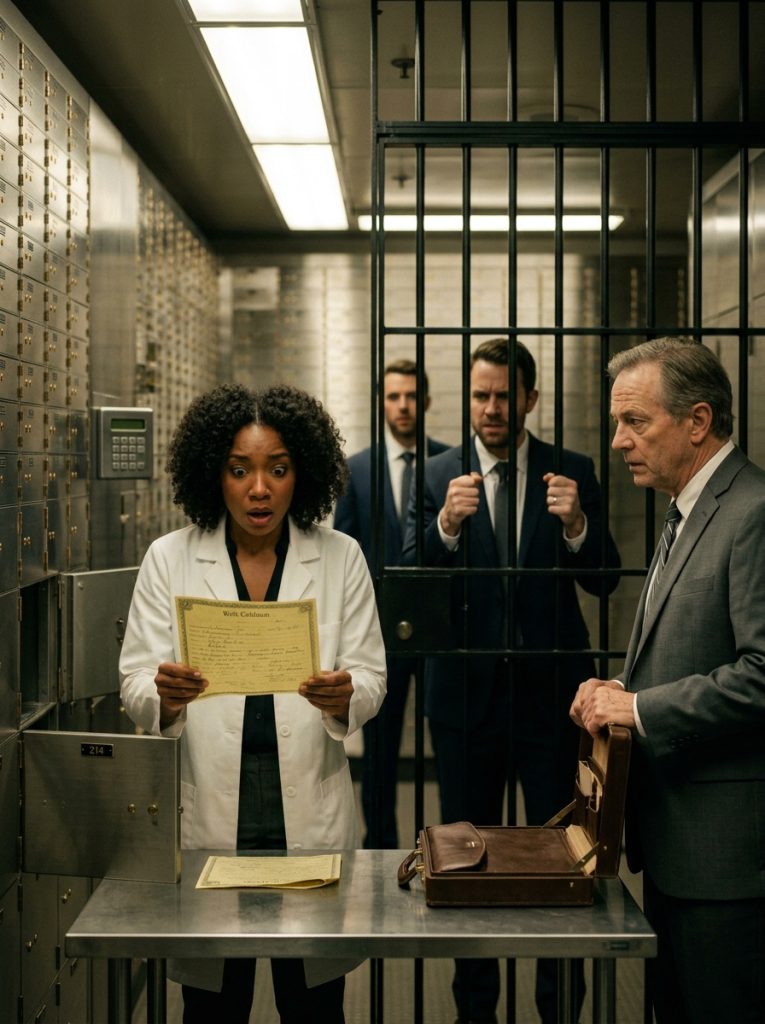
The lawyer’s name was Marcus Callahan, and he’d been managing the DeMarco safety-deposit box for twenty-two years.
“Your grandmother contacted me three months before she passed,” he explained, his voice low and careful. “She wanted you to know the truth before it was too late. She made me promise.”
“She knew?” I asked.
“Since the day you were born. Your mother told her everything. The payments, the arrangement, the danger. She agreed it was safer if you never knew.”
Safer.
The word hung in the vault’s stale air.
For twenty-nine years, my entire family had been lying to protect me from the truth about who my father was — and from the family that came with him.
The vault door’s bars rattled.
Both half-brothers had arrived.
The angry one — Vincent, I’d later learn — gripped the steel bars with white knuckles. He was mid-thirties, sharp black suit, dark hair slicked back, the kind of handsome that had been weaponized. His brother, Michael, stood behind him — softer features, more cautious, the one who held back.
“Who the hell is she?” Vincent demanded.
Marcus straightened. “Vincent, Michael — this is Nia Brooks. Your sister.”
The word landed like a grenade.
Vincent’s face cycled through confusion, fury, and something that looked a lot like terror. “That’s not possible. My father —”
“Your father had a relationship before he married your mother,” Marcus said calmly. “Nia is the result of that relationship. Her birth certificate names Dominic DeMarco as her biological father. The DNA confirmation is in the box. You’re welcome to verify it.”
Michael stepped forward. He didn’t look angry — he looked exhausted. Like he’d been bracing for a secret his whole life and it had finally arrived.
“Does Dad know?” he asked quietly.
“He’s known for twenty-nine years,” Marcus said. “He’s the one who set up the box. He’s the one who’s been ensuring Nia’s grandmother received monthly support since the day Nia was born. He never abandoned her. He just… couldn’t be there.”
Vincent slammed his palm against the bars.
“He has a week left to live — maybe less — and you’re telling me he’s been hiding a daughter this whole time?”
“I’m telling you what’s true,” Marcus said.
I hadn’t spoken yet. I was still holding the birth certificate, still trying to process the fact that my father — my real father — was dying in a hospital room across the city and I’d never met him.
“Can I see him?” I asked.
The room went quiet.
Vincent looked at Michael. Michael looked at Vincent. Some silent communication passed between them — years of brotherhood, shared pain, shared fear.
“He’s at Overlake,” Michael finally said. “Private wing. He’s barely conscious. But if you’re really his daughter…” He swallowed. “He’d want to see you.”
I went that night.
Dominic DeMarco was eighty-one years old, ravaged by cancer, tubes running from his arms into machines that beeped quietly in the dim hospital room. His eyes were closed when I walked in. One hand lay on the blanket — thin, spotted with age, a gold ring loose on his finger.
I sat beside him.
“My name is Nia,” I whispered. “I think… I think you’re my father.”
His eyes opened.
And in that moment, I saw my own eyes looking back at me — same shape, same color, same depth. The recognition was instant and absolute.
“I know who you are,” he whispered. His voice was barely a rasp. “I’ve known since the day you were born. I’ve kept every school photo. Every report card. Every letter your grandmother sent.”
I couldn’t speak.
“I’m sorry,” he said. “I couldn’t be there. My world… it would have put you in danger. But I never stopped watching.”
He squeezed my hand — barely, just enough to feel.
Three days later, Dominic DeMarco died.
The will was read in a conference room at Callahan & Rowe. Vincent, Michael, and me — the three children nobody had ever expected to share a room.
Marcus opened the document.
The estate was worth approximately four hundred million dollars. Dominic’s instructions were clear: the assets would be divided equally among his three children.
But there was one more provision.
“Furthermore,” Marcus read, “I name my daughter, Nia Brooks, as sole executor of this estate. She alone will oversee the division of assets. She alone will determine any disputes. This is my final wish, and I trust her judgment above all others.”
Vincent’s face went white.
Michael laughed — actually laughed — the first real sound of relief I’d heard since the vault.
“He knew,” Michael said. “He knew Vincent would fight. So he put the one person who had nothing to gain in charge.”
I divided the estate evenly. Every dollar. Every property. Every share.
Vincent didn’t thank me. He probably never will.
But Michael did.
“You didn’t have to do that,” he said, a month later, when the paperwork was signed. “You could have kept it all. You were the executor.”
“I didn’t want his money,” I said. “I just wanted to know who he was.”
Michael was quiet for a moment. Then he said, “He was a complicated man. He did terrible things. But he loved you. Even if he couldn’t show it.”
That was enough.