The Rusty Porch Swing Sale FULL STORY
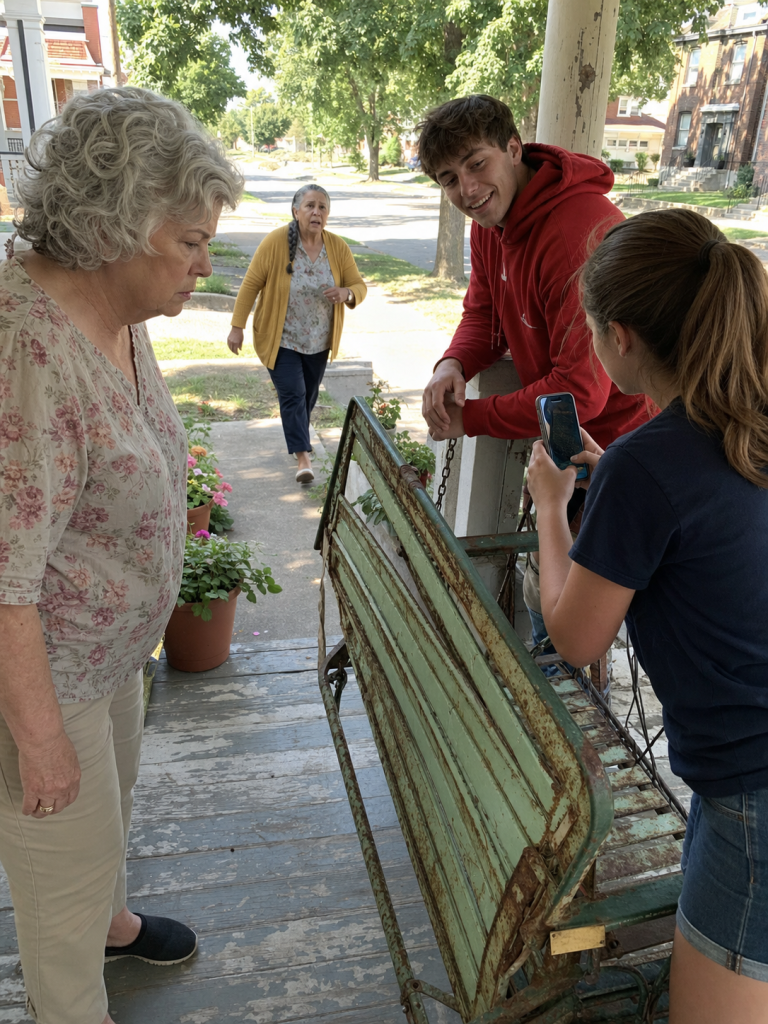
Tyler laughed once because he thought Mrs. Alvarez was exaggerating.
Then he saw my face.
I never told them. Not Tyler, not Brooke, not even my daughter in the full way. Some stories become furniture in your life. You walk past them every day and forget others cannot see what they hold.
Mrs. Alvarez climbed the porch steps, clutching the photo with both hands.
“May I?” she asked.
I nodded because I could not speak.
She turned the photo toward the children. It showed three young women on a porch in 1969. One of them was me, so slim and serious that Brooke whispered, “Wait, that’s Grandma?” The swing behind us looked new then, dark green and glossy. A little boy sat curled on it with a blanket around his shoulders, his eyes big and dark.
“That boy was my brother,” Mrs. Alvarez said, her finger hovering over him. “And that house was not just a house. Not that night.”
Tyler stopped leaning on the swing and stood up.
The young couple who had come to buy it lingered near the steps, unsure whether to leave. Something in Mrs. Alvarez’s voice held them there too.
She told my grandchildren what St. Louis had felt like when we were young, when certain neighborhoods could turn cruel fast if the wrong family tried to rent the wrong house. She told them how my mother had quietly opened our porch to women who needed a place to wait, children who needed a hot meal, and men who needed someone with a telephone before trouble found them.
“Eleanor was eighteen,” she said. “Just eighteen. Her parents were gone overnight, helping a cousin. My mother came here with four children and nowhere safe to stay until morning. We had been turned away three times already that night.”
I remembered the knock. I remembered the rain coming down in sheets. I remembered being more scared than brave, my hands shaking as I opened the door to strangers.
“There was a car parked across the street,” Mrs. Alvarez said. “Men in it. Watching the house. My mother saw it and started to cry, because she thought she had led her children into worse trouble. And do you know what Eleanor did?”
Brooke shook her head slowly. She had lowered her phone without noticing.
“She put my little brother on that swing,” Mrs. Alvarez said. “Wrapped him in a quilt off her own bed. And she sat down beside him and rocked, calm as Sunday, like this was the most ordinary evening in the world. Every time that car slowed down, Eleanor waved at them. Smiled. Like a girl waving at neighbors. She did that for hours, until the sky got light and the car finally drove off.”
I remembered my arm aching from waving. I remembered singing under my breath so the boy would not hear my voice shake.
“By morning we were safe,” Mrs. Alvarez said. “My brother grew up, had children, had grandchildren. There are eleven of us now who would not exist if a scared girl had not sat on that swing and pretended to be brave.”
Mrs. Alvarez reached down and touched the brass plate under the armrest. “Her father bolted this on later. It has the date. A reminder of the night this porch decided what kind of house it was going to be.”
Tyler crouched and squinted at the plate, but the letters had worn too soft to read.
“Why didn’t you ever tell us?” he asked me, his voice stripped of all its swagger.
I looked at the swing for a long moment. “Because when I did tell pieces of it, people made it sound like I was trying to make myself important. Like I was bragging. So I stopped telling it. I just kept the swing.”
“You were important,” Mrs. Alvarez said sharply. “You still are. Don’t you let anybody tell you different, and don’t you tell yourself different.”
That made me laugh and cry at the same time, standing there on my own porch.
The young woman who had come to buy the swing stepped forward. “Ma’am, we don’t want to buy it. Not now. We couldn’t.” She glanced at her partner. “But my dad restores old metalwork for a living. If you want, I could ask him about those chains. He could bring it back.”
Tyler’s face had gone red all the way to his ears. Brooke slipped her phone into her back pocket like she wanted to hide it.
“Grandma,” she said, “I’m so sorry. I didn’t know.”
Tyler stood there longer, working up to it. Pride is hardest at nineteen, when you are old enough to be cruel and young enough not to know how to repair it. Finally he reached over, untied the cardboard sale tag from the armrest, and crumpled it in his fist.
“I’ll fix it,” he said. “The swing. I’ll fix it myself.”
I almost said he did not have to. But then I looked at Mrs. Alvarez’s photo, at the boy on the swing wrapped in my mother’s quilt, at my grandchildren finally seeing me as more than an old woman clinging to a rusty thing.
“You can start with sanding,” I said.
So he did. Not perfectly. He scratched the porch rail and got green dust all over his good hoodie. Brooke helped Mrs. Alvarez scan the old photo so it would never be lost. The young couple returned that afternoon with the woman’s father, a quiet man who checked the chains and said the frame was stronger than it looked. Made to last, he said. They knew how to build things back then.
For three Saturdays, my grandchildren came over. Tyler sanded and primed and painted, arguing with me about the color until he agreed the original green was right. Brooke found a small replacement plate and asked me what should go on it. I told her the old date was enough, that we would keep the worn one and mount the new one beside it. On the back, where only our family would ever see, she added one line in her careful handwriting: “Ask before you throw away history.”
The first evening the swing hung rehung on its fresh chains, Mrs. Alvarez brought over a pitcher of lemonade. Tyler sat on one side of me. Brooke sat on the other. We rocked slow while the ice melted in our glasses and the streetlights came on one by one down the block.
The chain still squeaked. Tyler offered to oil it. I told him to leave it.
Some things should not sound brand new.