The Red Dress My Son Wore to Graduation Was a Promise I Never Expected
PART 3 (FULL STORY)
The handwriting on the back was unmistakable.
I knew that handwriting.
I had spent years trying not to remember it, and yet there it was in blue ink beneath the photograph.
Mara Bennett.
My daughter’s name.
Underneath it was an address in a town forty-three miles from ours.
For a few seconds, I could only stare.
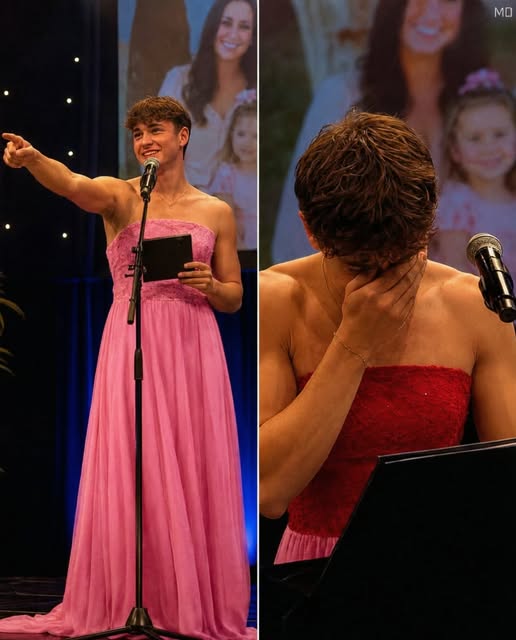
Aaron was still standing beside me in that ridiculous, beautiful red dress while the auditorium watched us.
The teacher had come closer.
“Aaron,” she said again, this time more sharply. “You need to come with me.”
He looked at her.
“She hasn’t finished reading it.”
The teacher glanced at me, then at the photograph in my hands.
I could see the uncertainty in her face.
She had expected a disruptive stunt.
She hadn’t expected this.
I folded the photograph against my palm.
“Aaron,” I whispered, “where did you get this?”
He didn’t answer immediately.
Instead, he reached into the other pocket of the dress and pulled out a second folded piece of paper.
My stomach tightened.
“Mom,” he said, “I need you to hear me before you get angry.”
“I already am.”
“I know.”
The teacher took another step toward us.
“Both of you need to come to the office.”
Aaron shook his head.
“No.”
A few people laughed again.
Someone muttered that he was making a scene.
Aaron turned toward the audience.
For the first time since he had stepped onto that stage, his face changed.
He looked tired.
Not embarrassed.
Tired.
“My mom spent eighteen years believing she had lost someone,” he said.
The auditorium began to quiet.
“My dad told her there was nothing she could do about it.”
My head snapped toward him.
“Aaron.”
He looked at me.
“I’m sorry.”
Then he faced the crowd again.
“She deserves to know the truth.”
That was when I stood.
I took his arm.
“Not here.”
He nodded.
We followed the teacher out through the side door.
The hallway was almost empty.
The sounds from the auditorium became muffled behind us.
The teacher led us into a small conference room and closed the door.
She folded her arms.
“Whatever this is, Aaron, you cannot use graduation to turn the ceremony into a personal confrontation.”
“I wasn’t trying to.”
“Then what were you trying to do?”
He looked at me.
“Give my mom something she should have had eighteen years ago.”
The teacher looked at me.
I couldn’t speak.
Aaron slid the second piece of paper across the table.
It was a letter.
The envelope was old and yellowed at the edges.
My name was written across the front.
Not Mom.
Not Mrs. Bennett.
Just my first name.
Claire.
I knew the handwriting before I opened it.
My hands started shaking.
“Where did you find this?”
“In Dad’s garage.”
I looked up.
Aaron swallowed.
“He didn’t know I had it.”
I opened the envelope.
The letter was dated three days before Mara disappeared.
My eyes moved across the first line.
Claire,
If you’re reading this, then I didn’t get the chance to tell you what happened.
I stopped.
The room seemed to tilt.
Mara had been four years old when she disappeared.
At the time, I had been told she wandered away from a crowded county fair.
That was the story I had repeated for eighteen years.
My husband had told the police he was watching her.
He had told me he had only looked away for a minute.
I had blamed myself anyway.
For eighteen years, I had carried the same question.
What kind of mother loses her child?
I had never forgiven myself for asking it.
Now I read the next line.
Your husband knows where she is.
I dropped the letter.
The teacher stared at me.
Aaron closed his eyes.
I couldn’t breathe.
“No,” I whispered.
“Mom.”
“No.”
I pushed the letter away.
“Your father said she was taken.”
Aaron didn’t correct me.
That was worse.
I picked up the letter again.
The handwriting continued.
He told me he was going to take Mara away because he believed you would leave him once you knew the truth about his debts.
I stared at the page.
Debts.
That word had never appeared in the police report.
Neither had the next sentence.
He said he would make it look like she wandered off.
I stopped reading.
I couldn’t.
Aaron reached across the table.
“Keep going.”
I looked at him.
“How did you find this?”
“I found a box behind the old furnace.”
My husband had kept that house for seventeen years.
He had never let me clean the garage.
He always said there were things in there that belonged to his father.
I had believed him.
I looked down at the letter again.
The final paragraph was shorter.
If something happens to me, look for Mara at the address I wrote below.
I had never seen the address.
Because the letter had never been delivered.
It had been hidden in my husband’s garage.
I looked at Aaron.
“Why the dress?”
He looked down at the red fabric.
“Because you bought this color for her.”
I felt something break inside me.
I remembered.
Mara had been four.
She had seen a red dress in a shop window and begged me to buy it.
I had told her she was too little.
She had cried all the way home.
Three days later, she disappeared.
I had not remembered the dress until Aaron mentioned it.
He had.
He had been looking through old photographs for months.
“She wore red all the time,” he said.
“She loved it.”
I covered my mouth.
Aaron leaned closer.
“I thought if I walked across that stage wearing it, you’d remember her.”
“I remembered.”
“I know.”
The teacher sat down.
She had stopped looking like an administrator.
Now she looked like a person who had accidentally walked into a family’s worst memory.
“Claire,” she said softly, “you need to call the police.”
“I will.”
My phone was already in my hand.
Before I could dial, it rang.
The screen showed my husband’s name.
I stared at it.
Aaron looked at me.
“Answer.”
I pressed the button.
“Hello?”
For several seconds, there was only breathing.
Then my husband’s voice came through.
“Where is Aaron?”
I said nothing.
“Claire, where is my son?”
“Why?”
His breathing changed.
“What did he tell you?”
I looked at Aaron.
He was watching me carefully.
I asked the question I had spent eighteen years believing I would never get to ask.
“Where is Mara?”
Silence.
Not confusion.
Not disbelief.
Silence.
Then he said, “You don’t understand.”
My knees weakened.
“Where is she?”
“Claire, listen to me.”
“No.”
I could barely hear my own voice.
“Where is my daughter?”
He hung up.
The teacher immediately reached for her phone.
Aaron didn’t move.
Then his phone buzzed.
He looked at the screen.
His face went white.
“What?”
I stood.
“What is it?”
He handed me the phone.
There was one text message.
Unknown number.
Stop looking for her.
Underneath it was a photograph.
A woman standing outside a small blue house.
She was maybe twenty-two.
She had dark hair.
She was wearing a red sweater.
I stared at the photograph.
There was something about her face.
Something I knew without understanding how.
Then I noticed the little silver bracelet around her wrist.
I had bought that bracelet for Mara when she turned four.
I had tied it around her wrist myself.
The photograph slipped from my fingers.
“She’s alive.”
Aaron nodded.
“That’s why I did it.”
I looked at him.
“Why didn’t you tell me?”
“Because I didn’t know if it was really her.”
He reached into his pocket.
“I’ve been trying to find her for eight months.”
Eight months.
While I had been going through ordinary mornings and ordinary evenings, my son had been searching for his missing sister.
“How?”
“Old records. School directories. Public databases. People who knew Dad.”
I sat down.
“What did you find?”
“Her name isn’t Mara anymore.”
He showed me another photograph.
A driver’s license.
Different last name.
Same face.
Same eyes.
My eyes.
And beneath the photograph was a name I had never heard before.
Mara Collins.
The teacher was crying quietly now.
I didn’t even notice until she handed me a tissue.
I looked at Aaron.
“Does she know?”
“She knows she was adopted.”
My throat tightened.
“Does she know who she is?”
“Not yet.”
I stared at him.
“Then why did you bring me here?”
He took a slow breath.
“Because I couldn’t tell you until I knew.”
The door opened.
A police officer stood there with another officer behind him.
Someone must have called them.
The teacher stepped aside.
I expected questions.
Instead, the older officer looked at the photograph.
His expression changed.
“I know this case.”
My stomach dropped.
He picked up the old letter.
“Where did you find this?”
“My son’s father’s garage.”
The officer read it carefully.
“Your husband is still alive?”
“Yes.”
“Where is he?”
“I don’t know.”
The officer exchanged a glance with his partner.
Then he said something that made the room colder.
“We need to talk to him before he knows we’ve found this.”
I thought of the phone call.
The text.
The photograph.
He already knew.
He knew Aaron had found something.
He knew I was asking questions.
I suddenly understood why he had hung up.
He wasn’t afraid of what I knew.
He was afraid of what Aaron knew.
The police took the letter and photographs.
Then they asked me to come with them.
Aaron stood.
“I’m coming.”
The officer looked at him.
“Not yet.”
Aaron looked at me.
I walked over and hugged him.
The red dress pressed between us.
For eighteen years, I had thought I was the one who had failed him.
Now I understood something else.
He had been carrying part of my grief because he loved me enough to go looking for the person I had lost.
“I was afraid they’d laugh at you,” I whispered.
He smiled against my shoulder.
“They did.”
“I’m sorry.”
“I know.”
We left the school through the side entrance.
The auditorium was still full.
I could hear the graduation ceremony continuing without us.
Outside, the afternoon sun was bright.
Too bright for the day we were having.
The police drove me home first.
My husband’s car was gone.
The garage door was open.
Inside, the old furnace was covered in dust.
Aaron had already found the box.
But beneath the box was something else.
A second envelope.
This one had no name on it.
The officer opened it carefully.
Inside was a motel receipt.
The date was from eighteen years ago.
The location was forty-three miles from our town.
The same town as the address on Mara’s photograph.
I stared at it.
My husband hadn’t taken Mara somewhere random.
He had taken her somewhere specific.
And someone had helped him.
The investigation moved quickly after that.
Records from the county fair were reopened.
Old phone records were subpoenaed.
The police found a witness who remembered seeing my husband leave the fairgrounds with Mara that afternoon.
She had never come forward because she thought the police already knew.
They didn’t.
Then they found the woman who had rented the motel room.
She was dead.
But her daughter was alive.
And she remembered Mara.
She remembered a little girl in a red dress crying beside a man who told her she was going on a trip.
The woman had thought the child was his daughter.
She never knew otherwise.
Until the police showed her the photograph.
Then she gave them an address.
The blue house.
The woman in the red sweater.
Mara.
My daughter.
The police arranged the first meeting carefully.
They warned me that Mara might not want to see me.
I said I understood.
I didn’t.
But I said it anyway.
I sat in the car outside the blue house with my hands folded in my lap.
Aaron sat beside me.
For once, he wasn’t wearing the red dress.
He had changed into his graduation clothes.
The diploma was still in the back seat.
I looked at it.
“Are you sorry?”
He shook his head.
“No.”
“Even after everyone laughed?”
“No.”
He looked at me.
“You were the only person I cared about.”
I smiled through my tears.
“I begged you not to.”
“I know.”
Then the front door opened.
A young woman stepped onto the porch.
Dark hair.
Red sweater.
Silver bracelet.
She looked at the police officer first.
Then at Aaron.
Then at me.
She didn’t move.
Neither did I.
There were eighteen years between us.
Eighteen years of birthdays.
Christmas mornings.
School photographs.
Illnesses.
First days of school.
Every ordinary thing I had missed.
I stepped out of the car.
My legs felt weak.
I stopped several feet from her.
“I don’t know what to call you,” I said.
She looked at me.
“My name is Mara.”
The sound of it nearly brought me to my knees.
I nodded.
“Mara.”
She touched the bracelet around her wrist.
“I was told my mother couldn’t keep me.”
I swallowed.
“I looked for you.”
She looked away.
“I didn’t know.”
“I know.”
There was no dramatic embrace.
No perfect apology.
No instant repair for eighteen years.
There couldn’t be.
Instead, she asked me a simple question.
“Did you really remember the red dress?”
I looked back at Aaron.
He was standing beside the car.
“Yes.”
Mara smiled faintly.
“I don’t remember it.”
“I do.”
She stepped closer.
Then she reached for my hand.
Her fingers were warm.
That was all.
For the first time in eighteen years, I wasn’t holding a photograph.
I was holding my daughter’s hand.
Months later, Aaron’s graduation photograph arrived in the mail.
Someone had taken it just before he walked down the stage.
He was standing in that bright red dress, diploma tucked under one arm, looking directly at the camera.
Behind him, the auditorium was blurred.
Six hundred faces.
Six hundred people who had laughed.
But Aaron wasn’t looking at them.
He was looking toward me.
I framed the photograph and placed it beside an older picture of Mara as a little girl.
The red dress in the graduation photograph matched the faded red ribbon in the old one.
I used to think the color belonged to the worst day of my life.
I don’t anymore.
Now, whenever I see it, I remember the moment my son walked toward me carrying eighteen years of grief in his pocket.
And I remember what he said.
“This is for you.”
Both of them.
Then I look at the two photographs sitting side by side on my shelf, and for the first time, neither one feels like a goodbye.