The Recipe Card Refusal FULL STORY
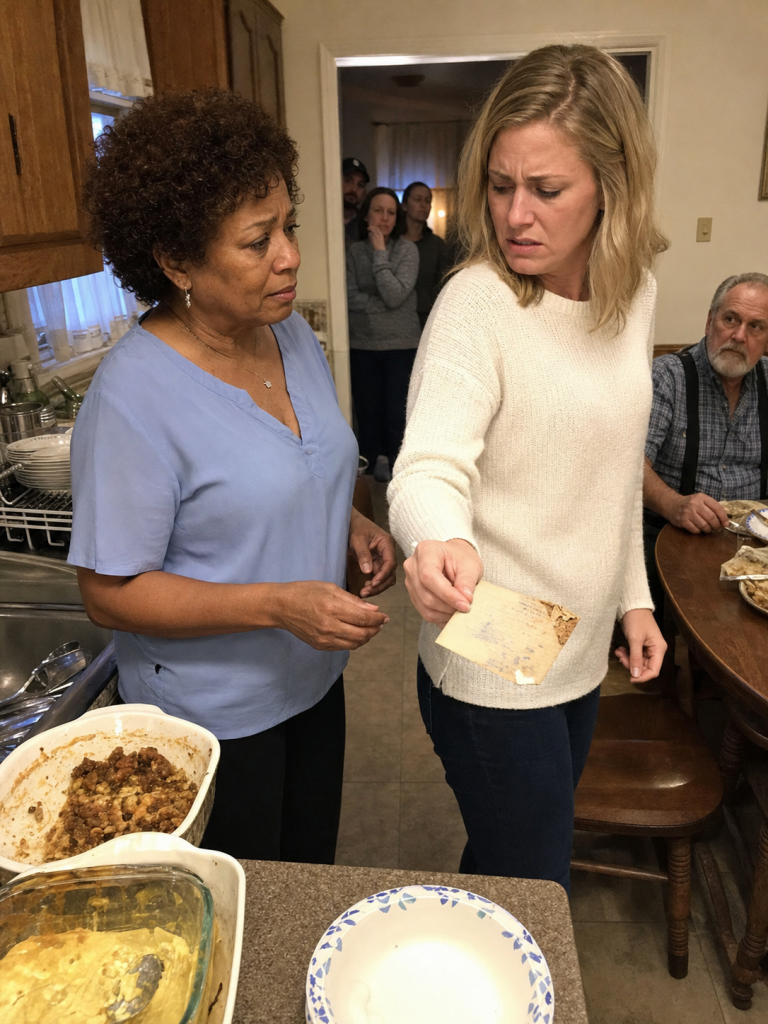
Megan stared at Uncle Ron as if he had said something disrespectful in church.
“Of course Mom wrote it,” she said. “It was her recipe. It was always her recipe.”
I wanted to disappear into the pantry. I wanted to let them argue without me, to slip out the back door and drive home in the dark. But the card was lying between us now, and Uncle Ron was looking at me with a sadness I had not expected.
“Carol,” he said gently, “you never told them?”
Megan turned to me. Her cheeks were blotchy from crying and anger. “Told us what?”
I dried my hands on the dish towel because I needed something to do with them. The towel had little yellow flowers on it. I remember that because grief makes small things very sharp, sharper than they have any right to be.
“Your mother had the recipe in her head,” I said. “She did not need a card. She could have made it in her sleep.”
Megan gave a bitter laugh. “Then why is it in her box?”
I looked at the old wooden recipe box. It had been Linda’s before it was mine, though I never said that out loud in this house. Linda was my husband’s first wife, Megan’s mother, and the woman whose photograph still sat on the mantel beside mine. That never bothered me. Love does not have to erase what came before it. A house can hold more than one kind of memory.
“Because she asked me to write it down,” I said.
Megan’s expression faltered.
Uncle Ron pushed himself up from the chair and came closer. “Your mom got sick fast,” he said. “Faster than any of us admitted out loud. She was worried about little things at the end. Socks. School forms. Birthdays. That chicken dish you and Mark loved so much.”
Megan’s knuckles tightened around the card.
I remembered the day too clearly. Linda sat in the recliner by the kitchen window, thin wrists under a blue blanket, telling me how much paprika, how much broth, how long to cook it so the rice did not go mushy. I was not married to Paul then. I was just the neighbor from across the street who came over after work because Linda needed help and Paul was drowning and somebody had to keep that house running.
Linda had looked at me that afternoon and said, “If I say it to Paul, he will cry and forget half of it. If I say it to my mother, she will make it about God. You write it. You’ll get it right.”
So I wrote it. My handwriting. Her voice. Every word hers.
I told Megan that part. Not all of it, but enough.
She flipped the card over slowly. On the back was a small note in faded blue ink, in different handwriting than the recipe. It was not readable from where the others stood, but Megan could see it. Her face changed as she mouthed the words to herself.
Linda had written one line herself at the bottom, on a day when her hand was steady enough to hold a pen.
Megan read it aloud in a whisper: “Carol knows how to make it right.”
No one moved.
I had forgotten that line was there. Or maybe I had made myself forget, because remembering it hurt too much to carry around every day.
Megan sank into the chair. The card trembled in her hand. “Why didn’t Dad tell us?”
“Your father tried,” Uncle Ron said. “You were ten. Mark was seven. Every time Carol cooked it, you both ate two plates and cried afterward without knowing why. Paul decided the food mattered more than the explanation. He thought the truth could wait until you were older. Then the years just went by.”
That was true. For years, I cooked Linda’s chicken on birthdays, snow days, graduations, and the night Megan got her first heartbreak at sixteen and could not stop shaking. The children called it Mom’s chicken, and I never corrected them, not once. It was their mother’s. I was only the hands that kept it on the table.
Megan looked at me with tears gathering again, but this time they were different. Softer. Confused in a new direction.
“I thought you were trying to replace her,” she said. “All these years. Every time you cooked it, I thought you were pretending to be her.”
I sat down across from her. “I know. I could feel it. I just never knew how to fix it.”
“Were you? Trying to replace her?”
The question was not cruel. It was a child’s question that had waited twenty-one years to be asked.
“No,” I said. “I was trying to help you remember her without starving on the days remembering hurt the most.”
Megan pressed the card to her chest.
I expected an apology right then, but grief moves slowly and does not take orders. She cried first. Uncle Ron put a hand on her shoulder. Her brother Mark, who had been silent in the doorway the whole time, wiped his face with his sleeve like a boy again.
Then Megan stood and held out the card to me.
“Can you show me?” she asked.
“Show you what?”
“How to make it right.”
So we did. Not that night, because we were too tired and the house still smelled like funeral flowers and casserole. But the next Sunday, Megan came to my kitchen with the wooden recipe box held in both hands like something breakable.
She did not call me Mom. I did not need her to.
We chopped onions until we both had an excuse for our eyes. We browned the chicken. We argued gently about salt, the way Linda and her own mother probably once had. When the dish finally came out of the oven and Megan took her first bite, she started crying again.
“That’s it,” she said. “That’s exactly it.”
I looked at the stained card propped against the sugar jar. Linda’s note faced us both, blue ink catching the afternoon light.
For the first time in twenty-one years, the recipe did not feel like a line between us. It felt like a bridge someone had built before she left, and left the plans behind so we could finish crossing it.