The Quiet Handyman Saluted by Senators FULL STORY
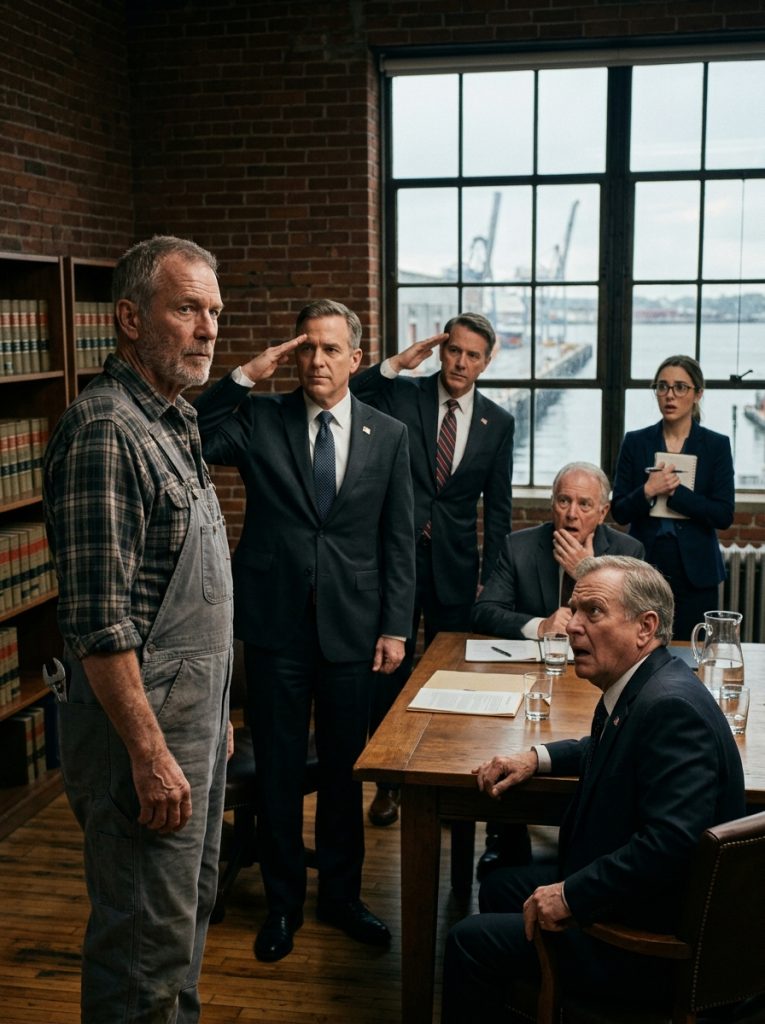
The senior partners didn’t just look like they’d swallowed cement.
They looked like the cement had swallowed them.
Arthur Hamilton, the firm’s founding partner — sixty-seven years old, three hundred dollar haircut, the kind of man who’d never been told “no” in his life — was the first to find his voice.
“Commander Voss,” he said, and the word “Commander” clearly burned his throat. “We had no idea.”
“I know,” Peter said quietly. “That was the point.”
He unfolded the deed. It was yellowed at the edges, typewritten, with the original seal of the City of Boston in the corner. The date read November 14, 1994.
“I bought this block when the docks were dying,” Peter said. “When everyone else was selling, I bought. Piece by piece. Warehouse by warehouse. I wanted to preserve something — the history, the working waterfront, the people who’d spent their lives here.”
He looked at Arthur Hamilton.
“Your firm leased this building from a shell company I controlled. You’ve been paying rent to me for twenty-three years.”
Arthur’s face cycled through incredulity, then anger, then something closer to fear.
“What do you want?”
“Fair terms,” Peter said. “The waterfront redevelopment deal you’re pushing with these senators — the one that would displace three hundred dockworker families — is not going forward. Not as written.”
One of the senators — a man named Whitford, tall, silver-haired, deeply uncomfortable — cleared his throat.
“Commander, with respect, the deal has been in the works for eighteen months. The funding is allocated. The contracts are drafted.”
“Then redraft them,” Peter said. “Include affordable housing provisions. Include job guarantees for the current dockworkers. Include community oversight — not corporate oversight.”
“That’s not how these deals work.”
Peter looked at him.
“Senator, I spent thirty-two years in the United States Navy. I served in the Gulf. I commanded a destroyer. I’ve been saluted by better men than you and I’ve never once asked for the gesture. But I am asking now. Not as a commander. As the man who owns the land your deal is built on.”
Senator Whitford looked at his colleague.
His colleague, a younger woman with sharp eyes, nodded.
“We can renegotiate the terms,” she said.
Whitford looked like he’d been handed a lemon. But he nodded too.
Peter folded the deed and tucked it back into his overalls.
Then he did something unexpected.
He turned to me.
“Miss Kowalski.”
I nearly dropped my notebook again.
“Yes?”
“You’ve been watching this room for eighteen months. You’ve seen how these men treat people they consider beneath them. You’ve taken notes on every meeting, every deposition, every injustice.”
I swallowed. He’d noticed.
“I want you to draft the new agreement,” he said.
Arthur Hamilton sputtered. “She’s a paralegal. She doesn’t have the experience—”
“She has more integrity than everyone at this table combined,” Peter cut him off. “She’s the one I trust.”
I looked down at my notebook. The pages were full of observations I’d never shared with anyone — the casual cruelties, the overlooked details, the patterns of power I’d documented in silence.
“I’ll do it,” I said.
Peter nodded once.
Then he picked up his wrench and walked back toward the hissing radiator.
The meeting had ended.
But my career had just begun.
Three months later, the redevelopment deal was signed. Three hundred families kept their homes. The dockworkers kept their jobs. And I was no longer a junior paralegal fetching coffee.
I was the lead negotiator for Voss Waterfront Holdings.
And every morning, when Peter Voss walked through the office in his worn gray overalls, I made sure to say good morning.
Not because he owned the building.
Because he’d earned it.