The Owner Mocked the Dishwasher’s Notebook FULL STORY
“It was you,” she said again. “Wasn’t it.”
I wiped my hands on my apron, because I didn’t know what else to do with them.
“Yes,” I said. “It was me.”
The whole bar had gone quiet. Brett stood there with his mouth half open, still holding the towel he’d been snapping at a busboy.
The woman in the cream blazer set the notebook down gently, like it was made of glass.
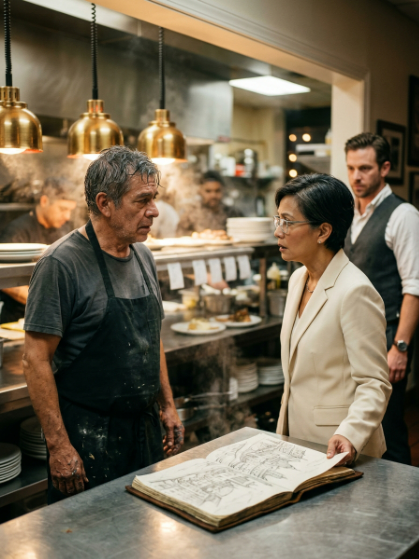
“My name is Eleanor Reyes,” she said. “I direct the city arts council. For two years I have been looking for the person who painted the Drayton Street mural. We had grant money set aside to preserve it. We were too late—a developer painted over it before we could act, and it nearly ended my tenure. Half the council thinks the artist is a ghost.”
She looked at the drawing in my notebook again. The same arches. The same figures leaning into the wind.
“You’re not a ghost. You’re washing dishes forty feet from where it stood.”
I should tell you why I never came forward.
I painted that wall over three nights, with permission from the building’s old owner—a handshake deal, nothing on paper. I didn’t sign it because I didn’t paint it for credit. I painted it because my wife had just passed, and I needed to put what was inside me somewhere, and a blank wall was cheaper than a therapist.
When the city started asking who made it, I was a fifty-five-year-old immigrant with no documents proving anything, working under a boss who already treated me like I was furniture. Coming forward felt like a good way to lose the only steady job I had. So I stayed quiet. I let it be a ghost’s wall.
Then they painted over it, and I figured that was the end of the story.
I was wrong.
Eleanor asked me to come to the council offices the next day. I almost didn’t go. Brett made sure of that—on my way out that night he muttered, “Don’t let it go to your head, Picasso. You’re still on dish duty Monday.”
But I went.
They had photographs of the mural, it turned out. Good ones, taken before it was destroyed. Eleanor laid them on the table beside my notebook, and three council members compared the linework, and there was no argument to be had. The hand that drew the small sketches was the hand that painted the wall.
What happened next still doesn’t feel real when I say it.
The council had been sitting on the preservation grant with nowhere to spend it. So they voted to commission a new mural. A bigger one. On the side of the downtown library, where the whole city would pass it.
By me.
Paid. With my name on a plaque this time, because Eleanor insisted. “No more ghosts,” she said.
I gave Brett my notice the same week. He laughed at first, thinking I was bluffing. Then a reporter called the bistro for a comment about “the dishwasher who turned out to be the city’s lost muralist,” and Brett stopped laughing.
I won’t lie—there was a small, human part of me that enjoyed handing him my apron.
But I didn’t gloat. My wife wouldn’t have liked that. I just thanked the kitchen guys who’d shared their breaks with me, shook a few hands, and walked out into the afternoon a free man with a wall to paint.
I started the library mural in the spring. Kids stop on their way home from school and watch. Some of them ask if they can help mix colors, and I let them, because somebody should know how this is done after I’m gone.
One of those kids was a quiet boy named Marco who came every single day. Never said much. Just watched. After a week I handed him a brush and showed him how to load it without dripping. His mother told me later he’d stopped drawing because a teacher told him art was a waste of time. He hasn’t stopped since.
That’s the part that matters more than the plaque. A wall fades. A kid who keeps drawing doesn’t.
Eleanor comes by most Fridays with two coffees, the way she used to at the bistro, except now we drink them looking up at the scaffolding.
“You know,” she said one evening, “if you’d left that notebook in your pocket one more second, I’d have walked out and never known.”
“I almost did,” I told her.
She shook her head. “Some things want to be seen, Tomás. Even when the person who made them is tired of hiding.”
I think about that on the scaffold sometimes, brush in hand, the city moving below me.
For three years I was invisible on purpose.
Now I’m forty feet up a library wall, in broad daylight, signing my name where everyone can read it.