The Old Man’s Calls About the Seeping Dam Were Ignored FULL STORY
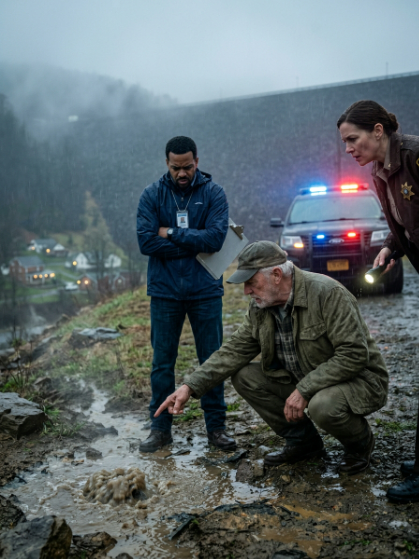
The sound a dam makes when it’s about to fail is not dramatic. People expect thunder. It isn’t thunder.
It’s a low, wet groan, like a big animal rolling over in its sleep. You feel it in your boots before you hear it in your ears.
I felt it in my boots.
Sheriff Dana Olsen heard it on my face. She’d known me her whole life — I coached her softball team back when her braids stuck out under the helmet — and she did not waste time asking a retired man for his credentials.
She got on the radio and called a voluntary evacuation of Cedar Hollow. Then, thirty seconds later, when the boil at the dam’s toe doubled in size while we stood there watching, she upgraded it to mandatory.
Marcus Webb finally came down off the embankment.
“You can’t order an evacuation,” he said. “That’s a county engineering decision. There’s a protocol—”
“Then file a complaint,” Dana said, not even looking at him. “Mrs. Alvarez, get in the truck.”
I’ll give Webb this much: he wasn’t a bad man. He was a young one who’d been taught to trust the binder more than the river. The binder said the dam had passed inspection eighteen months back. The binder said low-risk. The binder did not say what brown water means at five in the morning.
I grabbed his sleeve. “Son,” I said. “I’m not asking you to believe me. I’m asking you to stand right here and watch that water for ten more minutes. If I’m wrong, you’ll have a fine story about the crazy old man. If I’m right, you’ll be glad you already started moving people.”
He stayed.
The next half hour I will remember until the day I die.
We went house to house behind the sheriff’s truck. The Petersons, still in pajamas. The young couple with the twins, carrying a baby in each arm and a diaper bag in their teeth. Old Earl Whitcomb, who refused to leave until I told him his late wife would skin us both if he drowned over a recliner.
Forty-one houses emptied in under thirty minutes. Headlights crawling up the ridge road in a slow line, like a funeral driving the wrong way — away from the grave instead of toward it.
We got the last car up just as the sun cracked the ridge.
And then the Tillman dam let go.
It didn’t explode. The middle of it just sagged, the way a sandcastle sags when the tide reaches it, and then a notch opened at the crest, and the reservoir found that notch, and the notch became a canyon in about four seconds.
A wall of brown water and broken trees and somebody’s shed poured down into Cedar Hollow.
It took the Petersons’ house off its foundation. It folded the young couple’s porch like a cereal box. It pushed six feet of mud through Earl Whitcomb’s living room, recliner and all.
It did not kill a single person.
Because there was not a single person left down there to kill.
I stood on the ridge next to Marcus Webb, both of us soaked to the skin, and I watched a young engineer understand something no binder had ever taught him.
He didn’t say “thank you.” He couldn’t talk yet. He just put his hand on my shoulder and left it there, shaking, while the water did exactly what I’d told him it would do.
Later there were cameras. The county wanted a picture of “the hero,” and they kept trying to put me in the middle of it. I kept stepping out of the frame.
Here’s the truth, and it isn’t modest, it’s just true. I’m not a hero. I’m a man who walked the same dam for thirty-one years until I could read it like my wife’s handwriting. That valley didn’t survive because I’m special. It survived because somebody finally listened to an old man with mud on his boots instead of a clean jacket with a clipboard.
Marcus Webb said so himself. He stood up at the county review and said it into a microphone — that the protocol failed, that the dismissal had been his, and that forty-one households were alive because a retiree they’d put out to pasture kept driving up to check on a dam nobody paid him to love.
They’ve named the new sensor system after me. “The Dabrowski Protocol.” My late wife would have laughed at me trying to say it with a straight face. Every time some young engineer has to spell my Polish last name into a phone, I laugh too.
But you want to know the part I actually keep?
It’s a morning a month later, when that young couple knocked on my door. They handed me one of the twins to hold while they caught their breath on the porch.
“We wanted him to meet you,” the mother said. “We want him to know your name before he can even say it.”
I held that baby in the gray morning light, his fat little hand wrapped around my thick old finger, and I thought about brown water and empty roads and a clipboard that almost won.
Listen to the river. It was talking long before any of us got here.
The least we can do is stop pretending we can’t hear it.