The Note In The Little Girl’s Hand Exposed A Secret Her Teacher Couldn’t Ignore
PART 3 (FULL STORY)
Valerie stared at the folded paper without opening it again.
The counselor, Marissa Hale, gently asked Lila if she wanted her teacher to read it aloud.
Lila shook her head.
“Not out loud.”
Valerie unfolded the paper carefully.
There were only a few words, written in dark blue ink.
DO NOT LET HER TALK TO THE SCHOOL.
Valerie recognized the handwriting.
She had seen it before.
Not often, and never in a context that had seemed important at the time.
Daniel Mercer had written notes on two previous occasions when Lila had been absent. His handwriting was neat, narrow, and slightly slanted to the right.
Valerie remembered one note in particular.
Lila had missed three days the previous spring because of what her father had called a stomach problem.
At the time, Valerie had accepted it.
Now she wished she hadn’t.
Marissa saw Valerie’s expression change.
“What is it?”
Valerie handed her the paper.
Marissa read it once and folded it again.
She didn’t speculate.
She didn’t ask Lila what she thought it meant.
Instead, she told the nurse to stay with the child while she contacted the principal and followed the school’s child-safety procedures.
Valerie remained beside Lila.
The little girl watched every movement in the room.
“Am I going home?” she asked.
Valerie hesitated.
“I don’t know yet.”
“With Dad?”
That question landed harder than anything else.
Valerie looked at Marissa.
The counselor’s expression remained calm.
“We’re going to make sure you’re safe,” she told Lila.
Lila looked down at the blanket.
“Dad will be mad.”
“I know you’re worried about that,” Marissa said. “But none of this is your fault.”
Lila’s fingers tightened around the blanket.
“He said grown-ups would take me away if I told.”
Valerie felt something inside her go still.
There it was.
Not a confession.
Not an explanation.
A child’s fear of what would happen if she told the truth.
The school followed its required reporting procedures, and within the hour, the appropriate child-protection authorities had been contacted.
No one tried to investigate the matter themselves.
No one demanded that Lila repeat what she had said.
They understood that the job of the adults in that room was not to solve the case.
It was to protect the child and preserve what she had already trusted them enough to reveal.
At 10:11, the principal closed the office door behind her.
“Her father is asking to pick her up.”
Valerie’s stomach dropped.
Marissa nodded.
“Tell him she is receiving medical attention and that the school is following its safety procedures.”
The principal left.
Lila heard the words through the door.
She immediately began crying.
“He knows.”
Valerie crouched beside her.
“Who knows?”
“Dad.”
“What makes you think that?”
“He always knows.”
That answer frightened Valerie more than a detailed accusation could have.
Lila wasn’t talking like a child imagining consequences.
She was talking like a child who had learned them.
A little after eleven, an investigator arrived at the school.
She introduced herself simply and spoke to Lila privately with Marissa present.
Valerie stepped outside.
For the first time all morning, she was alone.
She walked back into Room 204.
The math worksheets were still scattered near the desk where Lila had collapsed.
The classroom had returned to normal.
Children were reading quietly.
Someone had erased the board.
A paper snowflake hung crookedly near the window.
Everything looked ordinary.
Valerie picked up the last worksheet from the floor.
Lila’s name was written at the top.
Underneath it, she had answered every math problem correctly.
Valerie sat at her desk for a moment.
She thought about how easily adults praised children for being quiet.
How often “well-behaved” meant a child had learned not to ask for help.
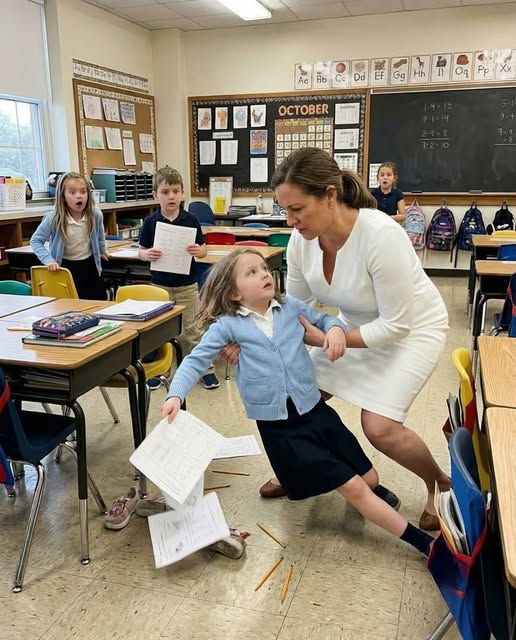
She thought about Lila’s careful movements.
The skipped button.
The practiced smile.
The sentence she had repeated because someone had apparently taught her exactly what to say.
At 12:36, Marissa returned.
Her face told Valerie that the situation was serious, but she did not share details she wasn’t permitted to share.
“Lila is staying with us for now,” she said.
Valerie nodded.
“Is she safe?”
“She is with people whose job is to keep her safe.”
That was enough.
Near the end of the school day, Valerie returned to the nurse’s office.
Lila was sitting up now.
She had a small cup of water in her hands.
“Ms. Kincaid?”
“Yes?”
“Am I bad?”
Valerie sat beside her.
“No.”
“But Dad said I was.”
“Adults can say things that aren’t true.”
Lila looked at the floor.
“Then why did he do it?”
Valerie did not pretend to have an answer.
“I don’t know.”
Lila seemed surprised by that.
“You don’t know?”
“No.”
Valerie paused.
“But I know something else.”
Lila looked up.
“You did the right thing by telling someone.”
The little girl studied her face.
Then she nodded once.
It was small.
Almost invisible.
But it was the first movement Valerie had seen from her all day that did not look frightened.
The following days were difficult.
There were interviews, paperwork, medical evaluations, and meetings.
There were adults making decisions Lila was too young to understand.
There were questions Valerie couldn’t answer.
And there were moments when Lila became quiet again.
But she kept coming back to school.
For several weeks, she avoided sitting in the third row by the windows.
Valerie never forced her.
One morning, Lila chose that seat herself.
She placed her backpack beneath the desk.
Then she looked at Valerie.
“Is this okay?”
“Yes.”
Lila sat down.
She shifted once.
Then again.
Valerie watched.
This time, Lila wasn’t bracing herself against pain.
She was simply getting comfortable.
Valerie turned toward the board and began the morning lesson.
Months later, the case was still being handled outside the school.
There were consequences for the adults involved, but Valerie understood that justice was not a single dramatic moment.
For Lila, healing happened in smaller ways.
She began raising her hand.
She started asking for help when she didn’t understand something.
She laughed more often.
She stopped apologizing every time she needed something.
One rainy afternoon in March, Valerie found a folded piece of paper on her desk.
At first, she thought it was another worksheet.
Then she saw Lila’s handwriting.
There were four words.
THANK YOU FOR LISTENING.
Valerie sat quietly for a moment.
She folded the paper and placed it inside the top drawer of her desk.
She still had the attendance sheet from that October morning.
She still remembered the time written beside Lila’s name.
8:17 a.m.
A perfectly ordinary school day.
Except it hadn’t been ordinary at all.
Sometimes, Valerie thought, children don’t need an adult to solve everything in the first conversation.
Sometimes they need one adult to notice that something is wrong, stay calm enough not to frighten them, and take their words seriously.
Years later, Valerie would still remember the pale blue cardigan.
She would remember the skipped button.
She would remember the little folded note.
But most of all, she would remember the moment Lila finally stopped looking at the door as if she expected someone to come through it.
On the last Friday before summer break, Lila walked past Valerie’s desk carrying a stack of drawings.
She stopped.
“I made you one.”
Valerie took the paper.
It showed a classroom with twenty desks, a large window, and a bright yellow sun outside.
In the corner, Lila had drawn herself sitting at a desk.
Beside her stood a teacher.
Their hands weren’t touching.
They didn’t need to be.
Above them, Lila had written two words in careful block letters.
I’M SAFE.
Valerie smiled.
“It’s beautiful.”
Lila smiled back.
Then she ran toward her classmates, leaving the drawing in Valerie’s hands.
Outside the window, rain tapped softly against the glass.
Valerie placed the picture beside the old folded note in her desk.
The two pieces of paper rested together.
One had once told a frightened child to stay silent.
The other told Valerie that, for one little girl, the silence had finally been broken.