The Name Hidden Beneath the Little Girl’s Bed
PART 3 (FULL STORY)
Diane stepped back into the room and found Mia watching the doorway.
Her mother was still there, standing beside the police officer with her arms folded tightly across her chest.
The officer, Daniel Reeves, held a small evidence bag in one hand.
Inside it was a child-sized plastic case.
It looked ordinary enough, except for the strip of paper taped across the lid.
There was a name written on it in faded black ink.
“Evelyn Foster.”
Diane felt the air leave her lungs for a second.
It was her own name.
Mia’s mother noticed the name too.
Her face went rigid.
“No,” she said.
Officer Reeves looked at her.
“You know this name?”
The woman shook her head too quickly.
“No.”
Diane stared at the case.
She had never seen it before.
But something about the name bothered her immediately.
Evelyn Foster had been her older sister.
She had died eleven years earlier.
Diane had not used that name professionally in years, and almost nobody in Silverwood knew the connection.
She turned slowly toward Mia.
“Sweetheart, did you put this under your bed?”
Mia shook her head.
“No.”
“Do you know who Evelyn is?”
The little girl looked at her mother.
Her mother immediately stepped forward.
“Mia, you don’t need to answer that.”
Officer Reeves raised a hand.
“Please stay where you are.”
The woman stopped.
Diane could see Mia gripping the worn teddy bear again.
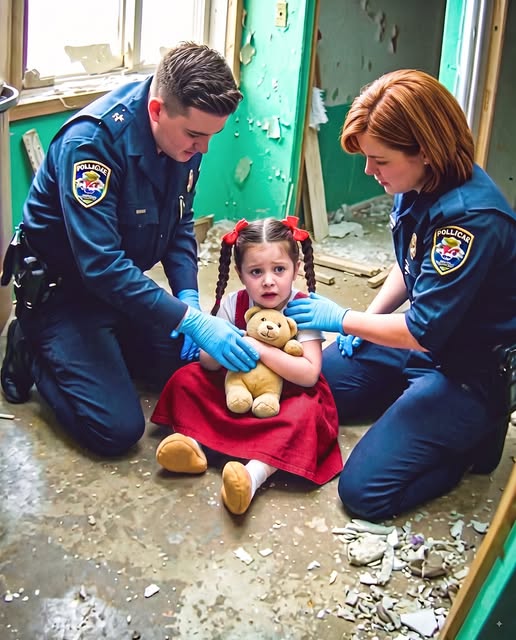
That same bear had been pressed against her chest when the paramedics found her.
“Mia,” Diane said gently, “did your mommy ever tell you that name?”
The little girl hesitated.
Then she nodded.
“She said I shouldn’t say it.”
Her mother closed her eyes.
Diane felt a cold heaviness settle in her stomach.
“Why?”
Mia looked toward the officer.
“She said if I told anyone, they would take her away.”
Her mother began crying.
Not loudly.
There was no dramatic collapse.
She simply covered her mouth and turned her face toward the wall.
Officer Reeves looked at Diane.
“Can you give us a few minutes?”
Diane nodded.
But before she could leave, Mia spoke again.
“She didn’t hurt me.”
Everyone looked at her.
Mia’s voice was small.
“She was trying to make Mommy better.”
Diane stopped.
“Who was?”
Mia pointed toward the evidence bag.
“Evelyn.”
The room went quiet.
Not because nobody had questions.
Because suddenly there were too many.
Earlier that morning, when Noah Blake entered Mia’s bedroom, he had noticed the medication bottles immediately.
There had been seven of them.
Five prescription bottles.
One bottle of children’s pain reliever.
And one small unlabeled vial tucked behind a box of tissues.
At the time, he had assumed the bottles belonged to Mia’s mother.
Now police had taken every container from the house.
A preliminary check showed that several prescriptions had been issued to different people.
Some were for anxiety.
One was for muscle spasms.
Another was a medication that could cause serious complications if given incorrectly.
And the unlabeled vial contained a compound that hospital staff could not safely identify without further testing.
That was why Mia had been kept under observation.
Her symptoms were real.
Her pain was real.
But doctors still needed to understand what had caused it.
Diane returned to the room after the police moved Mia’s mother into a nearby consultation area.
Mia was coloring again.
She had chosen a yellow crayon.
“Are you angry with me?” she asked.
“No.”
“Mommy will be angry.”
Diane pulled a chair beside the bed.
“Why would she be angry?”
“Because I called.”
Diane paused.
“Did you call 911?”
Mia nodded.
“My legs hurt too much.”
“You did the right thing.”
Mia looked down at the paper.
“My mommy said I was supposed to wait.”
“For what?”
The little girl pressed the yellow crayon against the page.
“For her hands to stop shaking.”
Diane remembered the sentence from earlier.
Sometimes I help her when her hands shake.
“How do you help her?”
“I get the bottles.”
Diane kept her voice calm.
“Which bottles?”
Mia pointed toward an imaginary dresser.
“The little ones.”
“Do you ever give her medicine?”
Mia nodded.
“She can’t open some bottles.”
Diane’s stomach tightened.
“Does she ever give you medicine?”
Mia looked confused.
“Mommy gives me medicine when my legs hurt.”
“What kind?”
“The one in the little bottle.”
Diane glanced toward the hallway.
The police were already investigating the medication.
But Mia’s answer changed the situation.
A child had been helping her mother manage medications, while the mother had apparently been giving medication to the child.
Diane needed to know exactly what had happened.
“Did Mommy give you something this morning?”
Mia nodded.
“She said it would help.”
“What happened after?”
Mia looked down.
“My legs started burning.”
Across the hospital, doctors were reviewing Mia’s initial examination.
Her vital signs were being monitored continuously.
Blood samples had been sent to the laboratory.
The team was careful not to make assumptions before the results came back.
One physician noticed that Mia’s symptoms did not fit neatly with the explanation her mother had initially provided.
The mother had told the paramedics that Mia sometimes complained of leg pain.
But Mia’s condition that morning had been significantly different.
The irritation was visible.
The pain was severe.
And the timing of the symptoms appeared to correspond with something she had been given.
The doctor asked Diane whether Mia had said anything about the medication.
Diane repeated the conversation as accurately as she could.
Then she mentioned the drawing.
“The syringe bothered me,” Diane said.
The doctor looked at the picture.
Mia had drawn three figures.
A woman.
A little girl.
And a third person standing behind them.
The third figure had been colored almost entirely in gray.
The syringe was in the woman’s hand.
The doctor pointed toward the gray figure.
“Who’s that?”
Mia answered without hesitation.
“Evelyn.”
Diane looked at her.
“What does Evelyn do?”
“She helps Mommy.”
“How?”
Mia’s fingers tightened around the crayon.
“She comes at night.”
The doctor and Diane exchanged a glance.
Mia continued.
“Mommy says Evelyn isn’t supposed to come anymore.”
That was when the police officer returned.
He had heard enough to understand that the name on the box was not random.
He asked Mia whether Evelyn had ever come inside the house.
Mia nodded.
“She came before Mommy went to work.”
“Today?”
“No.”
“Yesterday?”
Mia shook her head.
“Before that.”
“How long ago?”
Mia thought carefully.
“Three sleeps.”
Officer Reeves wrote it down.
“What did she do?”
“She talked to Mommy.”
“Did she hurt you?”
“No.”
“Did she give you anything?”
Mia shook her head.
“She told Mommy not to.”
That answer made the officer stop writing.
“Not to do what?”
Mia looked toward the door.
“Give me the little bottle.”
The first laboratory result arrived forty minutes later.
It wasn’t a final diagnosis.
But it was enough to change the investigation.
The substance found in Mia’s system was consistent with exposure to a medication that had not been prescribed to her.
Doctors immediately changed their treatment plan.
The police returned to the house.
This time they searched every room carefully.
Behind a loose panel in the bathroom cabinet, they found additional medication.
Several packages were empty.
Some had names that did not belong to anyone living in the house.
There were also handwritten notes.
Dates.
Times.
Dosages.
And beside some entries was a single letter.
E.
Officer Reeves photographed every page.
Then he found something else.
An old photograph.
It showed Mia’s mother standing beside another woman.
The woman was younger than Diane remembered seeing her in old family photographs.
But Diane recognized her immediately.
Evelyn.
Her sister.
On the back of the photograph was a date from eleven years earlier.
The date of Evelyn’s death.
Diane confronted Mia’s mother privately.
The woman sat with both hands wrapped around a paper cup of water.
“My name is Carla,” she said quietly.
“I know.”
Carla looked at the floor.
“You knew Evelyn?”
Diane nodded.
“She was my sister.”
Carla closed her eyes.
“I didn’t know.”
“What don’t you know?”
“That she had a sister who worked here.”
Diane sat across from her.
“Then tell me why her name was inside that box.”
Carla did not answer immediately.
When she finally spoke, her voice was exhausted.
“Because Evelyn helped me.”
“How?”
Carla rubbed her forehead.
“I was sick.”
Diane waited.
Carla continued.
“I had been struggling for years. My hands would shake. Sometimes I couldn’t sleep. Sometimes I couldn’t even get Mia ready for school.”
“Was Evelyn treating you?”
“No.”
Carla shook her head.
“She wasn’t a doctor.”
“Then what was she doing?”
“She knew about medications.”
Diane’s expression hardened.
“That isn’t the same thing.”
“I know.”
Carla looked up.
“I know that now.”
She explained that Evelyn had known Carla before Mia was born.
After Evelyn’s death, Carla had been left with several medications that had belonged to her sister.
Instead of disposing of them, she kept them.
At first, she took them only when she believed she needed them.
Then she began mixing medications.
Then she began relying on them.
And eventually, she stopped trusting herself to manage them.
That was when she started keeping handwritten records.
“She was trying to control everything,” Carla whispered.
“And Mia?”
Carla’s eyes filled with tears.
“I never wanted Mia involved.”
“But she was.”
“I know.”
Diane’s voice remained steady.
“She told us she helped you.”
Carla covered her face.
“I asked her to bring me the bottles.”
“And you gave her medicine?”
Carla didn’t answer.
That was answer enough.
Diane looked toward the window.
“You put your daughter in danger.”
“I know.”
“Why didn’t you ask for help?”
Carla lowered her hands.
“Because I was terrified someone would take Mia away.”
Diane thought of the sentence Mia had repeated.
If I told anyone, they would take her away.
Carla had said it to her daughter.
Not because she wanted Mia to suffer.
But because fear had become the thing controlling the household.
That did not excuse what happened.
It explained how the situation had been allowed to continue.
There was still one question.
Who was Evelyn?
And why had Mia said she came to the house?
Officer Reeves returned to the hospital that evening with an answer.
Evelyn had not actually been there.
The name inside the box belonged to a memory Carla had refused to let go of.
Before Evelyn died, she had left Carla a handwritten list of medication safety instructions.
The list was old.
Some of the medications were no longer being used.
But Carla had treated the paper like a rulebook.
Mia had seen the name so often that Evelyn became part of the language of the household.
“Mommy says Evelyn wouldn’t let me take that.”
“Mommy says Evelyn says this bottle is different.”
“She says Evelyn comes at night.”
To a six-year-old, those statements had sounded literal.
But Carla had been talking about Evelyn as though her sister were still advising her.
That was why the name had appeared on Mia’s drawing.
It was why Mia believed Evelyn was protecting her.
And it explained why Carla had panicked when she saw the drawing.
She knew exactly what Mia had been repeating.
The final piece came from the laboratory.
The unidentified vial was not some mysterious substance.
It was an old medication that had been improperly stored.
The doctors believed Mia’s symptoms were connected to exposure to medication that had never been prescribed for her.
There was no evidence that Carla had deliberately tried to poison her daughter.
But there was clear evidence that she had allowed a six-year-old to handle medication and had given the child drugs without medical direction.
The consequences were immediate.
Mia remained in the hospital for several days.
Child protective services became involved.
Carla was not allowed to take Mia home without supervision.
The police continued their investigation.
And for the first time, Carla had to face the thing she had spent years avoiding.
She needed help.
Real help.
Not another bottle.
Not another handwritten schedule.
Not a dead woman’s name written on a piece of tape.
Three days later, Diane walked into Mia’s room carrying the same teddy bear she had seen on the first morning.
Mia was sitting upright.
Her legs were improving.
The pain had eased.
She was watching cartoons again.
“Did you draw something new?” Diane asked.
Mia nodded.
She held up a sheet of paper.
This time there were only two figures.
Mia and her mother.
There was no syringe.
No gray figure.
No medication bottle.
Diane smiled.
“That’s beautiful.”
Mia looked at the drawing.
“Mommy is getting better.”
Diane sat beside her.
“Yes.”
“Can she come home?”
“Eventually.”
Mia thought about that.
“Will I have to help her?”
“No.”
The answer came immediately.
“Grown-ups are going to help your mommy.”
Mia nodded.
Then she looked at the teddy bear.
“Can he come too?”
Diane smiled.
“He can.”
Carla entered treatment before she was allowed supervised visits with Mia.
She admitted that she had been misusing medication for years.
She also admitted that she had been too afraid to tell anyone how badly things had become.
Her case did not disappear because she was frightened.
There were consequences.
There were investigations.
There were restrictions placed around Mia’s care.
But there was also a plan.
Mia would not be responsible for her mother’s safety anymore.
She would not open medication bottles.
She would not decide which pills her mother needed.
She would not listen for her mother’s hands to stop shaking.
Those responsibilities belonged to adults.
Weeks later, Mia returned to the hospital for a follow-up appointment.
Diane found her sitting in the waiting area with her teddy bear beside her.
“How are your legs?”
Mia smiled.
“They don’t hurt.”
“And how is Mommy?”
Mia looked down at the bear.
“She says she’s learning.”
Diane nodded.
“That sounds good.”
Mia handed her a folded piece of paper.
Diane opened it.
It was another drawing.
This time, the picture showed a little girl standing outside a white house.
The paint was still peeling.
The mailbox was still broken.
But the front door was open.
Beside the girl stood her mother.
And on the ground between them was the old medication box.
It was crossed out with a thick black line.
Diane looked at Mia.
“What’s this?”
Mia shrugged.
“Mommy said we’re not keeping it anymore.”
Diane folded the picture carefully.
“Good.”
Mia picked up her teddy bear.
Then she looked toward the hospital window.
Outside, autumn leaves moved across the parking lot in the wind.
The morning of the 911 call had begun with a little girl believing she had to endure her pain quietly.
It ended with her learning something far more important.
She was allowed to ask for help.
And this time, when she held the teddy bear against her chest, it wasn’t because she was waiting for someone to come.
It was because she finally knew they would.