The Mother Who Walked Out On Me at Fifteen Returned to Take My Son FULL STORY
Dr. Foss didn’t wait to be called. She stood, gave the bailiff her name, and asked the judge for two minutes. Judge Boyd, who had been watching my mother’s tears with the flat patience of a man who’d seen a thousand of them, said she could have five.
“I’ve treated Sergeant Vasquez for three years,” Dr. Foss said. “I’m here because I read the petition, and I will not let a sealed file be used to say the opposite of what it says.”
Gloria’s lawyer objected. Judge Boyd overruled him, because I’d already consented to unseal, and because a judge in family court has heard every trick and this one bored him.
So they opened the envelope.
Here is what my mother bet her custody petition on, and here is what was actually inside.
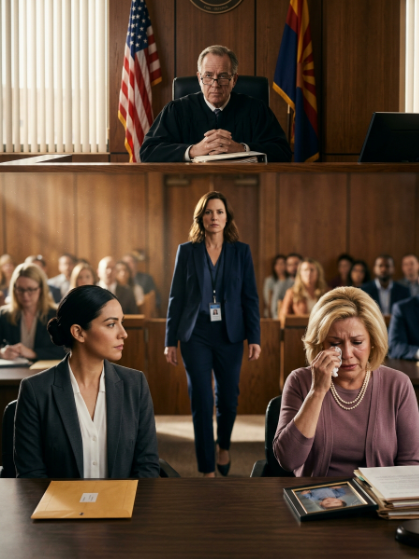
The records showed a combat medic who came home with diagnosed PTSD, the way roughly anyone would after what I did and saw. They also showed three years of weekly work. They showed sobriety dates. They showed a treatment plan I never missed. They showed a therapist’s standing assessment, updated every quarter, that I was stable, low-risk, and — her word — “an exceptionally engaged and protective parent.”
They showed something else, too. Because therapy notes have dates, and dates tell stories.
There was an entry from eighteen months ago. The week my son started kindergarten. I’d brought it up in session — how I’d had a voicemail, out of nowhere, from my mother. First contact in two decades. She’d said she’d seen on social media that Mateo was starting school, that she’d “been thinking about her legacy,” and wanted to “be involved.”
Dr. Foss read that note out loud. Then she read the one from the following week, where I described the second call, the one where Gloria asked, and I am quoting the note, “whether the boy stood to inherit anything from his father’s side.”
The courtroom understood it a beat before Judge Boyd said anything.
Gloria hadn’t come back for Mateo. Mateo’s father had passed two years ago, and there was a modest settlement held in trust for my son. A guardian controls a trust. She hadn’t filed to rescue a child from an unstable veteran. She’d filed because there was money behind a six-year-old, and a custody order was the shortest path to it.
She’d subpoenaed my therapy file certain it would show a broken woman.
She’d never once imagined I’d let them read it — or that the same pages proving I was well would also be dated proof of exactly when, and why, she’d reappeared.
“Sergeant Vasquez,” Judge Boyd said, “did you object to unsealing these records?”
“No, Your Honor.”
“Why not? Most people in your position would fight it to the Supreme Court.”
I stood up, because it felt like a thing you stand up for.
“Because my mother taught me something when I was fifteen and she left,” I said. “She taught me that the people who are supposed to protect you sometimes won’t. So I learned to keep proof. Every appointment. Every date. Not because I expected this room — but because a woman who’s been left once stops trusting that the truth will speak for itself. It needs a record. I brought mine.”
Gloria had stopped dabbing at her eyes some time ago. There was nothing left to perform to.
Judge Boyd denied the petition from the bench. He used phrases like “no credible evidence of unfitness” and “a pattern of conduct by the petitioner that the court finds troubling.” He ordered that the trust remain exactly where it was, under independent administration, untouchable by anyone whose name rhymed with grandmother.
He looked at me before he closed the file. Judges aren’t supposed to editorialize. He did anyway, quietly.
“Sergeant. Thank you for your service. And for your composure. Your son is lucky.”
Outside, in the dusty Tucson light, Dr. Foss caught up with me on the courthouse steps.
“You didn’t need me in there,” she said. “You’d have won without me.”
“Maybe,” I said. “But you stood up. You have no idea what it does for a person to watch someone stand up for them in a room like that. I went fifteen years without it.”
She squeezed my arm and let me go pick up my son.
Mateo was at a friend’s house, building something out of cardboard, gloriously unaware that a courtroom three miles away had spent the morning deciding his life. He ran at me the way six-year-olds run, full speed, no brakes, total faith that I’d catch him.
I caught him.
I think about the photo my mother had on her table that day, face-down, of my smiling boy. She’d brought it as a prop. A grandmother who loved a child would have set it upright, facing the room, proud.
She laid it face-down because she’d printed it off the internet that week and didn’t know him at all.
I keep my copy of those records now, resealed, in a box with my discharge papers and Mateo’s kindergarten drawings.
Not because I think she’ll come back. I don’t think she will; there’s no money left to come back for.
I keep them for the same reason I kept them in the first place.
Because the truth is strongest when it’s dated, and signed, and ready — and because the woman who taught me no one would protect me was wrong about exactly one person.
Me.