The Missing Scrapbook Page FULL STORY
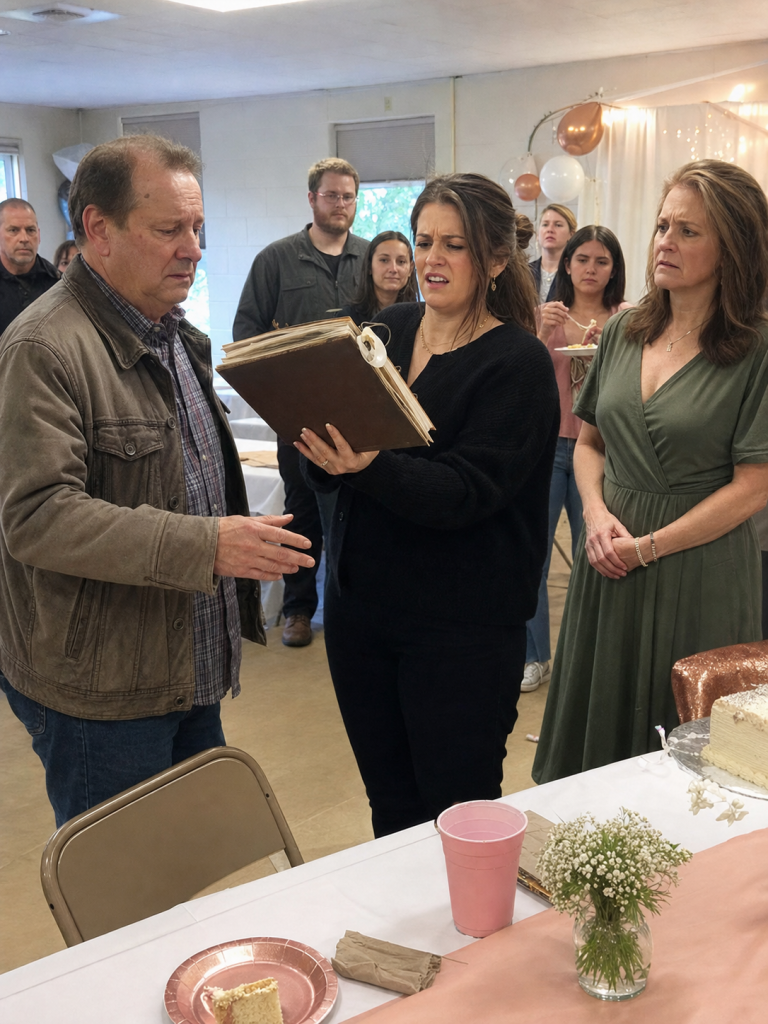
Dr. Patel did not touch the bracelet. He just stared at it like it had pulled him twenty-five years backward.
Dana held the scrapbook against her chest now. The joking smile was gone.
“What is it?” she asked.
Lena moved beside me and slipped her fingers through mine. I felt how cold her hand was. She knew exactly what page Dana had opened. She knew why I had left that corner empty.
“It was supposed to have a photo,” I said.
Dana looked irritated again, but less certain. “A photo of what?”
Dr. Patel answered before I could. “The pediatric wing. April 1998.”
A few relatives shifted in their chairs. The party noise softened to a hush. Someone turned down the music.
Dana looked at the bracelet more carefully, turning it in the light. “Was this mine?”
I nodded.
She gave a short laugh, defensive and sharp. “Okay. So you kept an old hospital bracelet. Why is everyone acting weird?”
Because she did not remember that year. She remembered stories we had sanded smooth. She remembered being told she was a tough little girl, that she bounced back, that everyone loved her. She did not remember the phone calls, the bills stacked on the counter, the second opinions, the nights Lena slept in a vinyl chair while I drove back to work in the dark.
I took the scrapbook gently from her hands and opened it on the table. The pages before that empty corner were full of things that looked silly if you did not know how to read them: a gas receipt, a parking stub, a cafeteria napkin, a note from Lena that said only, “Bring socks.”
“Your mother wanted to throw these away,” I said. “I kept them because they were proof we made it through.”
Dana’s eyes moved across the page. “Made it through what?”
Dr. Patel pulled a chair closer. “You were very sick for nearly a year. Your parents did not tell you the worst of it because you were a child, and children should not carry that.”
Dana looked at me. “I had pneumonia. That’s what you always said.”
“At first,” Lena whispered.
The diagnosis had changed. The treatment had changed. The insurance had refused things, then delayed them, then approved them too late to matter. I sold my truck. Lena sold her wedding bracelet, the gold one her mother left her. I worked nights at the loading dock after my day shift and slept in twenty-minute pieces. We borrowed from no one because my pride was ugly back then, and because I could not bear relatives discussing my daughter’s body like a family budget problem.
Dana sat down. The scrapbook lay open between us.
“But you always said money was tight because you were bad with it,” she said. Her voice sounded small. “You used to make jokes about it.”
I shook my head. “Money was tight because keeping you alive was expensive. The jokes were easier than the truth.”
Lena closed her eyes.
Dr. Patel said, “Your father came to my office every Friday with whatever he had. Sometimes cash. Sometimes a check that I knew would hurt him to write. He asked me to keep it quiet. He did not want you growing up feeling like a bill that got paid.”
Dana covered her mouth.
I did not want the doctor to make me sound grand. There had been nothing grand about it. I had been scared, exhausted, and sometimes angry in ways I still regret. I snapped at Lena once in a hospital hallway over something that did not matter, and I have never forgotten her face. But I had paid every bill I could reach. When I could not pay, I sat in offices until somebody explained the next form.
The missing page was the only one I had not finished. It was meant to hold the final paid invoice, the one that meant we were free. I had kept it blank because I never wanted Dana to feel she owed us her life.
“Then why put it in the scrapbook?” she asked, tears starting now.
“Because this book was for your mother,” I said. “And that year was part of our marriage. We held each other up. We held you up. I thought she deserved to see that I remembered all of it, not just the pretty parts.”
Dana looked at Lena. “Mom, why didn’t you tell me?”
Lena brushed a tear from her cheek. “Because every time you ran across a soccer field, every time you complained about homework, every time you slammed your bedroom door like a normal teenager, we were grateful you were well enough to be ordinary. We did not want to turn that into a debt you had to repay.”
The room stayed quiet. Even the cousins who usually had jokes looked down at their plates.
Dana stood and came around the table. She did not make a speech. She just put her arms around my neck and cried into my shoulder the way she had not done since she was twelve.
“I’m sorry,” she said. “I made it sound cheap.”
I looked at the scrapbook, at the crooked ribbon and the glue spots and the empty corner.
“It is cheap,” I said, trying to smile. “Glue was on sale. Two for one.”
She laughed through tears, and that broke the room open enough for people to breathe again.
Later, after the cake was cut, Dana asked if she could help me finish the missing page. Dr. Patel offered to send a copy of a letter he still had in his archives, one that said she was cleared to go home, dated the day she got to leave.
A week later, Dana came over with a new packet of photo corners. She did not bring an expensive gift. She brought coffee, scissors, and two hours of quiet.
We placed the old bracelet on the page beside one sentence Lena wrote in blue ink: “This is the year we got to keep her.”
Dana pressed the plastic sleeve flat with both hands, careful now, as if the homemade book had become something no store could sell.