The Medical Record My Parents Hid Until My Heart Nearly Stopped
PART 3 (FULL STORY)
“Florence,” Reed whispered, “there’s something else you need to know.”
I looked at him, but he wasn’t looking at me.
He was staring at my mother.
Dr. Lindren kept one hand on the folder.
“What does Reed mean?” I asked.
My mother finally raised her eyes.
“Nothing.”
It was the same word she had used for years whenever I asked why I kept collapsing.
Nothing.
At nine, nothing.
At eleven, nothing.
At seventeen, nothing.
In my twenties, nothing.
And nine days ago, when my heart had nearly stopped on a kitchen floor, apparently still nothing.
Reed stepped around the chair.
“Six years ago, Florence signed a durable medical power of attorney.”
Dad’s expression hardened.
“That document is irrelevant.”
“No,” Ruth said. “It isn’t.”
She took the folder from Dr. Lindren and looked at the paperwork clipped behind the old records.
Reed continued.
“She named me as her healthcare agent.”
I stared at him.
I remembered the document.
Six years earlier, after another fainting episode, Reed had sat with me at a coffee shop and told me something I hadn’t wanted to hear.
“You’re an adult now,” he’d said. “You need someone who will speak for you if you’re ever unconscious.”
I’d laughed at him.
He hadn’t.
So I had signed the document.
At the time, I thought it was simply the responsible thing to do.
I never imagined it would matter.
My father apparently hadn’t either.
“You disappeared from this family,” he said to Reed.
Reed nodded.
“You told everyone I did.”
“That was your choice.”
“No,” Reed said quietly. “It was yours.”
Camille looked between them.
“What are you talking about?”
Nobody answered her.
Dr. Lindren turned the final page toward me.
“This is what your mother wrote.”
I looked down.
The handwriting was unmistakably hers.
The date was twenty-five years earlier.
I read the first sentence again.
Patient’s parents decline further cardiac evaluation at this time.
My fingers tightened around the blanket.
I kept reading.
Mother reports that child frequently becomes distressed before family events and believes episodes may be behavioral.
My throat tightened.
There was more.
Family does not want unnecessary restrictions placed on child.
Then, underneath the cardiologist’s recommendation for continued evaluation of prolonged QT syndrome, my mother’s handwriting appeared again.
Please do not place this diagnosis in the permanent pediatric problem list until we know whether symptoms are genuine.
I stopped breathing for a second.
“Genuine?”
My mother shook her head.
“I was frightened.”
“You were frightened?”
“Yes.”
“Of what?”
She looked at Camille.
That tiny movement answered more than her words could have.
Camille’s face changed.
“What?”
Mom swallowed.
“Your engagement.”
I stared at her.
“You’re talking about Camille’s engagement?”
“No,” she said quickly. “Not this engagement. Years ago.”
Dr. Lindren turned another page.
“There is an additional note from the pediatric cardiologist.”
She pointed to the bottom.
I read it.
Given the abnormal ECG and family history, follow-up should not be delayed.
There was a date.
There was a signature.
And beside it was a short handwritten notation in my father’s handwriting.
Family declines.
For a few seconds, nobody spoke.
Then Dad said, “You don’t understand the situation.”
I looked at him.
“I was nine.”
He opened his mouth.
Nothing came out.
“I was nine,” I repeated.
“I didn’t know what the diagnosis meant.”
Dr. Lindren answered before I could.
“You were given a specialist referral.”
Dad looked at her.
“She wasn’t diagnosed.”
“She was not given the opportunity to complete the evaluation.”
That distinction landed heavily.
My mother started crying.
I expected myself to feel something enormous.
Rage.
Grief.
Maybe even relief.
Instead, I felt strangely calm.
Because suddenly every memory had a different shape.
The birthday party where I collapsed behind the garage.
The school nurse calling my mother.
My mother arriving irritated because she’d been shopping.
The time I woke up on the bathroom floor at seventeen and heard Dad telling someone on the phone that I was “doing it again.”
The doctor’s office where I was told to drink more water.
The years when I stopped mentioning the fainting because I had learned what happened whenever I did.
They called it attention-seeking.
They called it jealousy.
They called it drama.
But nobody had called it what the ECG had suggested.
A cardiac problem.
A potentially dangerous one.
Reed moved closer.
“There was another reason I kept trying to stay in touch with you.”
I looked at him.
“What reason?”
He hesitated.
“Six years ago, I found out about the old ECG.”
Dad’s head snapped toward him.
“You had no right.”
“I had every right to know what happened to my sister.”
“You weren’t part of this family.”
Reed’s jaw tightened.
“You made sure of that.”
Camille looked confused.
“Why did everyone stop talking to Reed?”
Mom wiped her cheek.
“That isn’t relevant.”
“It is to me,” Camille said.
Nobody answered.
Reed looked at me.
“I found the old referral after Grandma died.”
My stomach tightened.
“There was a box of medical papers in her house.”
Dr. Lindren nodded slowly.
“That explains how the old record resurfaced.”
Reed continued.
“I recognized the cardiologist’s name because I remembered you talking about him when we were kids.”
“I don’t remember that.”
“You wouldn’t.”
He looked down.
“You were nine.”
The room felt smaller.
“What did you do?” I asked.
“I called the medical office listed on the old paperwork.”
Dad stepped forward.
Ruth immediately blocked him.
Reed didn’t move.
“I wanted to know whether the diagnosis had ever been followed up.”
“And?”
“There was no record of a completed evaluation.”
I closed my eyes.
That was when everything became painfully clear.
My parents hadn’t lost the paperwork.
The paperwork had been there.
Someone had made a decision.
Dr. Lindren touched the folder.
“When Reed contacted the office, he encouraged Florence to establish an updated medical record.”
I opened my eyes.
“I remember.”
Six years ago, Reed had insisted I see a new doctor.
I’d complained that he was overreacting.
He had simply said, “I’d rather be annoying than sorry.”
I’d thought it was one of his usual lectures.
Now I understood.
“You knew?”
He shook his head.
“I suspected.”
“And you never told me?”
“I didn’t have enough proof.”
He looked at my parents.
“And every time I tried to ask them about it, they shut me out.”
Dad said, “Because you were trying to destroy this family.”
Reed gave a tired smile.
“No. I was trying to keep my sister alive.”
My mother covered her face.
Camille finally spoke.
“Why would you hide something like this?”
Mom lowered her hands.
“We were told that further testing could affect her life.”
“How?”
“Sports.”
I frowned.
“What?”
My father answered this time.
“The specialist said you might need restrictions.”
I stared at him.
“So you chose not to find out?”
Dad said nothing.
Dr. Lindren looked at him.
“And when Florence continued fainting?”
“We thought she was exaggerating.”
“You thought your nine-year-old daughter was exaggerating cardiac symptoms.”
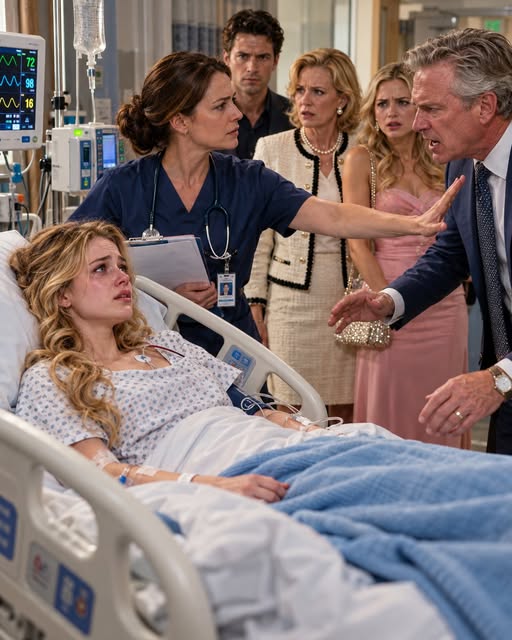
He looked away.
The sentence seemed to make him smaller.
Camille sat down.
Her expensive dress suddenly looked completely out of place in the hospital room.
“I never knew,” she whispered.
I looked at her.
“You complained when I collapsed.”
She started crying.
“I know.”
“You said I was doing it because you were leaving.”
“I know.”
“You left anyway.”
She nodded.
“I thought Mom and Dad had it handled.”
That sentence hurt more than I expected.
Because it was the truth.
She had trusted them.
So had I.
Ruth walked to the door.
“I’m going to ask everyone except Florence and Reed to step outside for a moment.”
Dad stiffened.
“You can’t remove me from my daughter’s room.”
Ruth looked at him.
“She has decision-making capacity.”
Dr. Lindren nodded.
“And she has already told us who she wants involved in her care.”
Dad looked at me.
There it was again.
That expectation.
That silent demand that I fix things.
That I tell everyone they were misunderstood.
That I forgive before anyone had actually asked what they had done.
For most of my life, I had done exactly that.
Not this time.
“Dad,” I said.
He waited.
“Please leave.”
His face went blank.
Mom looked at me.
“Florence…”
“Please.”
Camille stood.
She touched my mother’s arm.
“Mom.”
Mom looked at her.
“Let’s go.”
Dad didn’t move.
Reed stepped toward him.
“You heard her.”
For a moment I thought Dad might argue.
Instead, he turned and walked out.
My mother followed.
Camille stayed behind.
She looked at me through tears.
“I don’t expect you to forgive me.”
I nodded.
“Good.”
She flinched.
But she didn’t argue.
Then she left.
The door closed.
The room became quiet.
Reed sat down beside my bed.
Neither of us spoke for several minutes.
Finally, I asked, “Why didn’t you tell me about the power of attorney?”
“You knew you signed it.”
“I didn’t remember what it said.”
“That was the point.”
He reached into his jacket and pulled out a worn folder.
“You kept a copy.”
I looked at it.
My name was written across the front in my own handwriting.
He placed it on the tray table.
“Six years ago, you told me that if you were ever too sick to speak for yourself, you wanted someone who would ask questions even when the answers were uncomfortable.”
I stared at the folder.
“I said that?”
“You did.”
I laughed softly.
“I don’t remember being that smart.”
“You were always that smart.”
For the first time since waking in the hospital, I smiled.
Not because anything was fixed.
It wasn’t.
The diagnosis still had to be managed.
The years couldn’t be returned.
My childhood couldn’t be rewritten.
But I finally had the missing piece.
Dr. Lindren came back later that afternoon.
She explained what the prolonged QT finding could mean, what testing still needed to be completed, and what precautions would be necessary while the team investigated my condition.
She did not promise me that everything would be fine.
I appreciated that.
For once, someone was giving me information instead of reassurance.
My parents were not allowed to make decisions for me.
Reed remained my healthcare agent.
The hospital social worker documented what had happened.
The old records were scanned into my current chart.
And the page my mother had signed was placed in the evidence packet for the hospital’s review.
Three days later, my father came back alone.
He asked to see me.
I agreed.
He entered carrying nothing.
No flowers.
No apology written on a card.
Just himself.
He sat in the chair Reed had occupied.
For a while, he looked at the floor.
Then he said, “I was wrong.”
I waited.
He rubbed his hands together.
“I thought if we treated the fainting like it was nothing, it would stop being a problem.”
I said nothing.
“We had Camille. We had bills. We had work. We had things happening.”
“You had a nine-year-old daughter with an abnormal ECG.”
He nodded.
“I know.”
“No.”
He looked up.
“You know now.”
He swallowed.
“You’re right.”
I didn’t forgive him.
Not that day.
Maybe not for a long time.
But I listened.
He told me he had been afraid of having a sick child.
He told me my mother had been afraid that restrictions would change my future.
He admitted they had convinced themselves that waiting was safer than facing the possibility.
Then he said something I had not expected.
“We were afraid your life would become smaller.”
I looked at him.
“And you made it smaller anyway.”
He closed his eyes.
“Yes.”
That was the first honest thing he’d said to me in decades.
He left without asking me to come home.
That mattered.
My mother sent a message the next morning.
It was three paragraphs long.
I didn’t answer immediately.
When I finally did, I wrote only one sentence.
I need time.
She replied with two words.
I understand.
I don’t know whether she truly did.
But for once, I didn’t feel responsible for making her understand.
Nine days after I collapsed, I had entered the hospital believing I was the dramatic daughter nobody believed.
I left knowing something different.
I had been the daughter who had spent thirty-four years believing other people’s version of her own body.
That was the part I needed to change.
Not my past.
Not my parents.
Me.
Before I left the hospital, Dr. Lindren gave me a copy of the old ECG.
I folded it carefully and placed it inside the worn folder Reed had brought me.
The paper was yellowed at the edges.
My nine-year-old heart was recorded in those thin black lines.
For decades, everyone had treated them like nothing.
I closed the folder.
Then I slid it into my bag.
For the first time, I wasn’t carrying proof that I had been dramatic.
I was carrying proof that I had been right to ask questions.