The Master Jar – Full Story
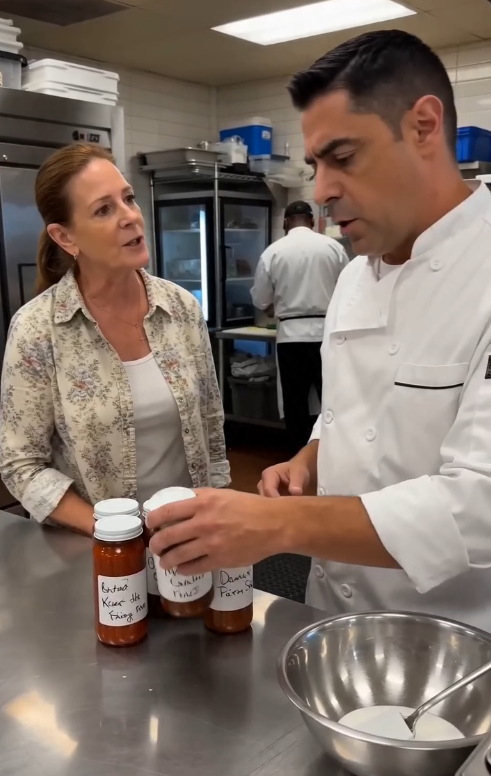
Julian’s eyes darted around the kitchen. The line cooks were staring. The stainless steel prep table reflected the harsh overhead lights. The rich, red sauce in the open jar caught the glare, looking like liquid ruby.
“That’s impossible,” Julian stammered. He adjusted the cuffs of his pristine white coat. His hands were shaking. “The 1982 recipe was lost. The fire in the old kitchen destroyed the original journals. I know this because I read the corporate acquisition files.”
My mother, Elena, didn’t flinch. She kept the open jar held high. The smell of roasted garlic, San Marzano tomatoes, and fresh basil hung heavy in the air. It was the smell of my childhood. The smell of Sunday afternoons.
“The journals weren’t destroyed, Julian,” she said. Her voice was perfectly level. “They were moved. To a safety deposit box at Chase Bank. The day before the fire.”
Julian’s face flushed a deep, angry red. The polite, corporate chef facade shattered. He slammed his hand on the steel table. The metal rang out like a gong, sharp and ugly.
“You’re lying!” he shouted. His voice echoed off the tiled walls. “I developed the flavor profile for the Bella Notte relaunch myself! I spent six months in a culinary lab in Lyon perfecting the tomato acidity! I am the reason this restaurant has a star!”
He pointed a shaking finger at me. The tip of his index finger was pale.
“And you! You’re fired. You brought unauthorized, unregulated ingredients into a sterile commercial kitchen. Get your jars and get out. Now.”
My stomach dropped into a cold, hard knot. I looked at the five jars. My mother’s life’s work. The recipe she had woken up at 4:00 AM to stir for three decades. I reached for the first jar. My fingers brushed the cold glass.
“Touch those jars, Sarah, and I will sue you for breach of contract,” my mother said.
Her voice wasn’t loud. It was ice. It cut through the kitchen like a cleaver.
Julian froze. His hand hovered in the air. He looked at her pearl necklace. He looked at the crisp black blouse. He looked at the deep lines around her eyes, the eyes that had stared down health inspectors, union reps, and arrogant food critics for forty years.
“Who are you?” he demanded. His voice cracked.
“I’m Elena Rossi,” she said. “The founder of Bella Notte. The widow of Marco Rossi. And the majority shareholder of the holding company that just bought your corporate management firm this morning.”
The kitchen went dead silent. The exhaust hoods hummed. The line cooks held their breath.
Julian’s mouth opened and closed. He looked like a fish gasping for air on the hot line. “You… you’re the ghost owner,” he whispered. “The board said you were dead. They said you retired to Tuscany and lost your mind.”
“I was in Tuscany,” she corrected him. “And while I was gone, I let you run the kitchen. I wanted to see if you would innovate. I wanted to see if you would respect the legacy my husband built with his bare hands.”
She stepped closer. The smell of her expensive perfume mixed with the sharp scent of the simmering tomatoes.
“Instead, you fired the old staff. You changed the suppliers to cheap imports. You took my husband’s stolen recipes, put them on a menu, and called them your own.”
Julian took a step back. He hit the stainless steel prep table. The metal clanged against his spine. “I improved it,” he spat. The desperation was bleeding into his voice. “Your husband’s recipe was peasant food. It was heavy. It was outdated. I elevated it for the modern palate.”
My mother reached into her black purse. She pulled out a thick, leather-bound book. The cover was cracked, worn smooth by years of handling. The pages were stained with saffron, red wine, and olive oil.
She dropped it on the steel table. It landed with a heavy, authoritative thud.
“Page forty-two,” she said. “Read the margin notes.”
Julian looked down. His hands trembled as he opened the book. He turned the pages, his eyes scanning the faded, elegant handwriting. He stopped. He read the margin notes. The color drained from his cheeks, leaving him looking pale and sickly under the fluorescent lights.
“He… he noted the exact same acidity adjustment,” Julian whispered. His voice was barely a rasp. “He wrote it in 1981. He used crushed fennel seeds to cut the sweetness.”
“He invented it,” my mother said. “You just copied it. And you failed. Because you didn’t understand the soul of the dish. You just understood the chemistry.”
She closed the book. The sound was final.
“Sarah,” she said, turning to me. “Pack up the jars. We’re taking the recipe to Osteria Luce down the street. They have a kitchen that respects its history. And they have a head chef position with your name on it.”
I nodded. I didn’t look at Julian. I picked up the jars, one by one. The glass was cool and solid in my hands.
Julian didn’t try to stop us. He didn’t yell. He didn’t threaten to call the lawyers. He just stood there, staring at the open journal, his pristine white coat suddenly looking very cheap, very small, and very empty.
I walked out of the kitchen, the smell of garlic and tomatoes following me into the Manhattan afternoon.