The Man I Called Dad Refused to Walk Me Down the Aisle FULL STORY
Walter’s hands didn’t shake as he unfolded the page. Mine did, watching him.
“She wrote it the winter before she passed,” he said softly, for me, not for the room. “She made me carry it for nine years. I almost burned it a hundred times. I’m glad I didn’t.”
He read it out loud, because my mother had asked him to, if it ever came to this.
“‘My Cora. If Walter is reading this where people can hear, then Raymond has finally done the cruel thing I always feared he would, and I am not there to stop it. So let me stop it now, from wherever I am. Raymond is not your father. He never was. I married him when I was three months along with you and frightened and alone, and he agreed to put his name on your birth certificate in exchange for things I am ashamed I gave him. Your real father is the man holding this letter. Walter found me again when you were sixteen. He did not know you were his until I told him on my deathbed, and he chose to love you as a stepfather rather than upend your life. He has been your father in every way that the word means. Raymond knew the truth the whole time and used it to make us small. You are not small, my girl. You never were.'”
The ballroom did not gasp the way ballrooms do in movies. It went the other way. It went so quiet I could hear the candle flame by my mother’s photo.
I turned to Raymond.
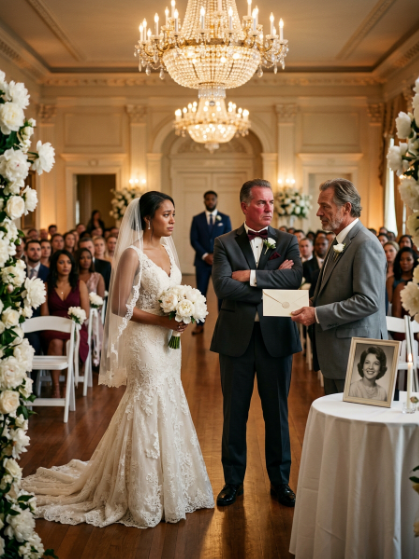
He wasn’t flushed anymore. He’d gone gray.
“You knew,” I said. “Every birthday you sat through like it cost you something. Every time you looked at me like a bill. You knew I wasn’t yours, and instead of telling me, you just — punished me for it. For twenty-eight years.”
“Your mother left me with nothing,” Raymond said, and even now, even here, it came out as grievance. “She used my name and then she found him again and I was supposed to just—”
“You were supposed to walk me down an aisle,” I said. “That’s all I asked. And you’d rather humiliate me in front of everyone I love than give Walter the one minute he actually earned.”
Sam had come down off the altar by then. He stood at my shoulder, not saying anything, just there, the way the good ones are.
Raymond looked around the room for an ally and found two hundred faces that had just heard a dead woman tell the truth.
He left.
He didn’t storm out. He just gathered whatever a man like that gathers, and he walked the length of the aisle alone — the aisle he refused to walk with me — and the doors closed behind him, and that was the last time I saw him for a long while.
I turned to Walter.
He was crying without making any sound, the cream envelope still in one hand.
“I didn’t tell you,” he said. “All these years. I was so afraid you’d think I was trying to take something. I just wanted you to have a father who showed up. The title didn’t matter to me.”
“It matters to me,” I said. “Dad.”
I don’t think I’d ever called him that. His whole face changed at the word, like something he’d held shut for nine years finally let go.
“Will you walk me?” I asked.
He set the letter down gently beside my mother’s photo, next to the candle, where it belonged. Then he offered me his arm.
We walked.
The quartet found the song again somewhere behind us. Two hundred people stood, not because anyone told them to, but because that’s what you do when you watch something get put right after a long time wrong.
We were married under the peony arch as the sun went down through the tall windows. Walter gave the toast. He kept it to four sentences because he said he’d cry through anything longer. The fourth sentence was, “Diane, she turned out exactly as brave as you promised.”
About Raymond.
He tried, a year later, to make a claim on a small trust my mother had left in my name — the last lever he had. His lawyer dropped it the day mine produced the letter and the original birth records Walter had quietly tracked down. There was nothing for Raymond in any of it. There never had been. That, I think, was the thing he could never forgive my mother for: that the family he resented was never going to make him rich, and he stayed anyway, sour, for reasons even he probably couldn’t name.
Walter walks Cora’s grandmother’s garden now — my mother’s mother, ninety-one and sharp as a tack, who hugged him at the reception and called him “son” before I did.
I framed my mother’s letter. It hangs in our hallway, beside the photo from the memorial table, the candle long since burned down.
Some nights I read it again.
She couldn’t be there.
But she walked me down that aisle all the same — in nine-year-old ink, in a sealed envelope, in the steady arm of the man she chose to carry it.
The man who turned out to be my father all along.