The Maid My Mother Trusted Had a Secret My Family Buried for Years
PART 3 (FULL STORY)
Mother’s words stayed in the room long after she stopped speaking.
I looked down at the photograph again.
The woman holding the little girl looked young, maybe twenty-five, with dark hair pulled away from her face and the same serious eyes Clara had when she was trying not to cry.
I knew that face.
Not personally.
From an old photograph in my father’s study.
Her name had been Rebecca Reed.
My father had mentioned her only once in my entire childhood.
He called her a former employee.
That was all.
I looked at Clara.
“Rebecca Reed was your mother.”
Clara nodded.
“My father knew her.”
“He knew her very well,” Mother said.
I felt something cold move through me.
“What does ‘he built this entire life on the lie’ mean?”
Mother looked exhausted, but there was something firmer in her expression than I’d seen since her diagnosis.
“Sit down, Bennett.”
“I’d rather stand.”
“Then stand.”
She took a breath.
“Your father and Rebecca worked together before you were born. She handled some of the Hale family’s private accounts and charitable foundations. She was smart, careful, and loyal.”
Clara lowered her eyes.
“My mother trusted him,” she said.
Mother nodded.
“And your father trusted her with something he should never have touched.”
She explained it slowly.
Years ago, my father had been moving money through several companies connected to the Hale organization.
I knew enough about my family’s business to understand what that meant.
My father had always called those companies investments.
Mother called them something else.
“Money that didn’t belong to him.”
I stared at her.
“Are you saying my father stole from the company?”
“No,” Mother said. “I’m saying he stole from people who could not afford to lose it.”
Clara finally spoke.
“My mother found out.”
The room went quiet.
She told me Rebecca had discovered that money intended for a group of small businesses and workers had been diverted through shell companies.
She confronted my father.
He promised to return it.
He never did.
Instead, according to the records Rebecca kept, my father arranged for her to be blamed when the missing money was discovered.
“She was accused of fraud,” Clara said.
I looked at Mother.
“You knew?”
“I knew enough to know your father was lying.”
“Then why didn’t you stop him?”
Her eyes filled with tears.
“Because I was afraid.”
It was the first time I’d ever heard my mother say those words.
Not because she was weak.
Because she was honest.
“Your father had already threatened to take you away from me if I went against him,” she said. “You were seven years old.”
I remembered almost nothing from that year.
A black car outside the house.
My father shouting downstairs.
Mother crying in the bathroom one night.
I had forgotten those things because children forget what adults teach them not to remember.
Mother hadn’t.
“Rebecca lost everything,” she continued. “Her job. Her reputation. Her savings. Your father made sure no one would believe her.”
“And Clara?”
Mother looked at her.
“Clara was only a child.”
Clara wiped her cheek.
“My mother spent years trying to clear her name.”
“She never stopped,” Mother said.
“Until she died.”
I looked at Clara.
“When?”
“Eleven years ago.”
“How?”
“Cancer.”
The word struck me harder than it should have.
Mother noticed.
“She died believing the Hale family had destroyed her life.”
I looked back at the photograph.
“Why did Clara come here?”
Clara finally met my eyes.
“Because my mother left me a box.”
She told me about it.
After Rebecca died, Clara found an old metal box hidden beneath loose floorboards in their apartment.
Inside were copies of bank statements, letters, photographs, and one handwritten note.
The note contained my mother’s name.
Clara came to the Hale mansion because she wanted to know whether Eleanor Hale had known what happened.
“At first, I thought I was here to find evidence,” Clara said.
“And then?”
She glanced toward my mother.
“Then I met her.”
Mother smiled faintly.
“I knew who she was the first day.”
I stared at both of them.
“You knew?”
“I recognized her mother’s eyes.”
“Then why did you let her stay?”
“Because she didn’t come here asking for money.”
Mother reached toward Clara.
“She came here carrying twenty years of hurt.”
I didn’t know what to say.
Clara had entered my house as a maid because that was the only position available to her without drawing attention.
She had cleaned rooms I barely noticed.
She had carried trays into meetings.
She had walked past me in hallways while I spoke to lawyers and business partners.
All that time, she had been searching through a family she believed had destroyed hers.
And I had never once wondered why.
“Did you find the evidence?” I asked.
Clara hesitated.
“Yes.”
My stomach tightened.
“Where?”
She looked at Mother.
Mother nodded.
Clara stood and walked toward an old cabinet beside the window.
She opened the bottom drawer.
Then she pulled out a thin brown folder.
I knew that folder.
It had been in my father’s study for years.
I had seen it when I was young.
I had never opened it.
Clara placed it on my desk.
“I found it three months ago.”
My fingers felt numb as I opened it.
Inside were copies of transfers, letters between my father and his accountant, and a statement from Rebecca.
The dates matched.
The signatures matched.
There was no dramatic mystery left to solve.
My father had stolen the money.
He had blamed Rebecca.
And my mother had known enough to suspect the truth but had been too frightened to expose him while I was a child.
I kept reading.
Then I found something I hadn’t expected.
A letter addressed to me.
My father’s handwriting covered the page.
I read it twice.
He admitted what he had done.
Not everything.
But enough.
He wrote that he had convinced himself he was protecting the family.
He wrote that Rebecca had threatened to expose him.
He wrote that he had made “arrangements” to make sure she would be discredited.
And at the bottom was a sentence that made me put the paper down.
If Bennett ever learns the truth, tell him I was trying to leave him something better than what I inherited.
I laughed once.
There was no humor in it.
“He left me a lie.”
Mother looked at me.
“He left you a choice.”
I closed the folder.
“What choice?”
“To become him,” she said, “or to stop.”
I wanted to argue.
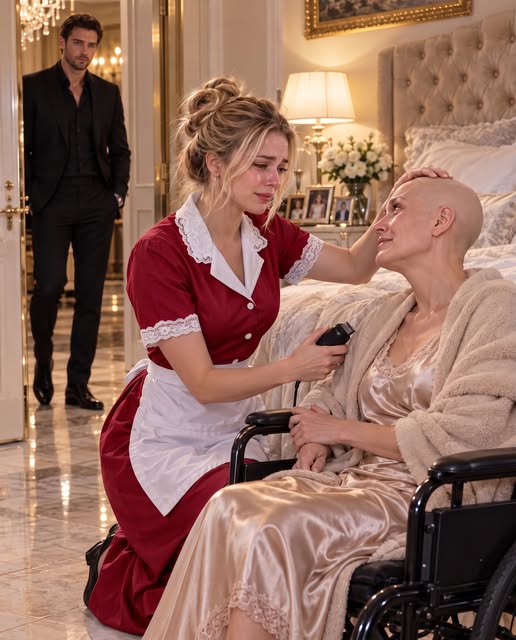
Instead, I thought about Clara shaving Mother’s head.
I thought about the tea.
The sleepless nights.
The towel covered in silver hair.
All the things I’d paid other people to handle because I believed payment was the same as presence.
I had spent years believing power meant never needing anyone.
My father had taught me that.
And without realizing it, I had built my life around the same lesson.
Clara had entered my home looking for justice.
Instead, she had shown my mother kindness.
That difference embarrassed me more than any accusation could have.
But there was still one question.
“What happened to the money?”
Clara looked at me.
“Most of it was recovered.”
I frowned.
“By whom?”
“My mother.”
She explained that Rebecca had secretly moved enough of the remaining records into a private account before she was accused.
She had never spent the money.
She had preserved it as proof.
After her death, Clara had inherited the account and the documents.
“But I never wanted your money,” Clara said.
“Then why stay?”
She looked toward my mother.
“Because she was the first person in this family who admitted my mother had been wronged.”
Mother reached for Clara’s hand.
“I should have done it sooner.”
Clara squeezed it.
“You did it when you could.”
I looked at my mother.
She was tired.
The cancer had taken weight from her face and strength from her hands.
But for the first time in months, she looked peaceful.
I sat beside her.
“Why didn’t you tell me?”
“Because you were already becoming too much like your father.”
That hurt.
More because I knew she wasn’t trying to hurt me.
“I thought money fixed things,” I said.
“No,” Mother replied. “You thought money kept you from having to see them.”
I looked down at my hands.
She was right.
I had hired nurses so I wouldn’t have to sit beside her at night.
I had hired coordinators so I wouldn’t have to listen to doctors.
I had sent gifts when I should have visited.
I had called from meetings and told myself that counted.
And while I was busy paying for everything, Clara had been sitting beside my mother when she was frightened.
I turned to Clara.
“I owe you an apology.”
She shook her head.
“You don’t owe me anything.”
“I do.”
She waited.
“I treated you like an employee when you were the only person in this house acting like family.”
Her expression softened, but she didn’t smile.
“Then don’t apologize,” she said. “Change it.”
That sentence stayed with me.
The next morning, I called my attorneys.
I gave them the folder.
I told them to reopen every record connected to my father’s old companies.
I ordered an independent investigation.
Not one controlled by the Hale organization.
Independent.
If money had been taken from anyone, I wanted it returned.
If records had been falsified, I wanted the truth documented.
If my father had harmed people beyond Rebecca Reed, I wanted their names found.
My attorneys warned me what it could cost.
I told them to continue.
For once, I wasn’t asking what something would cost me.
I was asking what it had already cost someone else.
Within weeks, the investigation uncovered more than I expected.
There were several people my father had deceived.
Some had already died.
Some had spent years believing they were responsible for failures they had never caused.
We could not undo all of it.
We could not give Rebecca another life.
We could not return Clara’s childhood.
But we could stop protecting the lie.
That mattered.
Clara didn’t become part of the Hale family.
She didn’t want that.
She moved out of the servants’ wing and rented a small apartment across town.
She kept working with the investigation.
She also visited Mother every afternoon.
Sometimes they talked.
Sometimes they watched television.
Sometimes they sat together without speaking.
I started coming home earlier.
Not every day.
But often.
I learned which tea Mother liked.
I learned how to adjust the blanket around her feet.
I learned that when she said she wasn’t tired, she usually was.
None of those things were difficult.
That was the part that bothered me.
I’d spent years paying other people to do simple things because I thought my importance made ordinary care beneath me.
One evening, Mother asked me to shave the rest of her hair.
My hands shook when I picked up the razor.
She noticed.
“You’re afraid?”
“Of cutting you.”
She smiled.
“Bennett, I’ve survived your father’s cooking. You’ll manage.”
I laughed.
A real laugh.
The same kind I had heard from her bedroom months earlier.
I turned on the razor.
The machine hummed softly.
Silver hair fell onto the towel.
For a while, neither of us spoke.
Then Mother looked at me through the mirror.
“Do you understand now?”
“Understand what?”
“That love isn’t what you provide.”
I stopped the razor.
She continued.
“It’s what you are willing to stay for.”
I looked at her reflection.
Then I looked down at the towel.
I thought of Clara kneeling beside the wheelchair that Wednesday afternoon.
I had walked away because I didn’t know what I was seeing.
Now I did.
When I finished, Mother touched her bare head and smiled.
“Not bad.”
“High praise.”
She laughed.
Then she reached for my hand.
I held it.
A few months later, the first restitution payments were made to the people identified in the investigation.
Clara refused every offer of personal compensation from me.
Instead, she asked that part of the recovered money be placed into a foundation supporting families dealing with medical debt and wrongful financial claims.
I agreed.
The foundation carried Rebecca Reed’s name.
Clara came to the opening but stood at the back of the room.
When I asked her to speak, she refused.
“She should have had this,” she said.
So we left the microphone empty for a moment.
Not as a performance.
As acknowledgment.
Mother was too sick to attend that day.
She watched the ceremony from her bedroom.
Clara sat beside her.
I came home afterward and found the two of them looking through the old photograph.
The same photograph that had once felt like an accusation now felt different.
It was still painful.
But it was no longer hidden.
Mother handed it to me.
“Keep it.”
I looked at Clara.
“Are you sure?”
She nodded.
“My mother deserves to be remembered for more than what happened to her.”
I placed the photograph in the frame beside Mother’s chair.
Not in my father’s study.
Not locked inside a drawer.
Where we could see it.
Where anyone could ask who the woman was.
Where I would have to answer honestly.
Mother died six weeks later.
She was not alone.
Clara was holding her hand.
I was holding the other.
There were no doctors in the room at that moment.
No accountants.
No assistants.
No hired coordinator telling us what came next.
Just the three of us.
Afterward, I returned to Mother’s bedroom alone.
The wheelchair was still beside the window.
The towel from that last haircut had been folded and placed over the back of the chair.
I touched it gently.
For years, I had believed my family was protected by walls, money, lawyers, and silence.
I finally understood that those things had never protected us.
They had only hidden what we were afraid to face.
I picked up the old photograph from the table.
Rebecca was smiling faintly.
The little girl in her arms was looking directly at the camera.
Clara.
Before she became a maid in my house.
Before she became the person who taught me what presence meant.
Before I understood what my father had taken.
I turned off the bedroom light.
Then I folded the towel, placed it carefully on the chair, and left the door open behind me.