The Lunch Card She Saved for a Hungry Boy Came Back to Her Decades Later
PART 3 (FULL STORY)
My son’s voice came through the phone before I could say anything.
“Mom, we need to talk about the house.”
I looked at Harrison.
He didn’t move.
He simply waited.
I pressed the phone closer to my ear.
“The house?” I asked.
“Yeah,” Ethan said. “We talked about it while you were in surgery.”
I swallowed.
“You talked about my house while I was having heart surgery?”
There was a pause.
“We were trying to be practical.”
Victoria’s voice came from somewhere in the background.
“Mom, don’t make this emotional.”
I almost laughed.
I had spent sixty-four years raising three children who had learned how to recognize when I was being emotional, but apparently none of them had learned how to recognize when they were being cruel.
Julian came onto the call.
“We just need to know what you’re planning to do with the property.”
I looked down at the yellow lunch card resting on my blanket.
For decades, I had remembered the three-dollar lunches more clearly than most things from my childhood.
That card had cost me money.
This conversation was costing me something else.
“I’ve just come out of heart surgery,” I said quietly.
“We know,” Ethan replied.
“And you left because the parking cost twenty dollars.”
Nobody spoke.
Then Victoria said, “It wasn’t just the parking.”
I closed my eyes.
“What was it?”
“We couldn’t sit there all day.”
I opened my eyes again.
“I didn’t ask you to sit there all day.”
“You were going to be fine,” Ethan said.
That sentence stayed with me.
Not because it was cruel.
Because it was so casual.
As if my survival had already been filed away as a certainty.
As if my fear, my pain, and the possibility that I might not wake up were inconveniences that had already passed.
Harrison quietly reached over and turned off the speaker.
“You don’t have to finish this conversation today,” he said.
I looked at him.
For the first time since waking up, I felt something other than abandoned.
I felt tired.
Not physically.
Something deeper.
The kind of tiredness that comes from spending years explaining other people’s behavior to yourself.
I placed the phone on the bedside table.
It rang again.
I didn’t answer.
Harrison opened the folder he had placed beside me.
“I should explain something before you read this.”
I nodded.
“When I became successful, I started looking for you.”
“You did?”
“Every few years.”
He smiled faintly.
“Franklin Elementary had changed names twice. Teachers had retired. Records had disappeared. People remembered you, but nobody knew where you went.”
I looked at the lunch card.
“I wasn’t exactly famous.”
“No,” he said. “You were just kind.”
He removed several sheets of paper from the folder.
“I eventually found you through an old school employee record.”
My eyes moved over the first page.
There was my name.
My maiden name.
My employment history.
And underneath it was a recent hospital admission record.
I looked up sharply.
“How did you get this?”
“The hospital records department contacted me because my foundation sponsors this cardiac wing.”
I stared at him.
“You sponsor this hospital?”
He shook his head.
“I don’t just sponsor the cardiac wing.”
He paused.
“I own the medical group that operates it.”
The statement should have sounded impressive.
Instead, Harrison said it almost apologetically.
“I wasn’t trying to frighten you.”
“You certainly surprised me.”
He smiled.
“I figured I owed you at least one surprise after fifty years.”
Despite myself, I smiled too.
Then his expression became serious.
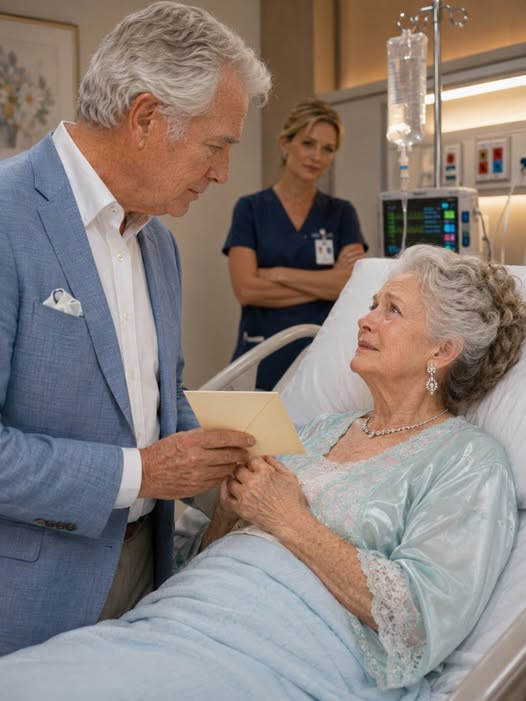
“I also learned that you paid for those lunches yourself.”
My smile disappeared.
“Who told you that?”
“Your old teacher’s aide supervisor.”
I looked toward the window.
“I didn’t want anyone to know.”
“I know.”
He reached into the briefcase again.
This time, he removed a small notebook.
The cover was worn.
The pages were filled with handwriting.
“I wrote down every time you gave me lunch.”
I stared at him.
“Every time?”
“I was a child. I didn’t know why you did it. I only knew that when I was hungry, you made sure I wasn’t.”
He opened the notebook.
There were dates.
Dozens of them.
Some pages had faded.
Some were covered with childish handwriting.
Three dollars.
Three dollars.
Three dollars.
I touched the page.
“You remembered the amount?”
“I remembered everything.”
My throat tightened.
“When I went home, my mother would ask why I wasn’t hungry.”
He smiled sadly.
“She couldn’t afford to feed us properly either.”
I said nothing.
“She worked nights,” he continued. “My father had left. Some days, there simply wasn’t enough.”
I looked down.
“I didn’t know.”
“You weren’t supposed to.”
That was when I finally understood why he had come.
Not because he owned a hospital.
Not because he was wealthy.
Not because he wanted to make some grand gesture.
He had come because a woman who had once noticed a hungry child was now lying alone after heart surgery.
And he couldn’t ignore it.
“What was in the folder?” I asked.
Harrison slid it toward me.
Inside was a letter.
I read the first line.
My hands began shaking.
“I don’t understand.”
“It’s a medical recovery plan,” he said. “Your doctor thinks you should have someone with you for the next several weeks.”
“I can manage.”
“I know you can.”
He smiled.
“But you shouldn’t have to.”
I stared at him.
“I’ve arranged for a nurse to visit you at home.”
“You don’t need to do that.”
“I know.”
He said it so simply that I couldn’t argue.
“I’ve also arranged transportation to your follow-up appointments.”
“Harrison—”
“And there’s one more thing.”
He placed another document on the bed.
I looked at the heading.
A scholarship fund.
Franklin Elementary.
My name was printed beneath it.
I shook my head immediately.
“No.”
“You haven’t even read it.”
“I don’t want my name on anything.”
“Why?”
“Because I didn’t help you so people would remember me.”
“I know.”
He leaned back.
“That is exactly why I put your name on it.”
I looked at him for a long moment.
“What does it do?”
“Every year, children whose families can’t afford school meals will receive lunch support.”
I couldn’t speak.
Harrison looked down at the old yellow card.
“I wanted the first scholarship to be for you.”
I laughed softly through my tears.
“I don’t need a scholarship.”
“No,” he said.
“But you spent money you didn’t have so a child could eat.”
He tapped the card gently.
“I think this is the only way I know how to tell you that it mattered.”
The door opened.
The nurse stepped inside.
Behind her stood Ethan.
Victoria and Julian were a few steps behind him.
All three looked uncomfortable.
Ethan noticed Harrison first.
His eyes moved from Harrison to me.
“Mom?”
I didn’t answer immediately.
Victoria glanced at the folder.
“What’s going on?”
Harrison stood.
“Your mother just came out of surgery.”
“We know.”
“I think she needs rest.”
Ethan frowned.
“Who are you?”
Harrison extended his hand.
“Harrison Vance.”
Ethan shook it automatically.
Then his expression changed.
He recognized the name.
Everyone in Seattle who followed business news knew it.
“The Harrison Vance?”
“Yes.”
Ethan released his hand.
Victoria stared.
Julian looked at the hospital room around him.
Then his eyes landed on the three empty chairs.
No one mentioned the parking fee.
They didn’t have to.
I could see the memory of it settle over them.
Ethan cleared his throat.
“Mom, we’re sorry.”
I looked at him.
“What are you sorry for?”
He glanced at his brother and sister.
“For leaving.”
Victoria spoke quickly.
“We thought you were stable.”
“I was.”
She nodded.
“That’s what we meant.”
I waited.
She didn’t say anything else.
Neither did the boys.
Harrison stepped away from the bed.
“I’ll give you some privacy.”
“No,” I said.
He stopped.
I looked at my children.
“I don’t want privacy.”
They looked surprised.
I had spent years smoothing over uncomfortable moments.
I had been the mother who called first after arguments.
The mother who sent birthday cards even when nobody remembered Mother’s Day.
The mother who explained away missed visits.
The mother who told herself that adult children were busy.
I was tired of doing that.
“I need you to hear something.”
They sat down.
Not because I asked them to.
Because they finally understood that this conversation wasn’t about money.
“I love all three of you,” I said.
Ethan lowered his eyes.
“But love doesn’t mean I have to pretend something didn’t hurt.”
Victoria wiped her cheek.
“I wasn’t asking you for money.”
“I know.”
“I wasn’t asking you to stay all night.”
“I know.”
“I needed you to be there when I woke up.”
Nobody answered.
I looked at the three chairs beside my bed.
“You knew that.”
Ethan’s eyes filled.
“We thought you would understand.”
“I always understand.”
I paused.
“That has been part of the problem.”
The words landed quietly.
No shouting.
No dramatic accusations.
Just the truth.
Julian finally spoke.
“We were scared.”
I looked at him.
He rubbed his hands together.
“I didn’t know what to do.”
“That I can understand.”
He looked relieved.
“But you still left.”
His face fell.
“Yes.”
I nodded.
“That is something you will have to live with.”
Nobody defended themselves after that.
Eventually, they left.
Not because they didn’t care.
At least, I hoped that wasn’t the reason.
They left because I had finally stopped making their discomfort easier for them.
Harrison stayed.
He sat beside the window while I rested.
For a long time, neither of us spoke.
Then I said, “You know, you don’t have to keep visiting me.”
“I know.”
“You have a company.”
“Yes.”
“A hospital.”
“Yes.”
“Probably a thousand things more important than sitting beside an old woman.”
He looked at me.
“You were never an old woman at Franklin Elementary.”
I smiled.
“I was sixteen.”
“You were the person who saved my lunch.”
I looked at the yellow card.
“No.”
He shook his head.
“You saved more than that.”
Several weeks later, I returned to Franklin Elementary.
I wasn’t supposed to walk far.
My doctor had been very clear about that.
But I wanted to see the cafeteria.
Harrison came with me.
The principal had arranged a small gathering.
There were no cameras.
No speeches.
No reporters.
Just children sitting at tables with trays in front of them.
Harrison had funded the meal program.
I had asked that nobody call it after me.
He ignored that request.
A small brass plaque hung beside the cafeteria entrance.
It read:
The Genevieve Sterling Lunch Fund.
I stood there staring at it.
“You really didn’t listen,” I told him.
“No.”
“You were always stubborn.”
“So were you.”
I laughed.
Then one of the children approached us.
She couldn’t have been more than eight.
She looked at Harrison.
Then at me.
“Are you Mrs. Sterling?”
“Yes.”
She smiled.
“Thank you for lunch.”
I felt something break open inside me.
Not pain.
Something warmer.
I crouched carefully beside her.
“You’re welcome.”
She ran back to her table.
Harrison watched her go.
“You see?” he said.
I nodded.
The old yellow lunch card was still in my purse.
I had carried it home from the hospital.
For nearly fifty years, Harrison had kept it because it reminded him of a time when someone saw his hunger and didn’t look away.
Now I understood why he had brought it back to me.
It wasn’t proof of what I had given him.
It was proof that kindness could travel farther than we ever knew.
That evening, when I returned home, I placed the lunch card on the kitchen table beside my hospital wristband.
The wristband reminded me that my heart had nearly stopped.
The lunch card reminded me why it had kept going.
And for the first time in a long while, the house did not feel empty.