The Little Girl Behind the Door That Changed Everything I Believed About My Father
PART 3 (FULL STORY)
The knock came again, harder this time.
Lily instinctively moved closer to the bed.
I looked at Sarah, but she was already struggling to sit upright.
“Who is it?” I asked.
No answer.
Another knock.
Then a man’s voice came through the door.
“Sarah, I know you’re in there.”
The color drained from her face.
Lily grabbed the edge of my coat.
“Don’t open it.”
I looked down at her.
“Who is he?”
“My grandfather,” she whispered.
The word landed strangely.
I turned toward Sarah.
She closed her eyes.
“Not your grandfather,” she said quietly. “Not the way he wants you to believe.”
I walked toward the door.
The eviction notice was still inside my coat.
For the first time that day, I forgot completely about the rent.
I opened the door only a few inches.
An older man stood in the hallway wearing an expensive gray coat.
His hair was white now, but there was something familiar about the shape of his face.
He stared at me.
For several seconds, neither of us spoke.
Then his eyes widened.
“Nathan.”
I knew him.
Not from some recent encounter.
From photographs.
From the few memories my mother had allowed herself to keep.
My father’s name was Daniel.
And this was his older brother, Robert.
“What are you doing here?” he asked.
“I own the building.”
Robert’s expression changed.
Then he glanced past me toward Sarah.
“You need to leave.”
I almost laughed.
“You’re giving me orders in my own property?”
“I’m trying to protect you.”
“From what?”
He didn’t answer.
I opened the door wider.
Robert took one step forward.
I blocked him.
Behind me, Lily was watching.
“She said you were her grandfather.”
Robert’s jaw tightened.
“Sarah has been sick for a long time.”
“That doesn’t answer my question.”
He looked at the little girl.
“Lily is my son’s child.”
“My son?”
“Daniel.”
The hallway seemed to tilt beneath me.
I stared at him.
“My father?”
Robert nodded.
“Your father had another child?”
“No.”
He swallowed.
“Your father had two.”
I turned toward Sarah.
She was crying silently.
Thirty years of memories suddenly felt incomplete.
My father had always been described to me as a man who disappeared.
A coward.
A man who abandoned my mother when money became tight.
But Sarah was looking at me as if she had been waiting decades for this exact moment.
“Tell him,” Robert said.
Sarah shook her head.
“You’ve lied long enough,” he snapped.
Then he looked at me.
“Daniel wasn’t your biological father.”
I couldn’t breathe.
Robert continued before I could speak.
“Your mother was pregnant when she met him.”
Sarah whispered, “Stop.”
But he didn’t.
“Daniel married her anyway.”
I stared at Sarah.
She looked exhausted, but she forced herself to meet my eyes.
“Your mother was afraid,” she said.
“Afraid of what?”
“Of losing you.”
She reached toward the bedside table.
Her hand trembled as she pulled out a small metal box.
“I kept this because I didn’t know what else to do.”
She opened it.
Inside was an old photograph, folded letters, and a tiny hospital bracelet.
My name was written on the bracelet.
Nathan.
I picked up the photograph.
It showed my mother standing beside a young man I had never seen before.
He was holding a baby.
Me.
On the back, in my mother’s handwriting, were four words.
“He saved our lives.”
I looked at Sarah.
“Who was he?”
She swallowed.
“Daniel.”
The room became very quiet.
Robert looked away.
Sarah continued.
“Your father wasn’t the man you thought he was.”
I sat beside the bed.
For thirty years, I had carried anger toward a man I believed had abandoned us.
But the truth was more complicated.
Daniel had not left because he didn’t care.
He had left because Robert had threatened to destroy him if he stayed.
“Why?” I asked.
Sarah looked at Robert.
He finally lowered his head.
“Because our family business was failing,” Robert said.
“Daniel wanted to sell his share and give the money to your mother.”
“You stopped him.”
“I was trying to save the company.”
“You threatened him.”
Robert said nothing.
Sarah wiped her cheek.
“Daniel gave us what little money he had and disappeared before Robert could find him.”
I looked at the photograph again.
“Then how did you know me?”
Sarah took a slow breath.
“Daniel came to see you once.”
“When?”
“When you were seven.”
My chest tightened.
I remembered a man standing across the street from our apartment.
My mother had pulled the curtains shut.
She had told me never to speak to him.
I had spent years wondering who he was.
Now I knew.
“He came back,” Sarah said.
“But he was sick.”
She paused.
“He died three days later.”
Robert looked toward the floor.
“I found out afterward.”
I couldn’t speak.
Lily climbed onto the edge of the bed.
“Mom says he was kind.”
Sarah smiled faintly.
“He was.”
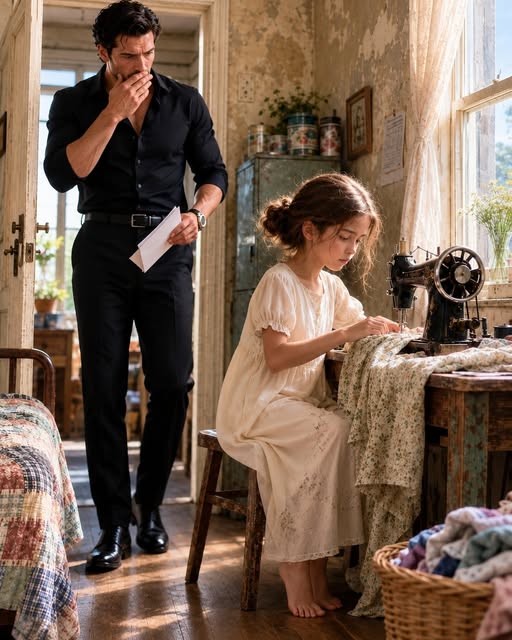
I looked at the sewing machine in the living room.
The blood on Lily’s finger.
The forty dollars in the envelope.
The empty medicine boxes.
“Why didn’t you ask me for help?”
Sarah looked ashamed.
“Because I knew you were the landlord.”
That answer hurt more than anything else.
“You thought I would throw you out.”
She nodded.
“I had seen what happened to people who couldn’t pay.”
I looked at the eviction notice inside my coat.
For years, I had believed rules protected people.
Sometimes they did.
Sometimes they simply protected the people who could afford to enforce them.
I took the notice out.
Robert watched me.
“What are you going to do?”
I tore it in half.
Then I tore it again.
Lily stared at the pieces falling into my hand.
“Does that mean we can stay?”
“Yes.”
Her shoulders dropped for the first time since I had entered the apartment.
“But that’s not enough,” I said.
Sarah looked at me.
“I want you to move into one of my vacant apartments.”
She immediately shook her head.
“I can’t accept charity.”
“It’s not charity.”
She waited.
“It’s repayment.”
“For what?”
“For the thirty years my family made you carry a burden that wasn’t yours.”
Robert stepped toward me.
“Nathan, don’t make decisions while you’re emotional.”
I turned to him.
“You had thirty years to make yours.”
He stopped.
I picked up the old photograph again.
There was one thing I still couldn’t understand.
“If my father knew where we were, why didn’t he come back?”
Sarah looked toward the window.
“He did.”
I waited.
“Several times.”
My anger returned, sharp and immediate.
“Then why didn’t I know?”
“Because I asked him not to.”
I stared at her.
She began to cry.
“Every time he came, you were sleeping.”
She pointed toward the hallway.
“Your mother couldn’t bear to let you see him leave again.”
I sat there for a long time.
There was no dramatic apology that could repair thirty years.
No sentence that could make a child understand why the adults around him had made the choices they did.
But there was something I could finally do.
I could stop repeating the same mistake.
I helped Sarah gather her medicine.
Lily folded the fabric beside the sewing machine.
When she reached for the needle, I gently took it from her.
“You don’t have to work tonight.”
She looked at me.
“But we need money.”
“You need to be seven.”
She didn’t understand.
Maybe she shouldn’t have to.
I found a local seamstress who could give Sarah proper work once she recovered.
I arranged for the medical bills to be reviewed.
And I made sure Lily had a school uniform before Monday.
I didn’t announce any of it.
I simply did it.
Robert left without another argument.
At the door, he stopped.
“Your father would have been proud of you.”
I looked at him.
“I don’t know if I deserve that.”
“You do.”
Then he walked away.
Months passed.
Sarah’s condition stabilized after treatment.
She still had difficult days, but she was no longer hiding behind a locked bedroom door.
Lily went back to school.
The sewing machine stayed in the apartment, but she no longer used it to survive.
She used it sometimes because she loved making things.
One afternoon, I came by to check on them.
Lily ran to the door carrying a small piece of fabric.
“I made this for you.”
It was a simple hand-sewn patch.
A little crooked.
One corner had a tiny red stain that hadn’t completely washed out.
I smiled.
“Where should I put it?”
“On your coat.”
I attached it carefully to the inside of my coat, where the eviction notice had once been.
I had spent most of my life believing the hardest thing about being poor was not having enough money.
I was wrong.
Sometimes the hardest thing was believing nobody would care when you couldn’t pay.
Lily had believed that.
Sarah had believed that.
And, in a different way, so had I.
That evening, as I left their apartment, I looked back through the open door.
The old sewing machine sat quietly beside the window.
For the first time, there was no blood on Lily’s fingers.
No eviction notice in my pocket.
Just a small piece of crooked fabric sewn inside my coat, covering the place where I had once carried a piece of paper that told a family they had nowhere left to go.
I touched the patch once before walking downstairs.
Then I kept going.