The Judge Said a Blind Man Couldn’t Read Music FULL STORY
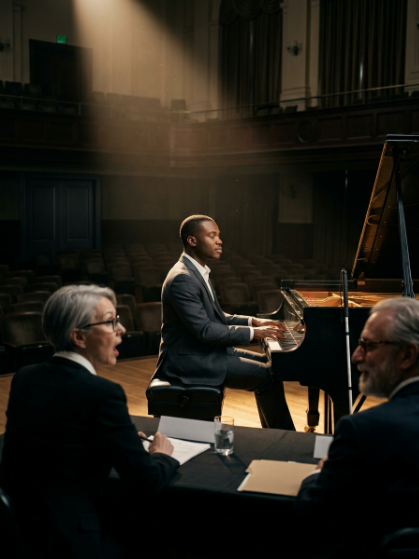
I played the sonata the way I’d promised—calling out the measures and the page numbers as I went.
“Measure forty, top of page three. The development begins here.”
My voice was steady between the phrases. The notes never wavered.
I’d memorized the entire score in braille months ago, then matched every braille page to the printed page numbers a sighted friend read aloud to me, dozens of times, until the map of it lived in my hands. So when Vivian Carr said a blind man couldn’t read music, she was right about exactly one thing and wrong about everything that mattered.
I can’t see a page. I never said I could.
But I know that score better than anyone in that room who can.
I reached the end of the first movement and lifted my hands. The last chord hung in the air and then dissolved into a silence so complete I could hear someone’s chair creak in the back.
Nobody spoke.
Then the older judge—the one with the silver beard and the tinted glasses who hadn’t said a word—started to clap. Slow. Deliberate.
“Vivian,” he said. “I think we can dispense with the question of whether the young man can read music.”
“Professor Stein,” she started, “the protocol—”
“The protocol,” he said gently, “was written by people who assumed reading happens only through the eyes.”
And then he did something I didn’t expect. He stood, came around the table, and walked toward the piano—and I heard the unmistakable tap of a white cane against the floor.
Professor Aaron Stein. I knew the name, of course. Half the modern repertoire I’d grown up on had his fingerprints on it. What I hadn’t known—what almost no one knew, because he never made it his headline—was that he’d been blind for the last twenty years of his career.
“I composed three symphonies after I lost my sight,” he said, to the panel, but really to me. “A great many people told me what I could no longer do. I found it useful to let them keep talking while I worked.”
He turned toward where he knew I was sitting.
“Young man. The piece you opened with. You wrote it?”
“Yes, sir.”
“Tell me about the second theme. The one that climbs and then refuses to resolve.”
“My mother,” I said. “She used to say my hands could see what my eyes couldn’t. I wrote it the year she died. It doesn’t resolve because she didn’t get to hear how it ends.”
The hall was very quiet again.
“It resolves,” Professor Stein said. “You just played the resolution. You finished it for her, right now, in front of all of us.”
I hadn’t cried during the audition. I came close then.
Here’s what I learned afterward.
The “skeptical judge” routine wasn’t entirely Vivian Carr being cruel, though she’d leaned into it more than she should have. Professor Stein had asked the panel, privately, to push hard on every finalist—to find the ones who would fold and the ones who wouldn’t. He believed the conservatory had spent years admitting talented students who crumbled the first time someone doubted them.
He hadn’t expected the test to land on a blind kid being told he couldn’t read music. When it did, he let it run, because he wanted to see what I’d do.
What I did was play.
I got the scholarship. The last chair. Unanimous, in the end—even Vivian Carr, who found me in the hallway after and said, stiffly, that she’d been wrong, and that she didn’t say that often. I believed her on both counts.
But the bigger thing came later.
Professor Stein took my case to the conservatory’s board. The braille-score situation that had nearly sunk me—the assumption baked into the “protocol” that musicianship is proven by sight-reading from a printed page—he had it rewritten. The school now provides braille and audio scores for auditions as a standard accommodation, not a special favor. The next blind student who walks in won’t have to prove they’re allowed to exist before they’re allowed to play.
They named the policy after the audition, not after me. Stein insisted on that. “It’s not about you,” he said. “It’s about everyone who comes after you and never has to hear that sentence.”
I study under him now.
He still pushes me harder than anyone. He still lets people underestimate him in meetings and then quietly dismantles their assumptions one bar at a time. I’m learning that from him too—not the music, the patience.
Sometimes, after a lesson, he asks me to play the piece I wrote for my mother.
I always do.
And every time I reach that second theme, the one that climbs and used to refuse to resolve, I let it land now.
For her. For the kid in the doorway who heard he couldn’t.
For the next one who won’t.