The Headline That Made My Family Beg For My Attention Six Months Later
PART 3 (FULL STORY)
The headline read: “Local Widow Creates Foundation in Memory of Husband and Children, Raises Millions for Highway Safety.”
For a few seconds, I simply stared at the screen.
Then I understood why my phone was exploding.
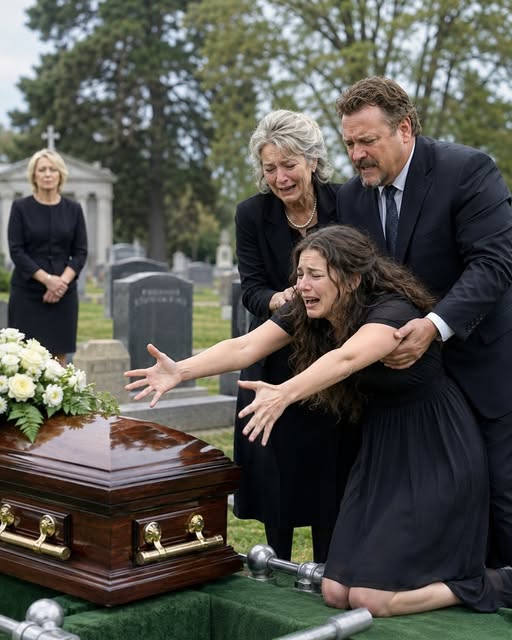
Six months earlier, I had stood beside three caskets and looked across an almost empty section of the church.
My parents had chosen Eleanor’s birthday dinner.
They had made their choice clearly.
So I had stopped asking them to choose me.
After the funeral, I went home to a house that still looked like my family had only stepped out for the afternoon.
Julian’s jacket hung behind the bedroom door.
Maya’s purple backpack was still beside the stairs.
Leo’s favorite toy truck sat upside down beneath the coffee table.
I couldn’t bring myself to move any of it.
For weeks, I barely functioned.
But Aunt Ruth kept coming.
Sometimes she brought food.
Sometimes she sat silently across from me.
Sometimes she helped me open envelopes because there were days when seeing Julian’s name printed on another document made my hands stop working.
One evening, she found me sitting on the floor of Leo’s bedroom.
“I keep thinking I should have been in that car,” I told her.
She sat beside me.
“No,” she said quietly.
“You keep thinking that because your mind needs somewhere to put the blame.”
I looked at the little bed.
“I wasn’t there.”
“That doesn’t make you responsible.”
I didn’t answer.
She stayed.
That became our pattern.
Slowly, I started dealing with the things that had to be dealt with.
The investigation into the crash had confirmed what the police initially suspected.
The truck driver had fallen asleep.
There had been no time for Julian to react.
The accident wasn’t something he could have prevented.
Neither could I.
But knowing that didn’t make the house any less empty.
A month after the funeral, I received the final settlement paperwork.
I almost ignored it.
Then I remembered something Julian had once told me.
We had been driving home after Maya’s school fundraiser, and we passed a terrible accident on the interstate.
Julian had slowed down while emergency vehicles moved around the wreckage.
“People think accidents are just bad luck,” he had said.
“What do you think?”
He shrugged.
“I think sometimes one small thing decides whether someone gets home.”
I remembered that sentence for weeks.
Then I began reading.
I studied highway safety reports.
I read about driver fatigue.
I learned how often crashes involving sleeping truck drivers occurred.
I spoke with people who had lost relatives in similar accidents.
One woman told me her husband had died when a fatigued driver crossed into his lane.
Another had lost a teenage daughter.
The stories were different.
The ending was always the same.
Someone was driving home.
Someone never arrived.
I decided I couldn’t bring Julian, Maya, or Leo back.
But maybe I could keep another family from receiving the phone call I had received.
I used part of the settlement to establish a small nonprofit focused on driver fatigue awareness, highway safety education, and emergency support for families affected by fatal crashes.
I named it the Vance Family Safety Foundation.
I didn’t tell my parents.
I didn’t tell Eleanor.
I didn’t tell anyone who had stood outside my grief and decided it wasn’t important enough to interrupt a birthday dinner.
I wasn’t trying to punish them.
I simply stopped giving people access to parts of me they had shown they didn’t value.
At first, the foundation was tiny.
Aunt Ruth helped me organize the first fundraiser.
A few friends from Julian’s workplace donated.
His parents contributed quietly.
Then a local reporter heard about the program.
One interview became another.
A highway safety organization contacted me.
Then a national transportation group offered to partner with us.
Within months, donations began arriving from across the country.
We funded rest-area education campaigns.
We helped families with emergency expenses after fatal crashes.
We worked with trucking companies on fatigue-awareness programs.
I spent my days surrounded by statistics, paperwork, meetings, and people who understood exactly what it meant to lose someone without warning.
It didn’t erase my grief.
Nothing could.
But for the first time since the funeral, I had a reason to get out of bed that wasn’t simply survival.
Then came the morning the headline appeared.
The foundation had just received a major corporate donation, bringing the total raised to several million dollars.
A reporter wrote a feature about the organization.
My photograph appeared beside the article.
Under it was my full name.
Sienna Vance.
Widow.
Mother.
Founder.
The article mentioned that I had personally funded the foundation’s first programs.
It mentioned the settlement.
It mentioned the scale of the organization.
And, apparently, it mentioned that I had not spoken publicly about my family since the funeral.
That was enough.
My mother called first.
I watched her name flash across my screen.
I didn’t answer.
She called again.
Then again.
By noon, she had called seventeen times.
My father called nine.
Then Eleanor.
Her voicemail was almost impossible to understand because she was crying.
“Sienna, please call me.”
I deleted it.
A few minutes later, my father called again.
This time, I answered.
“Hello?”
There was a pause.
“Sienna.”
His voice sounded different.
Not distracted.
Not calm.
Careful.
“What do you want?”
“We saw the article.”
“I assumed you did.”
“We didn’t know.”
I looked at the framed photograph on my desk.
It showed Julian holding Maya while Leo stood between them, grinning at the camera.
“You didn’t know what?”
“That you were doing all this.”
I almost laughed.
“You didn’t ask.”
My father went quiet.
Then he said, “Your mother wants to see you.”
“No.”
“Sienna—”
“No.”
“This is still your family.”
I looked down at the headline on my screen.
Six months earlier, my husband and children had died.
My father had told me he couldn’t attend their funeral because it was Eleanor’s birthday.
Now he suddenly remembered the word family.
“You made your decision six months ago,” I said.
“We were wrong.”
The words surprised me.
Not because they were impossible.
Because they were six months too late.
“Dad, you weren’t confused.”
“I know.”
“You weren’t busy.”
“I know.”
“You chose Eleanor.”
He didn’t argue.
“Yes.”
That one word hurt more than an excuse would have.
At least it was honest.
“What changed?” I asked.
He hesitated.
“The article.”
I closed my eyes.
There it was.
Not grief.
Not regret.
The headline.
“You saw that I had money.”
“No.”
“You saw that people knew my name.”
“That isn’t why—”
“You saw something worth coming back for.”
He didn’t answer.
That silence told me enough.
Then my father said something I hadn’t expected.
“Your sister wants to apologize.”
I felt the old ache return.
“Eleanor?”
“Yes.”
“For what?”
“For the funeral.”
I waited.
“She says she should have gone.”
I pictured my sister six months earlier, surrounded by birthday decorations while I stood beside three caskets.
“She should have.”
“She knows that now.”
“No,” I said.
“She knows it now because a newspaper article made me important.”
My father didn’t respond.
Then I heard my mother’s voice in the background.
“She just wants her daughter back.”
I almost broke at that.
Not because I wanted to believe her.
Because part of me still did.
That was the dangerous part.
Grief had made me vulnerable to the smallest piece of love.
But love wasn’t supposed to appear only after your name became valuable.
“I’ll meet you once,” I said.
My father exhaled.
“Thank you.”
“Not at your house.”
“Where?”
“Julian’s parents’ house.”
He went silent.
“Why there?”
“Because they were there.”
I hung up.
Two days later, my parents arrived.
Eleanor came with them.
When the door opened, I barely recognized my mother.
She looked older.
My father looked exhausted.
Eleanor had red eyes.
Nobody spoke at first.
Julian’s parents were sitting in the living room.
Aunt Ruth stood beside me.
My mother took one step forward.
“Sienna.”
I didn’t move.
She started crying.
“I am so sorry.”
I believed that she was sorry.
I just didn’t know what she was sorry for.
My father spoke next.
“We failed you.”
I nodded.
“Yes.”
Eleanor wiped her face.
“I was selfish.”
“Yes.”
She looked at me as if she had expected me to deny it.
“I thought everyone would understand because it was my birthday.”
“You were twenty-nine,” I said.
She lowered her eyes.
“My children were dead.”
“I know.”
“No,” I said.
“You know now.”
Nobody corrected me.
Aunt Ruth finally spoke.
“She called me the night of the funeral.”
My mother looked at her.
“Ruth—”
“She asked whether Sienna had anyone with her.”
Aunt Ruth’s voice remained calm.
“I drove six hours because I knew she shouldn’t be alone.”
My father looked down.
His shoulders seemed smaller than I remembered.
“We should have been there,” he said.
“Yes.”
“We can’t change it.”
“No.”
“I wish we could.”
I believed that too.
But forgiveness isn’t the same thing as pretending something didn’t happen.
My mother reached for my hand.
I let her touch it for one second.
Then I gently pulled away.
“I don’t hate you.”
She began crying harder.
“But I don’t trust you.”
That sentence finally made Eleanor look directly at me.
I continued.
“I spent six months learning how to live without you.”
My father nodded slowly.
“I know.”
“And I don’t want you coming back because you saw my name in a newspaper.”
“We don’t.”
I looked at him.
“Then prove it.”
He didn’t ask how.
He understood.
The foundation had recently begun a scholarship program for children who had lost parents in highway crashes.
I told my family they could volunteer.
Not as members of my board.
Not as people whose names would appear beside mine.
Just volunteers.
If they wanted to help, they could show up where people were hurting.
They could sit with grieving families.
They could carry boxes.
They could make phone calls.
They could do the work without expecting anything from me.
My father agreed.
My mother agreed.
Eleanor cried and said she would do whatever I asked.
I didn’t tell them that I didn’t know whether I would ever call them Mom and Dad again.
That wasn’t something I could promise.
Weeks passed.
Then months.
My father began volunteering at one of the foundation’s driver-safety events.
My mother started helping families fill out emergency assistance forms.
Eleanor worked with the scholarship program.
None of them mentioned the money.
None of them asked for publicity.
And slowly, something changed.
Not the past.
The past stayed exactly where it belonged.
But their behavior became different.
One afternoon, I visited the foundation’s office and found Eleanor packing school supplies into boxes.
She looked up.
“I know this doesn’t fix anything.”
“No,” I said.
She nodded.
“I know.”
I sat beside her.
For a while, we packed in silence.
Then she said, “I still think about that birthday.”
I stopped.
“So do I.”
“I hate that I cared about dinner more than your children.”
I looked at her.
“I don’t want you to hate yourself.”
She looked surprised.
“Then what do you want?”
I thought about it.
“I want you to remember.”
She nodded.
“I will.”
That was all I needed.
Not a dramatic apology.
Not tears in front of an audience.
Not a family photograph pretending nothing had happened.
Just remembrance.
A year after the accident, we held a memorial event beside the highway where Julian, Maya, and Leo had died.
There were flowers.
Photographs.
Families holding candles.
Truck drivers standing quietly in the crowd.
A small sign carried the foundation’s name.
At the end of the ceremony, I placed three flowers beneath a photograph of my family.
One for Julian.
One for Maya.
One for Leo.
Then I stepped back.
My father stood several feet away.
He didn’t approach until I looked at him.
He didn’t ask for a hug.
He didn’t ask whether I forgave him.
He simply stood there.
I nodded once.
He nodded back.
That was enough.
I walked home later with Aunt Ruth.
The evening was cold.
When I opened my front door, the house was still quiet.
Julian’s jacket was no longer behind the bedroom door.
Maya’s backpack was gone from the stairs.
Leo’s toy truck had been cleaned and placed on a shelf.
I picked it up.
For a moment, I could almost hear his little voice telling me it was his favorite.
I held the truck against my palm.
Then I placed it beside the framed photograph of the three of them.
The headline that had brought my family back into my life was still saved on my computer.
I never printed it.
I never framed it.
It wasn’t the headline that mattered.
It was what happened after it.
I had lost three people I would have given anything to keep.
I had also learned that family isn’t defined by who shares your blood.
Sometimes it is the person who drives six hours because you shouldn’t have to stand alone.
Sometimes it is the person who stays when there is nothing to gain.
And sometimes, if you are very lucky, it is the people who finally understand what they almost lost and spend the rest of their lives proving they understand.
That night, I turned off the lights and left the little toy truck on the shelf.
For the first time, I didn’t move it back to Leo’s room.
I let it stay there.
I closed the door gently and walked away.