The Golden Recipe – Full Story
The golden light from the book pulsed, casting long, warm shadows across the white subway tiles of the bakery. The smell of fresh sourdough suddenly felt heavy, charged with something ancient and electric.
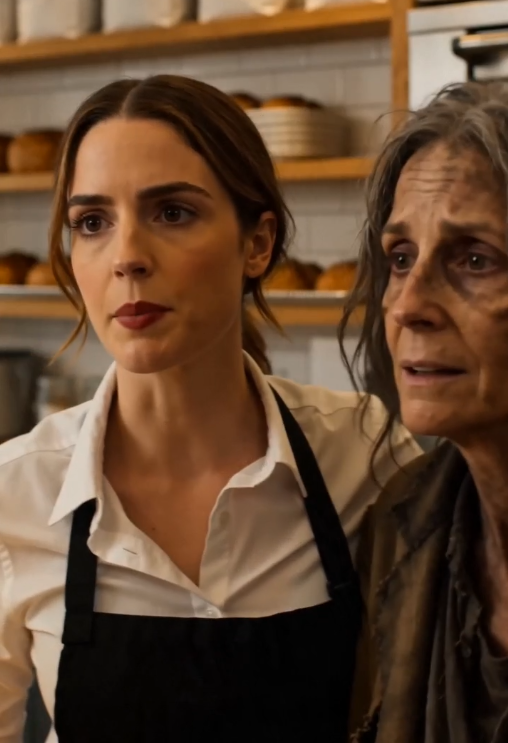
Elyse Jane didn’t smile. She just looked at Thomas, her eyes a striking, clear blue amidst the deep wrinkles of her weathered face.
“I told you I’d come back when the bread was ready,” she said. Her voice was raspy, like dry leaves scraping across pavement, but it carried perfectly in the quiet shop.
Thomas closed the book slowly. The golden text faded, but the impression of the name remained burned into the thick parchment. He stepped around the counter, ignoring the flour on his black apron. He stopped a few feet from her.
“We tried, Elyse,” Thomas said, his voice cracking. “For fifty years, my father tried. And then I tried. We followed the book. We followed the ratios. But the crust… it never sang.”
Elyse looked at the loaf in the display case. The glowing flour had settled back onto the dark, blistered crust.
“You followed the words,” she said softly. She reached out and tapped the glass. “But you didn’t listen to the dough.”
I stood frozen behind the counter. My mind was racing. Elyse Jane. The ghost of the bakery. The woman who had written the original ledger in 1974 and then disappeared without a trace, leaving the business to her sous-chef. I had spent my entire culinary career studying her techniques. And she was standing right in front of me, smelling like rain and old dust.
“Show me,” I blurted out.
Both Thomas and Elyse looked at me. I stepped out from behind the register, wiping my hands on my apron.
“Show me what I did wrong,” I said. My voice didn’t shake. “Please.”
Elyse studied me for a long moment. She looked at my flour-dusted hands, the burns on my forearms, the desperate, earnest look in my eyes. Slowly, she nodded.
“Open the case,” she said.
I unlocked the glass door. The warm, yeasty air rushed out. Elyse reached in. Her hands, though gnarled and trembling, moved with a sudden, fluid grace. She picked up the Heritage Loaf.
She didn’t use a knife. She just pressed her thumbs into the center of the crust. With a sharp, satisfying CRACK, the bread split open. The crumb inside was perfect. Open, airy, glistening with moisture. The smell was intoxicating—earthy, tangy, and deeply complex.
But there was something else. As the bread opened, a faint, golden shimmer rose from the steam.
“You used the commercial yeast,” Elyse said, looking at me. “The book tells you to use the starter. But it doesn’t tell you how to feed it.”
She reached into the pocket of her tattered coat. She pulled out a small, glass jar. Inside was a thick, grayish paste. It looked like wet cement.
“The original starter,” she said. “I’ve kept it alive. It needs to be fed with rye flour and a drop of honey every day at midnight. Not morning. Midnight.”
Thomas gasped. “Midnight? The book says dawn.”
“The book was written to protect the recipe from thieves,” Elyse said, a small, sad smile touching her lips. “Only the true baker knows the rhythm of the dough.”
She handed the jar to me. The glass was warm against my cold fingers.
“I’m tired, Thomas,” she said, looking around the bakery. The morning sun was streaming through the front windows, illuminating the dust motes dancing in the air. “I’ve walked a long way. I just wanted to see if my bread was still alive.”
“It is,” Thomas said. He stepped forward and gently took her arm. “And so are you. You’re coming home, Elyse.”
He led her to a small table in the corner, away from the prying eyes of the street. I watched them go, holding the small glass jar. I looked down at the open loaf on the counter. The golden shimmer was fading, but the smell remained.
I walked back to the kitchen, tied my apron tight, and reached for the rye flour. I had a lot of work to do before midnight.