The Fortune My Husband Thought I Had Given Away
PART 3 (FULL STORY)
The door opened before Raymond could finish his sentence.
Brendan stood in the doorway, one hand still resting on his loosened tie, with Samantha a few steps behind him. His eyes moved from my face to the small white urn inside Chloe’s crib.
For once, he didn’t have an immediate answer.
Then his expression hardened.
“You actually brought her back here?”
I looked at the urn.
“I brought our daughter home.”
He glanced toward Samantha as if expecting her to rescue him from the conversation. She looked away.
Brendan stepped into the room.
“Where are her things?”
I stared at him.
“Why?”
“Because the room needs to be cleared. My mother wants it converted into a guest room.”
I waited for the anger to come.
It didn’t.
Three days of watching Chloe’s tiny body disappear beneath a white hospital sheet had taken something from me that Brendan couldn’t reach anymore.
“Of course,” I said.
He seemed almost relieved.
“Good. I’ll have someone come tomorrow.”
I nodded.
Then I reached for the old phone still pressed against my palm.
Raymond was waiting on the line.
“Start with the accounts,” I said.
Brendan frowned.
“What accounts?”
I looked directly at him.
“You’ll find out.”
His face changed.
Not much.
Just enough.
“You’re talking nonsense.”
“Maybe.”
Samantha finally spoke.
“Brendan, we should go.”
He ignored her.
“You’ve been sitting in this room all day. You’re grieving. You don’t know what you’re saying.”
I almost laughed.
He had mistaken silence for weakness for so long that he couldn’t recognize the difference.
“I know exactly what I’m saying.”
I ended the call.
Brendan watched me carefully.
Then he left.
Samantha followed him.
Neither of them noticed that I had already taken the first step out of the life they had built around controlling me.
That night, I sat on the floor beside Chloe’s crib until the house became quiet.
At 11:42 p.m., the old phone vibrated.
One message.
Secure connection established. Check your email.
I opened my laptop.
There was one encrypted file from Raymond.
Its first page contained a list of Fairchild companies, trusts, holding entities, and transfers I had never seen.
I scrolled.
Then I stopped.
At the bottom of the page was a note written by my father three years earlier.
If Nora is reading this, assume the marriage failed for reasons she does not yet understand.
My hands tightened around the laptop.
The next page contained instructions.
My father had known Brendan’s family was deeply involved in private investment structures, but he had never believed their wealth was as simple as the public record suggested.
Before my wedding, he had quietly hired Raymond to examine the Fairchild organization.
The investigation had uncovered layers of companies owned through trusts and shell entities.
At first, my father thought the structure was designed for ordinary tax and asset planning.
Then Raymond found unusual transfers.
Money was moving between Fairchild-controlled companies and accounts associated with vendors, consultants, and charities.
Several of the transactions were connected to expenses listed as family medical costs.
My stomach tightened.
Chloe.
I opened the next document.
There were invoices.
Hospital invoices.
Medication invoices.
Payments authorized through Ximena’s office.
Except some of the amounts did not match the hospital records.
A medication billed to the Fairchild family trust had never been purchased.
A home-care service had been invoiced for weeks when the provider’s own records showed only a few visits.
And one emergency medical payment had been listed as approved by Brendan.
I knew that one.
It was the medication Ximena had refused.
I read the line again.
Payment authorized: approved.
But I had never received it.
My hands started shaking.
I called Raymond.
He answered almost immediately.
“What am I looking at?”
“The preliminary audit.”
“You knew?”
“I suspected.”
“Why didn’t you tell me?”
“Because your father instructed me not to contact you unless you activated the phone yourself.”
I closed my eyes.
“He thought Brendan was stealing from me?”
“Your father thought something more complicated was happening.”
Raymond paused.
“He believed the Fairchilds had created a financial system designed to make you appear dependent while moving assets away from your control.”
I looked toward Chloe’s crib.
“Why?”
“Because your father discovered something else.”
A file appeared in my inbox.
I opened it.
My maiden name appeared across the first page.
Not Brendan’s.
Mine.
My father had never told me that he had transferred several investment interests into a protected family trust before my marriage.
The trust had been created in my name.
I had been told only that my father wanted to make sure I would always have something independent of any husband.
But the documents showed something I had never known.
The trust owned a substantial minority position in a private holding company that had quietly invested in several Fairchild subsidiaries.
My father hadn’t married me into the Fairchild family.
He had made sure the Fairchild family had unknowingly become dependent on mine.
I sat motionless.
Then Raymond said the sentence that changed the entire situation.
“Brendan doesn’t know that your father’s trust is one of the largest beneficial owners behind the financing keeping his family’s company afloat.”
I looked at the documents again.
“Then why has he been controlling my money?”
“He hasn’t been controlling your money.”
Raymond’s voice was calm.
“He has been controlling what you were allowed to see.”
The distinction was devastating.
For three years, I had believed I was living on Brendan’s generosity.
In reality, I had been living inside a financial structure that had been deliberately hidden from me.
The next morning, Brendan came downstairs while I was drinking coffee.
He looked tired.
“You need to start packing.”
I put down my cup.
“Packing?”
“My mother thinks you should stay somewhere else for a while.”
“Your mother?”
“She says the house needs time to recover.”
I almost smiled.
“The house?”
He rubbed his forehead.
“Nora, don’t make this harder.”
I looked at him.
“Did you pay for Chloe’s medication?”
His expression changed.
“What kind of question is that?”
“Did you?”
“I authorized her treatment.”
“No.”
He stared at me.
“You don’t know what you’re talking about.”
“I know the hospital never received the payment listed under your authorization.”
His face tightened.
“Who told you that?”
“That’s not important.”
“It is if you’re making accusations.”
I stood.
“Then tell me where the money went.”
He said nothing.
That silence was the first honest answer he had given me in years.
His sister entered the room.
She looked between us.
“What happened?”
Brendan turned toward her.
“Nothing.”
I looked at both of them.
“Not yet.”
That afternoon, Raymond arranged for me to meet him at his office.
I carried Chloe’s medical records with me.
He spread the audit across a conference table.
“The medical expenses were only one part,” he said.
He showed me transfers involving Fairchild Logistics, Fairchild Capital, and several smaller companies.
Some were legitimate.
Others were not.
The pattern was consistent.
Money moved out of operating companies through consulting contracts and inflated vendor payments, then appeared in private accounts connected to people close to Brendan’s family.
One name appeared repeatedly.
Samantha Hayes.
I stared at it.
“She knew?”
“Possibly.”
“Was she receiving money?”
“Indirectly.”
Raymond showed me another file.
Samantha’s company had been paid for consulting work that had no obvious deliverables.
The payments had started months before Brendan and I married.
That made me pause.
“Then this isn’t about her.”
“No.”
Raymond closed the file.
“She may be part of it, but she isn’t the center.”
“Who is?”
“Your husband.”
I looked down at Chloe’s medical records.
“What do we do?”
Raymond answered without hesitation.
“We preserve everything.”
He explained that we couldn’t simply accuse Brendan publicly.
We needed evidence gathered properly.
Bank records.
Invoices.
Corporate filings.
Emails.
Internal authorization logs.
Medical records.
And proof that the financial decisions surrounding Chloe had been deliberately manipulated.
He also told me something else.
“We have reason to believe your father anticipated that the Fairchilds might try to challenge your ownership.”
“So what happens?”
“Nothing until we force them to show their hand.”
I went home before sunset.
Brendan was waiting in the living room.
His mother and sister were there too.
Samantha was standing near the window.
I stopped.
“You’re here?”
She looked uncomfortable.
Brendan stood.
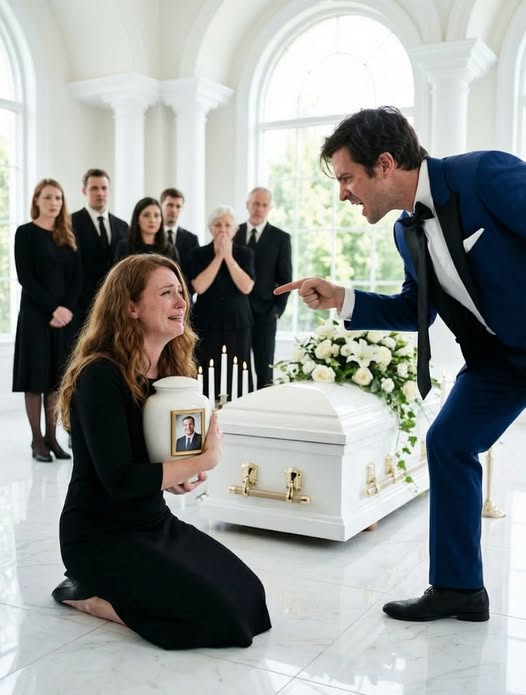
“We need to talk.”
I set my bag down.
“About Chloe?”
“No.”
“Then I don’t have anything to discuss.”
His mother spoke.
“You’ve become very disrespectful.”
I looked at her.
“My daughter died.”
She didn’t answer.
“And your first concern was the guest room.”
Her lips tightened.
“This family has suffered too.”
I looked around the room.
“No. You suffered inconvenience.”
Brendan stepped between us.
“Enough.”
I looked at him.
“You’re right.”
He seemed surprised.
“I’ve had enough.”
I walked upstairs.
That night, Raymond called again.
“We found the missing piece.”
I sat beside Chloe’s urn.
“What is it?”
“The medical portal.”
My stomach tightened.
“What about it?”
“Ximena didn’t merely reject the medication.”
He paused.
“She changed the classification of Chloe’s treatment expenses after the fact.”
“Why?”
“Because the Fairchild family trust had an internal threshold for extraordinary medical expenses.”
“And?”
“Someone moved Chloe’s treatment into a category that required additional approval.”
I stared at the urn.
“Who?”
“Ximena’s login was used.”
I swallowed.
“Was it her?”
“That’s what we don’t know.”
He sent me the access records.
There were timestamps.
Most of them matched Ximena’s working hours.
But one didn’t.
The final rejection had been entered at 1:17 a.m.
Brendan had been traveling that night.
I checked my old messages.
At 1:21 a.m., I had sent him a desperate text.
Please. Chloe needs this now.
He had never answered.
Raymond spoke softly.
“Nora, there’s more.”
I waited.
“The account that authorized the 1:17 a.m. change was linked to a device registered to Brendan.”
I couldn’t speak.
The room was quiet except for the hum of the heating system.
For three years, I had blamed Ximena.
Then Brendan.
Then myself.
But the truth was worse.
Someone had made a decision while my daughter was fighting to stay alive.
And that decision had not been an accident.
The following week, Raymond filed the first legal action.
Not against Brendan personally.
Against the corporate structure that had been hiding my beneficial ownership.
The filing triggered an emergency review of the Fairchild holding companies.
Within forty-eight hours, banks began asking questions.
Then auditors arrived.
Then Fairchild’s board members received notices.
Brendan called me fourteen times.
I answered the fifteenth.
“What did you do?”
His voice was no longer irritated.
It was frightened.
“I protected what was mine.”
“You don’t own those shares.”
“No.”
I looked at Chloe’s urn.
“My father did.”
There was silence.
Then Brendan whispered, “Your father?”
“He left everything with Raymond.”
“You knew about this?”
“I know now.”
He breathed heavily.
“Nora, listen to me.”
“I listened for three years.”
“I can explain.”
“You should explain it to the auditors.”
“Nora.”
“And to the hospital.”
His voice broke.
“Please.”
That was the first time Brendan had ever said that word to me.
I hung up.
The investigation continued.
The records eventually showed that Brendan had personally approved several transfers involving the medical expense system.
He had not ordered Chloe’s death.
But he had knowingly created a system in which her treatment could be delayed, and when the emergency arrived, he chose his company’s quarterly financial targets over an expense that might have saved his daughter.
The distinction mattered legally.
It mattered emotionally too.
I never called it murder.
I called it what the evidence supported.
Negligence.
Financial manipulation.
Breach of fiduciary duty.
And cruelty disguised as administration.
Ximena eventually agreed to testify.
She admitted that Brendan had told her to keep dependent medical expenses under the quarterly allowance unless he personally approved an exception.
She also admitted that he had instructed her not to contact him during his trip.
Samantha testified too.
She claimed she had never known what the money transfers were for.
The evidence supported her on some points.
She had received money.
She had not known where all of it came from.
But she had known Brendan was married.
That was enough for me.
The Fairchild company survived, but not intact.
Several executives resigned.
The board removed Brendan from his position.
The family’s ownership structure changed after the trust enforced its rights.
I did not take control of the company.
I could have.
My father had prepared the documents to make that possible.
But I didn’t want Brendan’s life.
I wanted my own.
Raymond helped me establish an independent foundation in Chloe’s name.
Its first purpose was simple.
Emergency medical assistance for families who couldn’t afford critical treatment while waiting for insurance or administrative approval.
The first check went to the hospital that had treated Chloe.
Not because I blamed them.
Because one doctor there had used their own money to buy my daughter one final dose of medication.
I never forgot that.
Months later, I returned to the Fairchild estate one last time.
The house looked smaller.
Brendan was sitting alone in the room that had once been Chloe’s.
The crib was gone.
The walls were empty.
He looked older.
“I kept thinking she’d come home,” he said.
I stood in the doorway.
“She did.”
He looked at me.
“I don’t deserve forgiveness.”
“No.”
He nodded.
“I know.”
I walked to the window.
Outside, the first snow of the season had begun falling across the garden.
Brendan spoke again.
“I loved her.”
I believed him.
That was the hardest part.
A person could love a child and still fail her.
A person could provide money and still deny care.
A person could call himself a father and still choose everything else first.
“I loved her too,” I said.
He lowered his head.
Neither of us spoke again.
I left the room.
I carried Chloe’s urn with me when I left the house that final time.
I didn’t take the crib.
I didn’t take the expensive furniture.
I didn’t take the photographs from the walls.
Just the urn.
Outside, I stopped beside my car.
For a moment, I held the white ceramic against my chest.
Three years earlier, my father had given me an old phone and told me that if I ever needed it, one call would be enough.
I had thought he was preparing me for a divorce.
He had been preparing me for the moment I finally understood who I was.
I put the phone into the glove compartment.
Then I placed Chloe’s urn carefully beside me.
I closed the car door.
And for the first time since my daughter was born, I drove away without asking anyone’s permission to take care of my own life.