The Father Who Vanished 25 Years Ago Quietly Paid Off My Mortgage FULL STORY
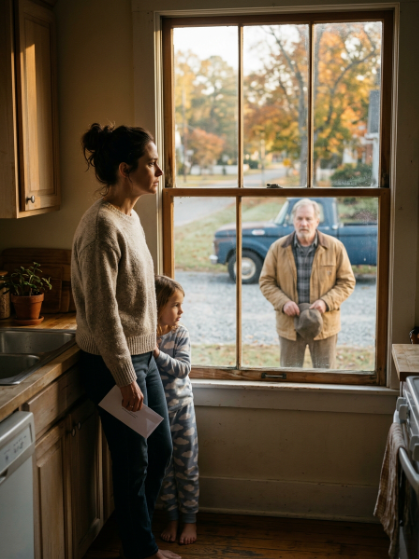
Frank Calloway crossed the street the way you cross a river you’re not sure is frozen.
I met him on the porch. I didn’t invite him in. Some doors you open one inch at a time.
Up close he was older than the anger I’d kept of him. Liver spots. A tremor in the hand holding the cap. Twenty-five years had happened to him too.
“I didn’t come to be thanked,” he said. “I didn’t come for anything. I paid it because I could, finally, and because I couldn’t stand the idea of you losing the house the way—” He stopped. “I’ll go. I just needed to see you were standing in it.”
“Why now?” I asked. “Why the house, why this morning, after twenty-five years of nothing?”
He looked at me a long moment.
“Because it wasn’t nothing,” he said. “And I think you deserve to decide what to do with that knowing, even if what you decide is to shut the door.”
Then he told me.
He didn’t leave the way my mother always said. There was no younger woman, no chosen freedom. When I was fourteen, Frank lost the trucking job and then the next one, and he started drinking the way his own father had, and one night he put his fist through a wall a foot from my mother’s head. He never touched her. But a foot is not far enough.
My grandfather — my mother’s father, a hard man with money and a long memory — gave Frank a choice. Get out, get sober, and stay gone until you’re a man worth being around, or I’ll make sure you never see either of them and I have the lawyers to do it.
Frank took the deal. He thought it would be a year. He got sober at fourteen months, by which point my grandfather had moved us, changed the listing on the phone, and told me my father chose himself.
“I wrote,” Frank said. “Every month, the first year. Your grandfather sent them back unopened. Then he sent a letter from a lawyer. So I did the only thing I could think of that he couldn’t return.” He nodded at the bank letter still in my hand. “I started paying into a trust through your aunt Carol. Whatever I had. For twenty-five years. Carol swore she’d get it to you when it mattered most and when I was either dead or too old to make it complicated. She called me last month. Said the bank was about to take your house. So I told her — not the trust. Pay the whole thing. Today. And then I drove down to stand across the street like a coward and look at it.”
Aunt Carol. My mother’s sister. The one who always slipped Birdie twenties and got cagey when I asked about my father.
“Why didn’t Carol ever tell me?” I asked.
“Because your mother asked her not to,” Frank said quietly. “And your mother had her reasons, and some of them were even good ones. She was protecting a fourteen-year-old from a man who’d scared her. I don’t blame her, Maeve. I scared her. That part’s true. The leaving part — that’s the part that got told wrong, and I’ve made my peace with not being able to fix the telling. I just didn’t want the money to be one more thing you never knew about.”
I stood there with twenty-five years rearranging itself in my chest.
I’d built my whole self around some people just leave. I’d been careful, guarded, quick to expect the door. I’d taught it to myself like a survival skill. And the foundation under it had a crack in it I’d never seen.
It didn’t make him a hero. A man who puts a fist through a wall near his wife’s head doesn’t get to be a hero, and Frank was the first to say so. But it made him something other than the cartoon villain I’d needed him to be. It made him a person who did a terrible thing, paid for it for a quarter century, and chose — when he finally had the means — to give without being seen.
“I’m not ready to forgive you,” I said. “I might never be. I want to be honest about that.”
“That’s fair,” he said. “That’s more than fair.”
Behind me, the screen door creaked.
Birdie, in her cloud pajamas, peered out at the old man on the porch.
“Are you the man with the blue truck?” she asked.
Frank crouched, slow, knees popping. “I am.”
“Do you like pancakes? Mama’s making pancakes.”
I hadn’t said anything about pancakes. But I looked at my daughter, who didn’t know yet that some people leave, who only knew there was an old man standing in the cold — and I made a decision that was mine to make, the way Frank said it would be.
“One breakfast,” I told him. “That’s what the money buys. Not forgiveness. Not the years. One breakfast, and we’ll see.”
He nodded like I’d handed him the world.
“One breakfast,” he said. “I’ll take it.”
He left after, and called the next week to ask if he could call again, and I said yes, smaller, but yes. We are building something slow and careful on a cracked foundation, with the truth finally poured into the gap.
The house is ours, free and clear.
But that’s not what the money bought, in the end.
It bought a conversation I’d spent twenty-five years being told I’d never get to have.