The Family That Vanished Came Back for the Check FULL STORY
I let my sister finish her presentation. I’m not a cruel man, but I’d be lying if I said there wasn’t a small, tired part of me that wanted to watch how far they’d go.
She went far. There was a tab in the binder labeled “Family Wellness Fund.” There was a spreadsheet. My mother nodded along like a woman at her own intervention, dabbing at eyes that stayed dry.
When Brandi turned to the page with the house, the one in my name they would live in rent-free while “managing my care,” I finally spoke.
“You came to the hospital once,” I said to her. “For a photo.”
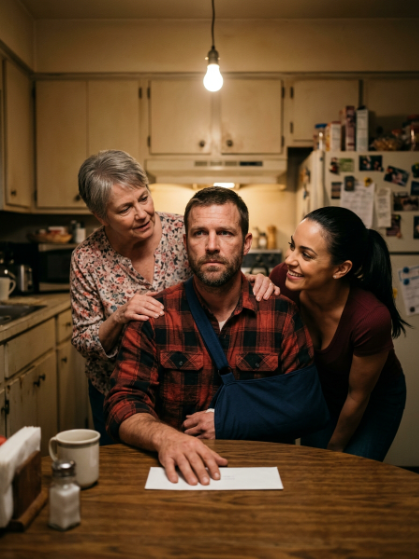
The binder stopped turning.
“And you,” I said to my mother, gently, because she’s still my mother and gentle costs me nothing, “asked me to cover your car payment while I was learning to walk to the bathroom.”
“Caleb,” she started, “we were going through our own—”
“I know,” I said. “Everybody’s going through something. Gus next door is eighty-one and going through plenty. He brought me soup forty-three times last year. I counted. You want to know how many times either of you came?”
Neither of them answered.
“Once,” I said. “For a photo.”
The room got very quiet. Brandi closed the binder.
Then I told them what I’d done three weeks earlier, in my lawyer’s office, with a clear head and one good arm.
I had put the bulk of the settlement into an irrevocable trust. Not a joint account. Not something a charming sister with a binder could get a signature on. A trust, with an independent trustee, structured to pay out slowly over my lifetime and to cover the medical care this shoulder is going to need for the rest of it.
No one can borrow against it. No one can be “added” to it. There is no card with two names. There is no house anyone gets to live in but me.
“You did that without talking to family?” Brandi said, and the warmth was gone now, fast, like it had never cost her anything to wear.
“You stopped being people I talk to about anything,” I said, “somewhere around month three.”
My mother tried tears next. The real-looking ones. “After everything I did raising you—”
“You did raise me,” I agreed. “And I was grateful, and I showed it, for years, until the year I needed you back and got a voicemail box. I’m not angry, Ma. I want you to hear that. I’m just done pretending the math works out in your favor.”
Here is the part that surprised even me.
I didn’t cut them off with nothing. Gus asked me, when I told him about it later, why I bothered to give them anything at all.
Because closing a door softly is still closing it.
I had the trustee set up two small, fixed monthly stipends. Modest. Automatic. Enough to tell myself I hadn’t let my mother go hungry, not a dollar more, and with one condition written in: the stipend exists only as long as there are no further requests for the principal. The first time either of them comes asking for the lump sum, the stipend ends.
It’s been six weeks. The casseroles stopped the night Brandi closed the binder. So did the “thinking of you, baby” texts. Which told me everything I already knew about what they were thinking of.
The stipends go out the first of every month. Neither of them has called to say thank you. I didn’t expect them to. That wasn’t why I did it. I did it so that ten years from now, when I’m old like Gus, I can look back and know I answered greed with more decency than it gave me, and still didn’t let it rob me.
I used a piece of the settlement for one thing right away, before the trust locked it down.
I paid off Gus’s roof. He fought me on it for a week. I told him forty-three bowls of soup at the going rate plus interest came out to about a roof, and he should take it up with my accountant.
He cried. I let him. He earned the right to, which is more than my own family can say.
I climb stairs now without the rail. The shoulder will never throw a beam again, but it holds a coffee cup, a steering wheel, the handle of a grocery bag. I’m learning a trade I can do sitting down, drafting, and it turns out I’m not bad at it.
Last week my mother sent one more text. No “baby” this time. Just: “I hope the money makes you happy since family clearly doesn’t.”
I looked at it a long time.
Then I set the phone down, knocked on the wall, and went next door, where an old man who owes me nothing had the soup already warm and two bowls out, because he set out two bowls now, every time, on purpose.
That’s the family the check didn’t buy.
That’s the family that was already there.