The Fall My Family Called an Accident Until the MRI Told Another Story
PART 3 (FULL STORY)
My head struck the edge of the wooden bench at the bottom of the stairs before the rest of me hit the floor.
For several seconds, I couldn’t tell whether my eyes were open.
Everything was white.
Then came voices.
“Get up.”
Dad.
“Come on. You’re fine.”
Tyler.
“She probably just scared herself.”
Mom.
I tried to answer, but my mouth felt numb. My right arm was burning from my shoulder to my fingertips, and there was a strange pressure behind my eyes.
I heard someone say they should call an ambulance.
Dad answered immediately.
“For what? She fell down a few stairs.”
Aunt Susan said nothing.
Neither did my uncle.
I couldn’t see their faces, but I could hear the uncertainty in their voices.
Tyler sounded annoyed.
“She was walking backward. I told her to watch where she was going.”
I wanted to say that wasn’t true.
I wanted to say that he had put both hands on my shoulders.
I wanted to say that everyone had seen it.
But when I tried to speak, the room tilted.
Then everything disappeared.
When I opened my eyes again, I was lying on the living room couch.
My neck was stiff.
My fingers on the right hand felt strangely distant, as if they belonged to someone else.
Mom was sitting nearby with her phone.
Dad was standing at the window.
Tyler was eating a piece of ice from his glass.
“You blacked out,” Mom said.
“I fell.”
“We know.”
I looked at her.
“What happened?”
“You lost your balance.”
“No.”
The word came out weaker than I expected.
Tyler laughed.
“Seriously?”
I turned my head toward him.
“You pushed me.”
His expression changed for half a second.
Then he smiled.
“Why would I push you?”
“Because you were blocking the stairs.”
Dad turned around.
“Enough.”
“But he—”
“You fell,” Dad said. “That’s what matters.”
I stared at him.
It was such a simple sentence.
You fell.
As if the person who had made me fall was irrelevant.
As if the fact that I had blacked out twice was an inconvenience.
As if the bruising on my shoulder was something I had done to myself.
Mom stood up.
“Can we please just get through the weekend without another family drama?”
I couldn’t believe she had said it.
“My neck hurts.”
“Then take some pain medicine.”
“My arm feels numb.”
“You’re shaken up.”
Dad walked over and placed a hand on my shoulder.
I flinched.
He pulled his hand away.
“See?” he said. “You’re fine.”
That was when I understood something I had been refusing to understand for years.
They didn’t need proof that I was okay.
They needed me to be okay.
There was a difference.
The paramedics arrived a few minutes later.
One of them was a woman with gray streaks in her dark hair.
She introduced herself, checked my pupils, asked me what day it was, and told me to squeeze her fingers.
I squeezed with my left hand.
When she moved to the right, my fingers barely responded.
She looked at me.
“Can you feel this?”
“Yes.”
“Does it feel the same on both sides?”
I hesitated.
“No.”
She asked Dad what had happened.
“Fall down the stairs,” he said.
“How many stairs?”
“I don’t know.”
“Did she lose consciousness?”
Dad looked at Mom.
“She was out for a second.”
“A second?”
“Maybe longer.”
The paramedic looked at Tyler.
“And you?”
Tyler shrugged.
“I was upstairs. She turned around and missed the step.”
I watched the paramedic’s face.
She didn’t challenge him.
Not yet.
She helped me onto the stretcher.
The movement sent a sharp bolt through my neck.
I cried out.
Dad sighed.
“Oh, come on.”
The paramedic looked at him.
“Please don’t move her.”
Dad raised his hands.
“I’m not doing anything.”
In the ambulance, the woman asked me questions again.
She wanted to know if I had experienced dizziness before.
I told her yes.
“How often?”
“Sometimes.”
“How long?”
I swallowed.
“Months.”
That made her pause.
I had never told my parents that.
Not because I was hiding something.
Because every time I had complained about headaches or dizziness, someone had called me dramatic.
The paramedic asked whether I had ever been evaluated.
“No.”
She looked down at the tablet.
Then back at me.
“Any weakness before today?”
I thought about the mornings when my right hand had gone numb.
The headaches after family gatherings.
The strange stiffness in my neck.
The times I had dropped a glass and pretended it was nothing.
“Yes,” I whispered.
She didn’t say anything for several seconds.
At the hospital, they took me for scans.
My family waited outside.
I remember waking up under fluorescent lights.
My mouth was dry.
My neck hurt.
And for the first time that day, nobody was telling me to stop making a scene.
A nurse adjusted the blanket over me.
“You’re going to have an MRI.”
I nodded.
“Will my family come in?”
“Not yet.”
There was something comforting about that.
For once, I didn’t have to convince anyone that I was hurting.
The MRI took longer than I expected.
The machine was loud.
Every few seconds, it made a hard mechanical knocking sound that traveled through my skull.
I tried to stay still.
I thought about the staircase.
Tyler’s hands.
The railing.
Dad’s voice.
You fell.
When the scan was over, I was rolled back into the room.
The paramedic was gone by then, but a doctor came in holding a folder.
He wasn’t smiling.
“Have you had any previous neck injuries?”
“No.”
“Any significant headaches?”
“Yes.”
“How long?”
“Almost a year.”
He looked at the images again.
“Has anyone ever told you that you have a cervical spinal cord problem?”
“No.”
He pulled up a chair.
“There is significant swelling around your spinal cord, and there are signs that this isn’t entirely new.”
I stared at him.
“What does that mean?”
“It means today’s fall may have aggravated something that was already developing.”
My throat tightened.
“Is it permanent?”
“We don’t know yet.”
I looked toward the door.
“My family is here.”
“I know.”
“Can they come in?”
He hesitated.
“Not right now.”
I didn’t understand why.
Then he explained.
“The imaging shows an injury pattern that needs to be documented carefully.”
My stomach dropped.
“Because I fell?”
“Because we need to understand how you were injured.”
A few minutes later, the same paramedic came back into the room.
She had been reviewing the initial report.
She looked at me.
Then at the doctor.
Then at the scan.
Her face changed.
It wasn’t fear exactly.
It was recognition.
She asked me quietly, “Did someone tell you that you simply lost your balance?”
“Yes.”
“Who?”
“My family.”
She nodded once.
Then she asked whether anyone had witnessed the fall.
I said yes.
“Who?”
I told her.
“Everyone.”
She looked through the glass toward the waiting area.
My father was there.
My mother beside him.
Tyler sitting with his arms crossed.
The paramedic lowered her voice.
“You need to be very careful about changing your story because someone pressures you to.”
I stared at her.
“I don’t want to lie.”
“Good.”
She looked at the scan again.
“The MRI shows more than a simple fall.”
My chest tightened.
“What does it show?”
She didn’t answer immediately.
Instead, she asked the doctor something I couldn’t hear.
Then she came back to my bedside.
“There is evidence of a spinal cord injury that appears to have been aggravated by today’s trauma.”
I swallowed.
“Could a fall do that?”
“Yes.”
“Then why does it matter?”
“Because the pattern matters.”
She looked toward the door again.
“And because your neurological symptoms were apparently present before today.”
I thought of every headache.
Every numb finger.
Every time I had quietly rubbed my neck under the dinner table.
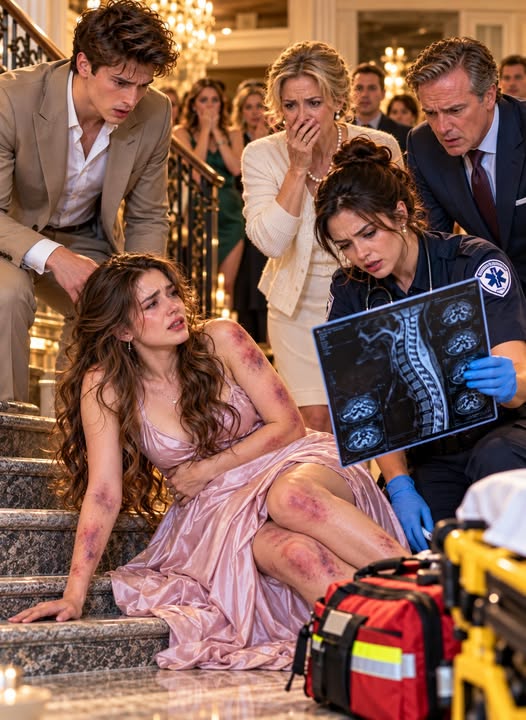
My family had seen all of it.
They had simply called it something else.
The door opened.
Dad stepped inside.
“What is going on?”
The doctor stood.
“We’re still evaluating her.”
Dad looked at me.
“She’ll be okay, right?”
Nobody answered immediately.
That silence scared me more than anything else.
Dad’s eyes narrowed.
“What does that mean?”
The paramedic looked directly at him.
“Were you present when she fell?”
“Yes.”
“Did you see what happened?”
“I saw her lose her balance.”
Tyler appeared behind him.
“That’s exactly what happened.”
The paramedic studied Tyler.
“You’re her brother?”
“Yes.”
“And you were on the stairs?”
“Nearby.”
Dad stepped forward.
“She doesn’t remember everything clearly.”
I looked at him.
“I remember.”
He frowned.
“What?”
“I remember.”
My voice shook, but it was loud enough.
“I remember you.”
Nobody spoke.
“I remember Tyler standing in front of me.”
Tyler’s jaw tightened.
“I remember telling him to move.”
“You were upset,” Tyler said.
“I remember your hands.”
His face went still.
“You pushed me.”
Dad immediately stepped between us.
“Enough.”
But the paramedic didn’t move.
She looked at me.
“Did he push you with both hands?”
“Yes.”
Tyler shook his head.
“No.”
Aunt Susan appeared at the doorway.
She had been crying.
That surprised me.
She looked at Tyler.
Then at me.
Then down at the floor.
The paramedic noticed.
“Ms. Susan?”
Aunt Susan took a breath.
“I saw it.”
Dad turned toward her.
“Susan.”
She didn’t look at him.
“I saw Tyler put his hands on her.”
Tyler stared at her.
“You didn’t.”
“I did.”
The room changed.
Not dramatically.
Nobody screamed.
Nobody threw anything.
But the version of the story my family had been building around me started to crack.
Dad’s voice dropped.
“You must have misunderstood.”
Aunt Susan shook her head.
“I didn’t.”
Tyler looked at her as though she had betrayed him.
“You’re seriously doing this?”
She finally looked at him.
“You shoved her.”
He didn’t answer.
The doctor quietly asked everyone to step outside.
Dad protested.
“She is my daughter.”
“And she is our patient,” the doctor said.
That was the first time anyone had spoken to my father as though he wasn’t automatically in charge.
The door closed.
I looked at the paramedic.
“What happens now?”
“Now you get treatment.”
“And Tyler?”
“That depends on what the investigation finds.”
The word investigation made everything feel real.
I started crying.
Not because of Tyler.
Not even because of the pain.
I cried because for years I had wondered whether I was imagining things.
Maybe I was too sensitive.
Maybe I really did make everything harder.
Maybe every argument was partly my fault.
Maybe Tyler was just joking.
Maybe Dad was right.
Maybe I should have learned to take a joke.
But the MRI didn’t care about any of that.
The scan couldn’t hear Dad calling me dramatic.
It couldn’t hear Mom saying I had ruined another weekend.
It couldn’t hear Tyler telling everyone I was looking for sympathy.
It could only show what had happened inside my body.
The next morning, a neurosurgeon explained that I had suffered an acute spinal cord injury on top of pre-existing structural abnormalities in my neck.
The fall had worsened the compression.
That explained the numbness, the weakness, and the episodes I had experienced for months.
The doctor couldn’t promise how quickly I would recover.
He could promise that ignoring the symptoms had been dangerous.
I asked him why nobody had caught it earlier.
He looked at me carefully.
“Because you weren’t evaluated.”
I knew what he meant.
I had been told to ignore it.
And I had learned to obey.
The hospital social worker later came to speak with me privately.
She asked whether I felt safe going home.
I didn’t answer.
She waited.
Finally, I said, “Not with Tyler.”
That was enough.
She arranged for me to stay temporarily with Aunt Susan after discharge.
My parents objected.
Dad said the whole situation was being blown out of proportion.
Mom said Tyler was already devastated.
Nobody asked what I wanted.
Except Aunt Susan.
She sat beside my hospital bed and took my hand.
“You don’t have to protect him anymore.”
I stared at her.
“I don’t know how not to.”
“You start by telling the truth.”
So I did.
I gave the hospital everything I remembered.
I told them about the shove.
I told them about the earlier symptoms.
I told them about the times Tyler had hurt me and then convinced everyone I had caused it.
Some of those memories were difficult to explain because there were no witnesses.
The staircase was different.
There were witnesses.
And there was an MRI.
The investigation did not turn into the dramatic courtroom scene I had imagined in my head.
There were interviews.
Statements.
Medical records.
A report from the hospital.
A conversation with an attorney.
Tyler’s version changed slightly each time.
First, I had fallen.
Then I had stepped backward.
Then he had reached out because he thought I was going to fall.
Finally, he admitted he had touched my shoulders but insisted he had only been trying to stop me.
Aunt Susan’s statement contradicted that.
So did another witness who had been standing near the bottom of the stairs.
The family weekend ended quietly.
No one played Monopoly again.
The burgers were thrown away.
The bourbon stayed untouched on the counter.
And the staircase where I had fallen remained exactly where it had always been.
Wooden railing.
Narrow landing.
Three steps before the turn.
For years, I had thought that staircase was simply where I had fallen.
Eventually, I understood that it was where my family’s version of me had fallen apart.
My recovery was slow.
Some days my right hand worked almost normally.
Other days, it felt weak and clumsy.
Physical therapy became part of my routine.
So did medical appointments.
So did learning how to ask for help without apologizing for needing it.
I didn’t cut my parents out overnight.
Real life rarely works that neatly.
Mom called.
Sometimes she cried.
Sometimes she said she didn’t understand how things had gotten so bad.
Sometimes she asked me to forgive Tyler.
I told her forgiveness was not the same thing as pretending nothing had happened.
Dad was harder.
For months, he insisted that everyone had overreacted.
Then one afternoon, he came to see me.
He sat in Aunt Susan’s kitchen while I worked through a set of exercises for my hand.
He watched for a while.
“You really can’t feel this?”
I shook my head.
“Not much.”
He looked down.
For once, he didn’t tell me I was fine.
“I thought you were always trying to get attention,” he said.
I stopped moving.
“I know.”
He rubbed his hands together.
“I didn’t understand.”
I looked at him.
“You didn’t try to understand.”
He didn’t argue.
That was the closest thing to an apology I got from him.
It wasn’t enough to repair everything.
But it was honest.
Tyler eventually faced consequences for what happened.
The details were handled away from our family.
There was no triumphant speech.
No public humiliation.
No magical moment where everyone suddenly understood my entire life.
There was simply a record of what happened.
A shove.
A fall.
An injury.
Witnesses.
Medical evidence.
And a story that could no longer be rewritten to make me responsible for it.
Months later, I returned to the lake house.
I almost didn’t go.
Aunt Susan offered to come with me.
I said yes.
The house looked smaller than I remembered.
The lake was still bright beyond the windows.
The smell of sunscreen still drifted in from the porch.
Someone had replaced the wooden bench at the bottom of the staircase.
I stood there for a long time.
Aunt Susan didn’t say anything.
Neither did I.
Then I touched the new railing.
It was smooth.
No splinters.
No scratches.
Nothing dramatic.
Just a piece of wood that had been replaced after an ordinary-looking accident that had never been ordinary at all.
I used to think disappearing was how I survived my family.
Now I understood something different.
Disappearing had only made it easier for everyone else to decide what had happened to me.
So I stopped.
I started speaking before someone else could speak for me.
I stopped apologizing every time I entered a room.
And when my body hurt, I said so.
When something was wrong, I said so.
When someone crossed a line, I said so.
I still had a long recovery ahead of me.
There were mornings when my hand didn’t cooperate.
There were nights when I woke with pain in my neck and remembered the staircase.
But I no longer confused being quiet with being safe.
Before we left that evening, I looked once more at the stairs.
Three steps to the turn.
The railing beneath my palm.
And for the first time, I didn’t see the girl who had fallen.
I saw the girl who had finally stopped disappearing.