The Day My Husband Realized His Family’s Secret Was Evidence
PART 3 (FULL STORY)
Vance stood on Teresa’s porch with the envelope hanging loosely from his fingers.
For the first time since I had known him, he looked genuinely afraid.
Not angry.
Not annoyed.
Afraid.
Behind him, one of the tow-truck drivers climbed out and walked toward the driveway.
Teresa appeared in the doorway a second later, still wearing the silk robe she usually reserved for Sunday mornings.
“What is going on?” she demanded.
Then she saw the trucks.
Her expression hardened.
“Who are those people?”
My mother stepped out of our car.
I remained inside with Amelia, exactly where my doctor had told me to be.
Evelyn closed the car door gently and looked at Teresa.
“You said Lauren was no longer welcome in your house.”
Teresa stared at her.
“Yes.”
“So she isn’t coming inside.”
Teresa glanced at me through the windshield.
“Then why are you here?”
“Because this stopped being a family dinner yesterday.”
Vance turned toward his mother.
“Mom.”
She looked at him sharply.
“What?”
He held up the envelope.
“You told me you had everything under control.”
Teresa’s eyes moved to the papers.
“What did she give you?”
He didn’t answer.
She walked down the steps and snatched the envelope from his hand.
The first page was enough to make her stop.
I watched her read.
Then she turned the page.
Then another.
Her lips pressed into a thin line.
“What is this?” she asked.
My mother answered calmly.
“Copies of the financing documents.”
Teresa laughed, but there was no confidence in it.
“Those are confidential.”
“They were obtained through lawful discovery after Lauren received notice that her credit had been used.”
“You can’t just—”
“We didn’t take anything,” my mother interrupted.
“Daniel Ortega requested the records through the appropriate channels after Lauren disputed the guarantees.”
At the mention of Daniel’s name, Teresa’s face changed.
She knew exactly who he was.
Daniel had been my senior partner for years before I left the firm to start preparing for motherhood.
He knew how commercial financing worked.
He knew what fraudulent guarantees looked like.
And most importantly, he knew what questions to ask.
Three weeks earlier, after I showed him the first documents, he had told me not to confront anyone again until we understood the entire structure.
“People lie when they’re scared,” he had said.
“Documents don’t.”
He was right.
The first $150,000 loan wasn’t the only obligation.
There had been a second equipment facility.
Then a business credit line.
Then a short-term working-capital loan.
The total exposure was more than $300,000.
My name appeared on several documents.
My mother’s name appeared on two.
And Vance’s name appeared in correspondence connected to all of them.
Teresa looked at her son.
“Tell them this is a misunderstanding.”
Vance didn’t speak.
“Vance.”
He swallowed.
“I didn’t know about the signatures.”
I finally opened the car door.
My mother immediately came around to help me stand.
I moved slowly, one hand pressed against my abdomen.
Teresa stared at me.
“You came here?”
“No,” I said.
“I came near here.”
“I’m still not walking into your house.”
Her face reddened.
“You’re making a scene.”
“No.”
“You made the scene.”
“I just brought the paperwork.”
Vance looked at me.
“Lauren, please.”
That word almost made me laugh.
Please.
Four days after surgery, he had told me I needed him more than ever.
Now he was asking me for help.
I shook my head.
“You should have thought about that before you signed my name.”
“I didn’t sign it.”
“You approved it.”
He looked down.
That was the answer.
Teresa stepped between us.
“My son never committed fraud.”
My mother opened the folder.
“Then you should have no problem explaining these.”
She handed Teresa a printed email.
The message was short.
Teresa had written to Vance asking whether the lender had received “Lauren’s authorization.”
Vance had replied that everything was handled and that “she won’t look closely enough to notice.”
Teresa read the sentence twice.
Then she looked at her son.
“You said that?”
Vance’s face had gone pale.
“I was trying to help you.”
“Help me?”
“You said the company would collapse if we didn’t get the financing.”
“You knew?”
His voice cracked.
“I knew about the applications.”
The admission settled over the driveway.
Teresa stared at him as though he had suddenly become a stranger.
My mother didn’t react.
She simply turned another page.
“There is more.”
Teresa’s eyes narrowed.
“What more could there possibly be?”
“The money transfers.”
Daniel had traced the funds as far as the available records allowed.
Some of the money had gone toward legitimate business expenses.
But not all of it.
Several payments had gone toward personal credit cards.
A luxury vehicle payment had been made from the company account.
There were transfers to Ryan.
And one large payment had been made to cover an old debt Teresa had never disclosed to the family.
The catering business wasn’t simply struggling.
It had been operating on borrowed money for years.
The loans taken using my identity and my mother’s information had been used to keep the entire structure standing.
Teresa sat down on the porch step.
For the first time, she looked old.
Not evil.
Not powerful.
Just tired.
“I was going to pay it back,” she whispered.
My mother looked at her.
“That’s not the point.”
“I had contracts coming in.”
“That still isn’t the point.”
“I couldn’t lose the company.”
I finally spoke.
“You couldn’t lose your company, so you decided I could lose my future.”
Teresa looked at me.
“I never meant for you to be responsible.”
I almost couldn’t believe what I was hearing.
“You put my name on personal guarantees.”
“I thought you would sign if I asked.”
“You never asked.”
She looked away.
That was when I understood something that had taken me months to accept.
She hadn’t made one desperate mistake.
She had made a series of decisions.
Each time, she had chosen what was easier for herself.
And each time, someone else had been expected to absorb the consequences.
For three years, that person had been me.
The Thanksgiving dinners.
The bookkeeping.
The surprise errands.
The unpaid work.
The insults disguised as family expectations.
They had trained me to stop objecting.
Then they assumed I would never look closely at the paperwork.
They were wrong.
One of the tow-truck drivers approached us.
“Which vehicle is listed on the order?”
Teresa looked at him in disbelief.
“You’re taking my car?”
My mother answered before he could.
“Only the vehicle specifically identified in the secured financing records.”
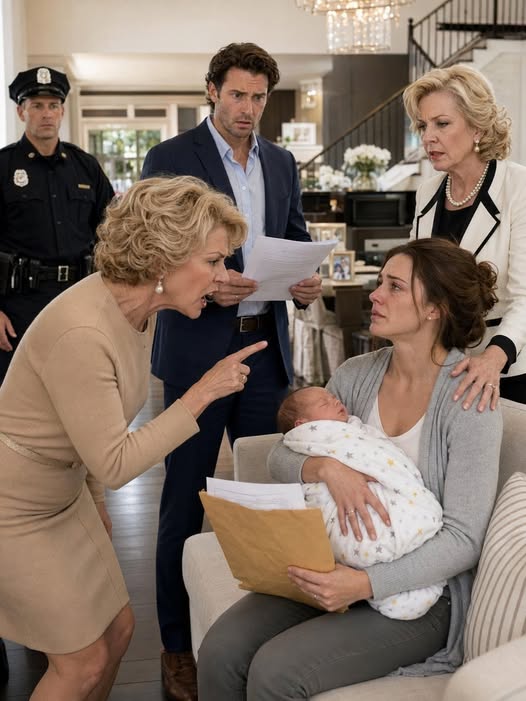
Teresa looked at Vance.
“You did this.”
Vance shook his head.
“No.”
“You brought them here.”
“I didn’t.”
His eyes moved toward me.
I said nothing.
The trucks weren’t there because I wanted revenge.
They were there because Daniel had advised us to preserve the secured assets identified in the financing records before they could disappear.
That distinction mattered.
I wasn’t trying to destroy Teresa.
I was trying to make sure she couldn’t destroy me.
The tow truck slowly pulled the vehicle from the driveway.
Teresa watched it go.
Then she turned back toward me.
“You’ve always hated me.”
“No.”
She frowned.
“I never hated you.”
“Then why would you do this?”
“Because I trusted you to keep choosing peace.”
She looked confused.
I continued.
“You mistook my patience for permission.”
Vance closed his eyes.
I could see the fight leaving him.
“Lauren,” he said quietly, “I should have told you.”
“Yes.”
“I was scared.”
“I know.”
“I thought if Mom got through the next few months, the business would recover.”
“And if it didn’t?”
He had no answer.
I looked at him for a long moment.
That was the hardest part.
Not Teresa.
Not the money.
Him.
Because I had spent three years telling myself there was a good man underneath all the silence.
A man who would eventually stand beside me.
A man who would eventually say, Enough.
But when the moment finally came, he hadn’t stood beside me.
He had stood beside his mother.
Until the documents made that impossible.
I told him I wanted a separation.
He didn’t argue.
Maybe he understood that arguing would only make the decision uglier.
Maybe he finally realized I wasn’t bluffing.
Or maybe the envelope had simply made the consequences real.
Either way, he nodded.
“What about Amelia?”
“She has a father,” I said.
“I won’t stop you from being one.”
“But being her father doesn’t require me to remain your wife.”
He looked toward the car.
Our daughter was asleep inside.
For several seconds, neither of us spoke.
Then Vance walked over and rested one hand against the window.
He didn’t ask to hold her.
He didn’t ask me to reconsider.
He simply stood there.
I think that was the first time he understood how much he had already lost.
The legal process took months.
Teresa’s company entered restructuring.
The lenders investigated the guarantees.
The fraudulent signatures were formally disputed.
My mother’s attorney made it clear that she had never authorized any of the obligations connected to the financing.
Daniel helped me provide every document we had.
The investigation eventually established that my electronic signature had been copied from an old file and used without my authorization.
That evidence mattered.
So did the emails.
So did the bank records.
So did Vance’s messages.
Teresa eventually accepted responsibility for submitting the applications, while Vance admitted that he had known about the financing and had helped conceal it from me.
The consequences were not dramatic in the way television makes these things dramatic.
There was no courtroom speech that changed everyone’s life in one afternoon.
There were meetings.
Lawyers.
Bank statements.
Questions.
Forms.
Long stretches of waiting.
And bills.
Real consequences are often boring like that.
But they are still consequences.
Vance moved into a small apartment.
For the first few months, he saw Amelia only when someone else was present.
Eventually, when things became more stable, that changed.
I never told our daughter what had happened.
Not then.
She was too young.
She only knew that her mother and father lived in different homes.
I went back to work part-time when my doctor cleared me.
Daniel offered me a position with a commercial litigation team.
I accepted.
The first time I sat behind a desk again, I stared at the stack of contracts in front of me and almost cried.
Not because I was unhappy.
Because I remembered the woman I had been before all of this.
I had spent years believing that becoming a wife meant learning how to bend.
Then motherhood taught me something different.
Sometimes protecting your family means refusing to bend at all.
Months later, I received a letter from Teresa.
I almost threw it away.
Instead, I opened it.
It wasn’t an apology filled with excuses.
There were no accusations.
No mention of family obligations.
No request for money.
She wrote that she had confused control with responsibility.
She wrote that she had believed everyone would keep rescuing her.
And she wrote one sentence I never expected to read.
“You were never my servant, Lauren.”
I folded the letter and placed it in a drawer.
I didn’t forgive her that day.
Maybe I never fully would.
But I didn’t need to hate her either.
That was another thing I learned.
Walking away doesn’t require hatred.
Sometimes it only requires clarity.
A year after the dinner that never happened, Amelia took her first steps across my living room.
I was sitting on the couch, watching her wobble toward me.
My mother stood nearby, laughing softly.
On the coffee table sat the same thick blue folder.
I had kept it.
Not because I wanted to remember Teresa.
Not because I wanted proof of what they had done.
I kept it because it reminded me of the moment I stopped asking other people to protect me from consequences they had created.
Amelia reached the couch and grabbed my knee.
I picked her up carefully.
She laughed and wrapped both arms around my neck.
For a moment, I thought about the woman lying on that same couch a year earlier, four days after surgery, wondering whether she had imagined the cruelty coming through the phone.
She hadn’t imagined it.
But she had also underestimated herself.
I looked down at my daughter.
Then I reached over and closed the blue folder.
The sound was small.
Just paper against paper.
But I knew exactly what it meant.
That chapter was over.