The Daughter My Family Erased Became the Witness Who Exposed Them
PART 3 (FULL STORY)
Luke stared at me as if the years between us had vanished in a single second.
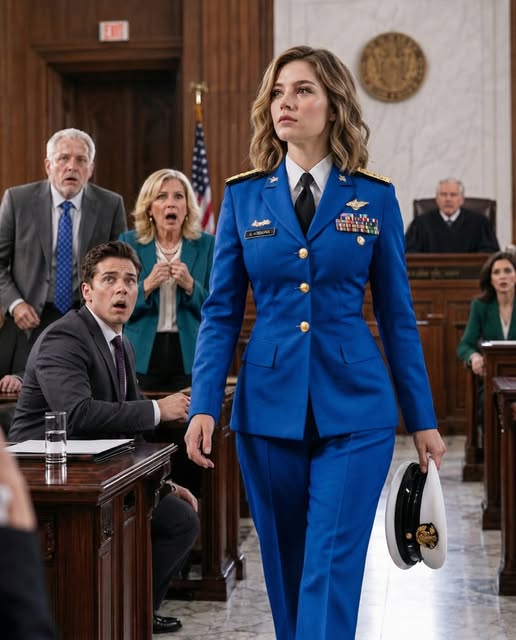
I kept walking toward the witness stand.
My heels sounded sharper against the marble than they had in the hallway, and I could feel my mother watching every step.
Dad whispered my name again.
This time, I heard the uncertainty in it.
I did not turn around.
The prosecutor waited until I was seated before placing a thick folder in front of me.
He introduced himself for the record, then asked me to confirm my full name, rank, and service history.
I answered each question plainly.
No speeches.
No accusations.
Just facts.
Then he opened the first document.
“Do you recognize this signature?”
I looked down.
It was mine.
Or, more accurately, it was the version of my signature Luke had been using for years.
“I recognize the signature,” I said. “I did not sign this document.”
The prosecutor nodded and placed another page beside it.
“Your service record?”
“Yes.”
“Did you provide it to Vance Shield Recovery for the purpose of establishing veteran eligibility?”
“No.”
“Did you authorize anyone in your family to use your identity for federal contracting?”
“No.”
Across the courtroom, Luke shifted in his chair.
His attorney leaned closer and whispered something into his ear.
Luke did not look at me anymore.
For years, he had been comfortable telling my story because I was not there to contradict him.
Now I was sitting less than thirty feet away, answering questions under oath.
The prosecutor continued carefully.
He showed the court a series of applications, ownership statements, certifications, and hardship documents connected to Vance Shield Recovery.
My name appeared throughout them.
Sometimes it was written in full.
Sometimes it appeared as an initial.
Sometimes my service history was copied almost word for word from records I had never given Luke.
The company had presented itself as having qualifying veteran-linked ownership.
That status had helped it compete for storm-recovery work.
Luke had built the company around a version of me that did not exist.
The disgraced Navy daughter.
The damaged veteran.
The family member who supposedly needed Luke to manage her affairs.
The person who could not defend herself because she had supposedly disappeared.
The prosecutor asked when I had learned about the company.
I told him about the federal review.
I told him how the file had crossed my desk and how familiar details had immediately caught my attention.
At first, I had thought there had been an administrative mistake.
Then I saw my signature.
Then my service record.
Then the hardship narrative.
I read the pages again and again because my mind kept rejecting what my eyes were seeing.
The story described a woman who had suffered a career-ending collapse and depended on her family for support.
That woman was supposed to be me.
Except I had never lived that life.
“What did you do after discovering the documents?” the prosecutor asked.
“I reported what I knew.”
“And when investigators contacted you?”
“I cooperated.”
“Why?”
I looked toward the judge before answering.
“Because someone used my identity to build something that was never theirs.”
The prosecutor let the sentence sit there without embellishment.
Then he asked about Luke.
I told him Luke had always been competitive.
When we were younger, it had been harmless enough.
He wanted to be the one people noticed.
He wanted our father’s approval.
He wanted to be the person relatives called when they needed help.
But after I enlisted, something changed.
My accomplishments became inconvenient.
Every promotion made his jokes sharper.
Every letter home seemed to irritate him.
Whenever I returned from training, he found a way to remind me that I was abandoning the family.
When I told my parents I intended to make the Navy my career, Dad warned me that I might not be strong enough.
Luke said nothing.
He simply smiled.
Then the forged messages began.
At first, I did not know they were forged.
My parents stopped answering my calls.
Mom’s messages became short.
Dad stopped asking about my work.
When I finally came home, Luke already had an explanation.
I had failed.
I had been discharged.
I was ashamed.
I was unstable.
I needed money.
I denied every part of it.
Dad showed me the documents.
I remember staring at them on his desk and realizing that the pages mattered more to him than my face.
I told him the discharge papers were false.
He asked why Luke would lie.
I had no answer that he was willing to hear.
Then Mom asked whether I had come home because I needed money.
That was the moment I stopped trying.
On the witness stand, I did not describe that night dramatically.
I simply told the court what happened.
The prosecutor asked whether I had remained in contact with my family afterward.
“Not really.”
“Why?”
“Because there was nothing left to explain.”
My mother lowered her head.
For the first time since I had entered the courtroom, she looked older than I remembered.
The defense attorney stood for cross-examination.
He was polished, calm, and careful.
He did not accuse me of lying outright.
Instead, he asked whether I had been angry with Luke.
Whether I had felt rejected by my parents.
Whether I might have misunderstood what happened years earlier.
Whether resentment could have influenced my testimony.
I answered each question without raising my voice.
“Yes, I was hurt.”
“Yes, I was angry.”
“No, that does not change the documents.”
He asked whether I had ever wanted Luke to fail.
I thought about it.
“No.”
He seemed surprised.
“I wanted him to stop using me,” I added.
The prosecutor did not object.
He did not need to.
The documents were already speaking for themselves.
When the defense attorney finished, the prosecutor requested permission to introduce another group of records.
This time they concerned the Sterling family assets.
My father’s signature appeared on guarantees.
My mother’s appeared on financial authorizations.
Their retirement accounts had been pledged.
Property connected to the family had been used to support the company.
My parents had not known the entire scheme.
But they had signed documents because Luke told them the business needed protection.
That distinction mattered.
The government was not presenting them as the architects of everything Luke had done.
It was showing how his lies had spread until people who trusted him became part of the machinery.
My father finally stood.
“Your Honor,” he said, his voice rough, “I didn’t know.”
The judge told him to sit unless his attorney advised otherwise.
Dad sat down.
Luke looked at him.
For a moment, they looked like two strangers who had just discovered they were standing on opposite sides of the same collapsing bridge.
During the afternoon recess, I waited in a secured hallway while attorneys moved between rooms.
I expected anger.
Instead, I felt tired.
Then my mother appeared with her attorney.
She stopped several feet away.
“I didn’t know,” she said.
I said nothing.
“I believed him.”
“I know.”
Her eyes filled.
“I should have believed you.”
That was the first honest sentence she had given me in years.
It did not erase anything.
It did not restore the years I had spent rebuilding a life without them.
But I did not need to punish her with silence either.
“I needed you to ask me,” I said.
She nodded.
“I know.”
Then she walked away.
My father did not approach me that day.
Luke did.
His attorney tried to stop him, but Luke stepped into the hallway after me.
“You could have talked to me,” he said.
I turned around.
“For twelve years, you told everyone I was a failure.”
His face tightened.
“I was trying to keep the company alive.”
“You used my identity.”
“I never meant for it to go this far.”
“That doesn’t make it smaller.”
He looked toward the courtroom doors.
Then he said the sentence I had waited years to hear.
“I thought you would never come back.”
I studied him.
“I didn’t come back for you.”
He had no answer.
The prosecutor later returned to the issue of the marshland.
Our grandfather’s property had always mattered to Luke.
He had maneuvered himself into control of it after telling the family I was incapable of managing anything.
The land had become part of his business plans and part of the collateral supporting the company.
But the government had discovered something Luke apparently had not expected them to find.
The original transfer records did not support the story he had told the family.
My grandfather had never intended the property to become Luke’s simply because Luke was the dependable grandson.
There were restrictions attached to the transfer.
They had been overlooked when Luke built his paperwork around his version of the family.
The prosecutor showed me the original records.
I recognized my grandfather’s handwriting.
He had left instructions that the marshland was to remain within the family unless both grandchildren agreed to a transfer.
Luke had acted as though I had disappeared.
That assumption had allowed him to move forward without me.
But I had never signed away my interest.
The marshland was not his.
The revelation changed the financial picture immediately.
Luke’s attorney asked for a recess.
The judge granted it.
My parents sat together for the first time all day.
My mother reached for Dad’s hand.
He let her take it.
Luke remained at the defense table, staring down at the papers.
The courtroom that morning had been built around certainty.
By evening, certainty was gone.
The case did not end with one dramatic confession.
There was no sudden apology that repaired twelve years.
There was no speech that made everything fair.
There were hearings.
Financial reviews.
Additional testimony.
Documents examined line by line.
Assets frozen.
Contracts scrutinized.
People who had trusted Luke forced to explain why they had signed what they signed.
Eventually, the court reached its conclusions.
Luke was held responsible for the fraud he had engineered.
The consequences were serious and permanent.
Vance Shield Recovery collapsed under the weight of the investigation, and the assets tied to the scheme were dealt with through the legal process.
My parents were not treated as though they had planned the fraud.
But they had to face the consequences of signing documents they had never properly understood.
Their retirement plans changed.
The house they had once considered untouchable was no longer guaranteed.
Their comfortable version of the Sterling family disappeared.
Mine had disappeared years earlier.
The difference was that I had already learned how to live without it.
Months later, I returned to the marshland.
The place looked almost exactly as I remembered it.
Tall grass moved in the wind.
The water reflected the late afternoon sky.
The old wooden post near the shoreline was still crooked from years of storms.
I stood there alone for several minutes.
My grandfather had brought us there when we were children.
Luke used to race ahead.
I used to follow more slowly because I was always stopping to look at the birds.
I had forgotten that until I came back.
My father eventually joined me.
He did not ask permission to speak.
“I don’t know how to fix this,” he said.
“You can’t.”
He nodded.
“I know.”
We stood beside the water.
After a while, he asked whether I hated him.
I considered the question.
“No.”
His shoulders lowered slightly.
“But I don’t trust you the way I used to.”
“I understand.”
That was all.
It was enough.
My mother came later with an old box she had found while clearing out the house.
Inside was a photograph from the day I left for training.
I was nineteen.
My hair was pulled back.
My uniform was new.
I was standing beside my parents and Luke.
Everyone in the photograph was smiling.
My mother handed it to me.
“I almost threw it away,” she said.
I looked at the picture.
“I won’t.”
She looked surprised.
“Why?”
“Because it happened.”
She nodded.
I put the photograph back into the box.
I did not forgive them that afternoon.
I did not need to.
Forgiveness was not the price of telling the truth.
Neither was revenge the reason I had testified.
I had simply refused to let someone else’s lie become the official version of my life.
The next morning, I returned to work.
My white ceremonial uniform hung inside my closet, clean and pressed.
The medals were where I had left them.
I ran my hand across the fabric once, then closed the door.
For years, Luke had used that uniform as the symbol of everything he claimed I had failed to become.
Now it was simply mine.
Outside, the city was already waking.
I picked up my keys, locked the door, and walked toward the morning light without looking back.