The Cracked Frame – Full Story
The glowing golden signature in the ledger caught the harsh track lighting. Ramo Karust.
Richard’s smirk faltered. He took a half-step back, his polished oxfords squeaking on the concrete. “What is this?” he stammered, his eyes darting from the book to my face. “A forgery. You forged a fifty-year-old document to steal a masterpiece.”
“It’s not a forgery, Victoria,” Arthur said, his voice steady. He tapped the glass screen. “It’s the original bill of sale. Digitized from the Sterling family archives this morning. It explicitly states that the copyright and physical ownership of ‘Composition in Blue’ were retained by the artist’s spouse. Eleanor Vance.”
Richard’s face flushed a deep, blotchy red. He lunged for the ledger, his manicured nails scraping against the glass. “Give me that! This is a private gallery. You’re trespassing!” He pulled his phone from his pocket, his hands shaking. “I’m calling the police. I’m calling the board of directors. You’re going to ruin this exhibition.”
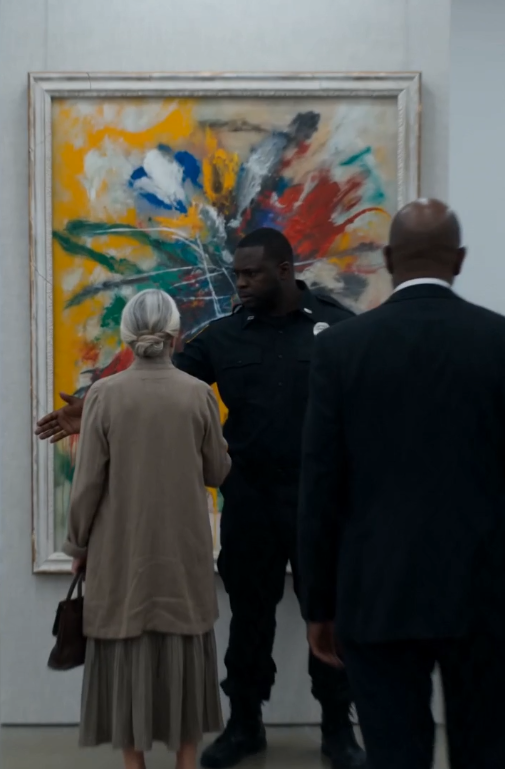
My stomach twisted again. The air in the gallery felt suddenly thin, suffocating. I looked at the painting. The swirling blues and golds. I had painted every stroke while my husband was dying in the next room. Richard Sterling had stolen it, claimed it was a lost masterpiece, and built his empire on my grief.
“You can’t call the police, Richard,” I said. My voice was stronger now. It carried across the quiet gallery. “Because the board is already here.”
The heavy oak doors at the back of the gallery swung open. Three men in tailored charcoal suits walked in. The lead man, David Croft, the chairman of the Sterling Trust, stopped dead in his tracks. He looked at the ledger, then at the painting, then at me.
“Eleanor,” he said softly. “We received the email. The forensic analysis of the paint pigments confirms it. The specific cadmium red used in the lower quadrant wasn’t manufactured until 1976. The original artist died in 1973.”
Richard froze. The color drained completely from his face, leaving him looking sickly under the track lighting. He looked at the painting, then at the ledger, then at David. The arrogance was completely gone. He looked like a trapped animal.
“That’s… that’s impossible,” he whispered. “The provenance report… I wrote it myself. The experts authenticated it. The Tokyo museum paid forty million dollars for it.”
“You bribed the experts, Richard,” David said coldly. His voice echoed off the vaulted ceiling. “And you embezzled twelve million dollars from the trust by selling a fake painting. We have the wire transfers. We have the emails. And we have the original artist standing right in front of you.”
The silence that followed wasn’t just quiet. It was a physical weight. It crushed the air out of the space between us.
Richard’s jaw tightened. He looked at the exit, calculating the distance. “You can’t prove that,” he hissed, his voice cracking. “I’m the director. I built this collection. I am the Sterling Gallery.”
“You stole it,” I corrected. I stepped forward and placed my hand flat against the cracked white frame. The wood was cool and smooth beneath my fingertips. It felt like coming home.
David nodded to the two men behind him. They weren’t lawyers. They were federal agents.
“Richard Sterling, you’re under arrest for wire fraud, art forgery, and grand larceny,” the lead agent said.
They moved in fast. They pulled his arms behind his back. The metallic click of the handcuffs was sharp and final. It echoed off the vaulted ceiling, silencing the room completely. They marched him out of the gallery, past the staring patrons, and into the waiting cruiser. He didn’t look back. He just stared at the floor, his shoulders slumped, entirely defeated.
I turned back to the painting. I traced the cracked frame with my thumb.
The heavy oak doors clicked shut behind the agents, leaving only the sound of my steady breathing.