The Busking Violinist Stepped Over on the Courthouse Steps FULL STORY
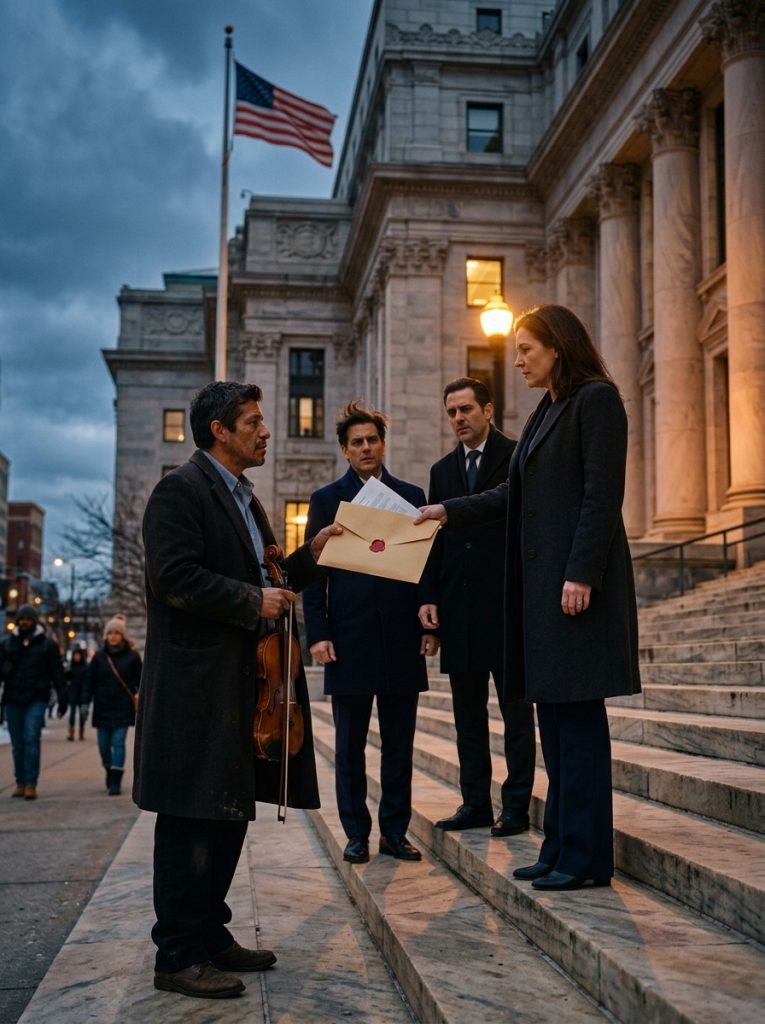
The marble floors of the Cuyahoga County Courthouse had never felt colder.
Victor and Anthony Falcone followed me inside, their expensive shoes clicking against the stone like gunfire. They were flanking the estate attorney now, demanding to see the will, demanding explanations, demanding the reversal of something that couldn’t be reversed.
“There’s been a mistake,” Victor said, his voice tight with barely controlled fury.
“No mistake, Mr. Falcone,” the attorney replied. Her name was Margaret Chen, and she’d been Dominic Falcone’s personal lawyer for thirty years. She didn’t blink. “Your father added the codicil six months before he passed. It was witnessed, notarized, and legally binding.”
“He was sick! He wasn’t in his right mind!”
“Your father was sharper at seventy-eight than most men are at forty. The codicil is ironclad.”
We gathered in a private conference room. Long table. Leather chairs. Portraits of dead judges staring down from the walls. I set my violin case on the table — gently, the way you set down something precious — and waited.
Margaret opened the will.
“To my sons, Victor and Anthony Falcone, I leave the family home in Shaker Heights and a trust fund of fifty thousand dollars each.”
Victor slammed his hand on the table.
“Fifty thousand? That’s nothing! The empire is worth hundreds of millions!”
Margaret didn’t look up. “To my protégé, Rafael Torres, I leave controlling interest in Falcone Industries, all commercial real estate holdings, and the position of sole executor of my estate.”
Anthony stood up so fast his chair tipped over.
“He’s a homeless violinist! He plays on the courthouse steps for change!”
“He’s the man your father trusted more than anyone,” Margaret said quietly. “Including you.”
Those words landed harder than any insult.
Anthony’s face crumpled.
Victor was trembling. “Why? We’re his sons. His blood. Why would he do this to us?”
“Because you never once visited him after his diagnosis,” I said.
Both of them turned to stare at me.
“I was there every weekend,” I continued. “Every Sunday. For twenty years. I played violin while he read the newspaper. I made him coffee the way he liked it — black, one sugar. I listened when he talked about the business, about the men who betrayed him, about the sons who only called when they needed money.”
Victor’s face twisted. “You were just trying to get his money.”
“I never asked for a dollar. I never took a paycheck. He offered me a position in the company fifteen years ago, and I turned it down because I wanted to earn my place through music, not through his name.”
“Then why did he name you?” Anthony whispered.
I looked at Dominic’s sons — the men who’d stepped over me on the courthouse steps, who’d mocked my violin, who’d laughed at my coat — and I told them the truth.
“Because he knew you’d destroy everything he built. And he trusted me to protect it for the people who actually matter — the workers. The families. The communities that Falcone Industries supports.”
Victor opened his mouth to argue.
I raised my hand.
“The Shaker Heights house is worth two million. The trust fund will keep you comfortable. I’m not taking those from you. But Falcone Industries — the factories, the warehouses, the jobs — those belong to the people who built them now.”
I stood up.
Picked up my violin case.
Walked past the brothers without looking back.
Outside the courthouse, the gray Cleveland sky had cleared just enough to let a sliver of winter sun through. I tucked my violin under my chin and played the first notes of Dominic’s favorite piece — a Vivaldi concerto he’d asked me to play at his bedside, three days before he died.
Some of the passersby stopped this time.
They didn’t step over me.
They listened.