The Boy Who Slept Through My Class FULL STORY
The door drifted open, and I saw the whole truth of Marcus Dale in about four seconds.
A tiny kitchen. One bare bulb. A sixteen-year-old boy at the stove in his school hoodie, stirring a pot of pasta, while a little girl in pajamas set out three mismatched plates and a slightly older boy did homework at a wobbling table.
Marcus turned and saw me in the doorway and froze, the wooden spoon still in his hand.
“Ms. Hale?”
I didn’t have a speech anymore. The one about responsibility had evaporated somewhere on the drive over.
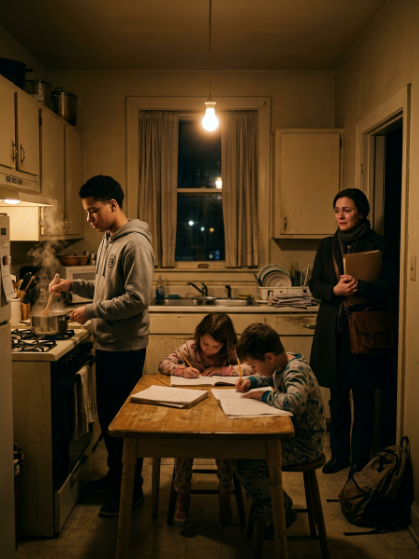
“Your essay,” I managed, holding up the folder. “You left it. I came to—” I stopped. “Marcus, where are your parents?”
The little girl answered before he could. “Mommy works nights at the hospital. And the other one.” She shrugged the way kids do about things too big for them. “Marcus takes care of us.”
Slowly, over a cup of weak tea he insisted on making me, the story came out.
Their mother worked double shifts as a hospital aide, often overnight, the only way she could keep the apartment. Their father had left eighteen months earlier. That made Marcus, at sixteen, the one who picked Lily up from school, helped Theo with his reading, made dinner, did the dishes, and got everyone to bed—before he even started his own homework, usually after ten p.m.
That was why he was late every morning. He walked Lily to her elementary school first.
That was why he slept in third period. He’d been up past midnight.
That was why three essays were missing. He’d been choosing, quietly, every week, between his assignments and his family. He’d been choosing them. Every time.
The detention slips in my folder suddenly read like a list of my own failures, not his.
I’d had a boy raising a household in my classroom, and I’d written “not applying himself” on his report card.
“Why didn’t you tell anyone?” I asked.
He looked at his siblings, then back at me, and gave an answer far too old for his face.
“If I tell the school, they might call somebody. And if they call somebody, maybe we don’t all stay together.” He stirred the pot. “I can do late homework. I can’t do that.”
I drove home that night and didn’t sleep either.
The next morning I did something I should have done three months and a dozen detention slips earlier. I actually looked at the kid in front of me.
I started with the counselor, Ms. Adeyemi, who I trusted to help and not to swing a hammer. Quietly, carefully, we built a net under that family instead of a trapdoor.
We got Marcus’s first class shifted to a later period so the walk with Lily wasn’t a strike against him. We cleared the detention record—every slip, gone, with a note in the file explaining why. The school had a discreet food pantry that Ms. Adeyemi ran; the Dales started getting groceries home each Friday in an unmarked bag, no questions, no shame.
I talked to his other teachers. Not all of them got it at first. One of them said, “We can’t make exceptions, Rebecca.” I said, “It’s not an exception. It’s the actual situation. We were grading him on a test the rest of us would have failed at sixteen.”
That landed.
His mother came in to meet me, exhausted and braced for judgment, clearly expecting to be told her son was a problem. Instead I told her she was raising one of the most responsible young men I’d taught in nineteen years, and that the school was going to help carry some of it so her kids could stay together.
She cried at my desk. I’m not ashamed to say I did too.
Here’s what Marcus didn’t know he had: that essay. The one I’d marked down for being late and never really read. “A hero is someone who shows up even when no one claps. Especially then.”
I entered it, with his permission, in a regional student writing contest.
It won.
The prize was a scholarship fund—modest, but real, the kind of money that turns “maybe college” into “college.” When they read his name at the ceremony, his mother got the night off to be there. Lily and Theo wore their good clothes. Marcus walked across the stage in a borrowed blazer, and the whole auditorium clapped.
He looked for me in the crowd. I was already on my feet.
He’s a senior now. Headed to a state university next fall, close enough to keep an eye on his family, with a plan to study social work. “So I can be the somebody they call,” he told me, “except the kind that helps you stay together instead of splitting you up.”
I keep a copy of that essay in my desk drawer. I read it on the hard days, the ones where I’m tempted to write a kid off with a tidy phrase on a progress report.
Because I almost did exactly that to a boy who was carrying his whole family on his back.
I came to that apartment angry, ready to lecture a lazy student about showing up.
He was the one who’d been showing up all along.
I just hadn’t, until the night I finally opened the door.