The Bicycle My Son Never Bought and the Secret Behind His Paychecks
PART 3 (FULL STORY)
I looked at the woman standing in the kitchen doorway, then at the little girl holding her hand.
The child was maybe five years old.
She had a knitted pink hat pulled low over her ears, even though the diner was warm, and she was clutching a plastic bag filled with groceries.
Her eyes stayed on Evan.
“You’re the boy who brings us food,” she said again.
Evan looked down at the floor.
The woman wiped her cheek with the back of her hand.
“I’m sorry,” she said to me. “I didn’t know he hadn’t told you.”
I couldn’t speak.
Sal quietly closed the kitchen door behind them.
Nobody seemed to know where to look.
I picked up the folded paper again.
The handwriting was unmistakably Evan’s.
There were names listed down one side and dollar amounts beside them.
Some were small.
Twenty dollars.
Thirty-five.
Fifty.
Others were larger.
At the bottom was the number Sal had pointed out.
The amount next to Evan’s own name.
“I still owe them.”
I looked at my son.
“Evan, who are you talking about?”
He swallowed.
“The people at the apartment.”
“What apartment?”
He rubbed his sleeve across his face.
“The one near the creek.”
The creek.
The same place where he had claimed he fell.
The same place where he’d come home with mud on his shoes and a torn sleeve.
I felt something inside me sink.
“You weren’t just walking home that night, were you?”
He shook his head.
“No.”
The woman stepped closer.
“My name is Marissa,” she said quietly. “My husband left us last winter. I lost my job a few months later.”
She glanced at the little girl.
“We were staying with relatives for a while, but that ended.”
I looked at the bags on the floor.
“So Evan has been bringing you food?”
Marissa nodded.
“At first, it was just a loaf of bread.”
She gave a small, embarrassed smile.
“He told me he had extra.”
I looked at Evan.
He still wouldn’t meet my eyes.
“Then he started bringing more,” Marissa continued. “Cereal. Milk. Medicine when my daughter got sick.”
The little girl hugged the grocery bag against her chest.
“He brings the good cereal,” she said.
Evan finally smiled.
Just a little.
“The one with the marshmallows,” he said.
The girl’s smile widened.
For a moment, nobody spoke.
Then I turned back to my son.
“How long?”
He knew what I meant.
“About six months.”
“Six months?”
He nodded.
“Since you started working?”
Another nod.
My mind went back through every Saturday.
Every evening he came home smelling like fryer grease.
Every time he said, “Almost there.”
Every time I asked about the bicycle.
“You lied to me.”
His face tightened.
“I know.”
“Why?”
He looked at me then.
There was no defiance in his expression.
Only shame.
“Because if I told you, you’d make me stop.”
I opened my mouth, but he continued.
“You already had bills.”
His voice cracked.
“You were always looking at those papers at the kitchen table.”
I looked away.
He noticed.
“I knew you didn’t have extra money, Mom.”
“That doesn’t mean you had to solve it.”
“I wasn’t solving it.”
He wiped his eyes.
“I was just helping.”
“You’re thirteen.”
“I know.”
“You’re a child.”
“I know that too.”
“Then why did you think you had to take care of everybody?”
He looked toward the little girl.
“Because somebody had to.”
The words landed harder than I expected.
Sal cleared his throat.
“There’s something you should know.”
I looked at him.
“Evan didn’t just spend his paychecks.”
He walked toward the counter and picked up another envelope.
“He kept some of the money.”
He handed it to me.
Inside were folded bills and a small notebook.
I opened it.
There were careful calculations in Evan’s handwriting.
Paycheck.
Groceries.
Medicine.
Bus fare.
Emergency.
Bicycle.
I looked at the last word.
“Bicycle?”
Evan nodded.
“I still wanted one.”
I stared at him.
“Then why didn’t you buy it?”
He shrugged.
“I figured I’d get it eventually.”
“You could have bought it months ago.”
“I know.”
He looked embarrassed.
“But every time I got close, something happened.”
The first time, it had been food.
The second time, medicine.
Then Marissa needed money for a bus ticket to get to a job interview.
Then the little girl needed shoes.
Then there was the night Evan had come home covered in mud.
That night, he had been carrying two grocery bags down the muddy path behind the apartment building when he heard shouting.
A pipe had burst inside the building.
Water was pouring through one of the lower rooms.
Evan had slipped while trying to move the bags out of the way.
His sleeve caught on a broken piece of fencing.
He scraped his face on the bank.
He still delivered the groceries.
Then he walked home.
He hadn’t told me because he knew I would ask questions.
And he knew those questions would lead back to the money.
But the money wasn’t the only secret.
I looked at the line on the paper.
“I still owe them.”
“Who?”
Evan hesitated.
“Mr. Carter.”
Sal’s expression changed.
“The landlord?”
Evan nodded.
I looked at Marissa.
She lowered her eyes.
“He was going to put us out,” she said.
Evan spoke quietly.
“I heard him talking to her one day.”
He had been working that Saturday when he overheard Marissa crying in the alley behind the diner.
She owed rent.
Her daughter was sick.
She had no money.
Evan had gone home that night and emptied the cash he had saved.
He gave Marissa enough to cover part of what she owed.
She refused at first.
He insisted.
Then he started working more hours whenever Sal needed help.
Sal had never promised to hide the extra work from me.
Evan simply never told me.
“I should have told you,” he said.
“Yes,” I answered.
He nodded.
“I know.”
I sat down on one of the kitchen chairs.
For months, I had thought my son was keeping secrets because he was getting into trouble.
I had imagined drugs.
Older kids.
Stolen money.
Fights.
People taking advantage of him.
I had never imagined this.
But I also didn’t want to turn what he’d done into something it wasn’t.
He had lied to me.
He had worked himself exhausted.
He had hidden money.
He had put himself in situations that weren’t safe for a thirteen-year-old.
That still mattered.
I looked at him.
“Evan, helping someone doesn’t mean you get to disappear for two hours and come home injured.”
“I know.”
“It doesn’t mean you lie to me.”
“I know.”
“And it definitely doesn’t mean you carry this entire problem by yourself.”
He nodded.
Tears were running down his face now.
“I just didn’t want you to worry.”
I stood.
“I worry because I’m your mother.”
He looked at me.
“That’s my job.”
His shoulders finally dropped.
For the first time since I had walked into the kitchen, he looked thirteen again.
Not like a little man trying to carry an adult’s problems.
Just my son.
I pulled him into my arms.
He resisted for half a second.
Then he folded against me.
His face pressed into my shoulder.
“I’m sorry,” he whispered.
“I know.”
“I really did want the bike.”
A laugh escaped me before I could stop it.
“I know you did.”
He sniffed.
“I still do.”
I looked over his shoulder at Sal.
Sal smiled.
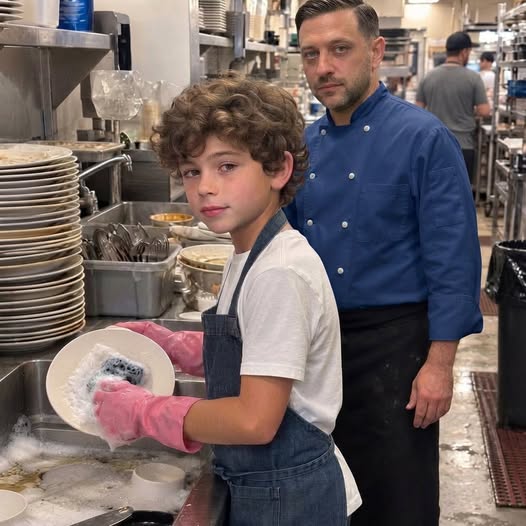
“You know,” he said, “he’s actually a pretty good dishwasher.”
Evan groaned.
“Sal.”
“What?”
“You’re making this worse.”
Sal laughed.
The tension in the kitchen finally broke.
Even Marissa smiled.
But there was still the matter of the money.
I asked Sal to show me the pay records.
He brought out the payroll book.
Evan had earned exactly what he said he had.
There had been no stolen cash.
No secret second job.
No older group waiting for him.
He had simply been using nearly all of his earnings to buy things for a family that needed help.
And he had kept just enough aside to keep believing that one day he might finally buy the bicycle.
I turned to Marissa.
“We need to talk about something.”
She nodded.
“I know.”
“I don’t want Evan paying your rent.”
Her face tightened.
“I never asked him to.”
“I believe you.”
I looked at my son.
“But he cannot be responsible for this.”
Marissa nodded.
“I agree.”
I didn’t have a magical solution.
I couldn’t suddenly erase every bill in her life.
I couldn’t promise her everything would be fine.
But I could do something.
I could help her find a local assistance program.
I could help her contact the school about transportation for her daughter.
I could help her look for work.
And most importantly, I could make sure Evan understood that compassion didn’t require him to become responsible for another family’s survival.
That night, when we finally got home, Evan went upstairs.
I followed a few minutes later.
His backpack was on the floor beside his bed.
The zipper was broken from how often he had been stuffing it with groceries, receipts, and cash.
I picked it up.
A small orange scrap of paper fell out.
I recognized it immediately.
It was the bicycle advertisement from the sporting-goods store.
The same matte black bicycle.
The same orange lettering.
The same price.
I carried it downstairs.
Evan was sitting at the kitchen table.
The same table where he had watched me count bills.
The same table where he had watched me say no to things.
I put the advertisement in front of him.
“You still want it?”
He looked at the picture.
Then at me.
“Yes.”
“Okay.”
His eyebrows lifted.
“Okay?”
“We’re going to figure it out.”
“But—”
“No.”
I raised a finger.
“You are not paying for anybody’s rent.”
He smiled faintly.
“You’re also not working every Saturday if your grades drop.”
“Okay.”
“And you’re going to tell me where you’re going.”
“Okay.”
“And if you want to help somebody, you tell me first.”
He hesitated.
“Even if you say no?”
“Especially then.”
He smiled.
“All right.”
I looked at the advertisement again.
“You know what else?”
“What?”
“You’re buying that bicycle.”
His eyes widened.
“Mom, no.”
“I didn’t say I’m buying it.”
He looked confused.
“Then what do you mean?”
“You’re still going to earn part of it.”
He laughed.
“And I’ll help with the rest.”
He stared at me for a moment.
“Really?”
“Really.”
He picked up the paper.
For the first time in six months, the bicycle didn’t look like a secret.
It looked like something we could talk about.
Something that didn’t have to compete with food, medicine, rent, or the needs of a little girl.
The following Saturday, Evan didn’t go to the diner alone.
I drove him.
Before he went inside, he looked at me through the open car window.
“Mom?”
“Yeah?”
“Can we still bring groceries to Marissa sometimes?”
I thought about it.
“Yes.”
His face brightened.
“But together,” I added.
He nodded.
“Together.”
He closed the car door and ran toward the diner.
I watched him disappear through the front entrance.
Then I looked down at the passenger seat.
There was a small paper bag sitting there.
Inside was the first piece of bicycle equipment he had bought with his own money.
A new orange water bottle.
I smiled.
Six months earlier, I had thought my son was saving every paycheck for a bicycle.
He wasn’t.
He had been saving something else.
Not money.
Not even the bicycle.
He had been trying to save a little dignity for people who had almost none left.
But he had also learned something I wished his father had lived long enough to teach him.
Being kind does not mean carrying everything alone.
Sometimes the most responsible thing a person can do is ask for help.
And sometimes a thirteen-year-old boy needs his mother to remind him that he is allowed to be thirteen.
A few weeks later, we went back to the sporting-goods store.
Evan stood in front of the same display window.
Matte black frame.
Orange lettering.
He looked at it for a long time.
Then he turned to me.
“That’s the one.”
“I know.”
He smiled.
This time, there was no backpack full of hidden cash.
No excuses.
No “almost there.”
Just my son standing beside me, holding the bicycle helmet we had bought together.
He reached for my hand.
And we walked inside.