The 1969 Trust – Full Story
The envelope slipped from her gloved fingers. It landed in the wooden bowl with a soft, dry thwack. The sound echoed off the vaulted ceiling, sharp and final.
Richard Sterling froze. His hand was outstretched, his fingers inches from the dark wood. His face flushed a deep, angry purple. The veins in his neck bulged against his crisp white collar.
“Give me that bowl,” Richard demanded. His voice cracked, echoing through the silent sanctuary. “The contents of the offering belong to the board. It’s church property.”
He stepped into the aisle. He reached for the heavy wooden bowl.
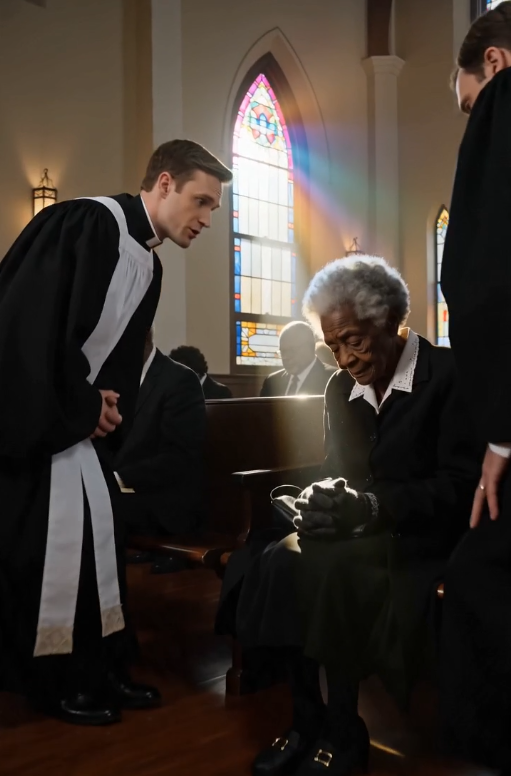
I moved faster. I stepped between him and the altar. My black robes brushed against the polished wood of the communion table. I placed my hand flat on the rim of the bowl.
“It’s not an offering, Richard,” I said. My voice didn’t rise. It just filled the space, bouncing off the stone pillars. “It’s a deed.”
The congregation shifted. The men in dark suits in the third row stopped looking at their phones. In the back row, two lawyers in grey suits—the developers’ legal team—sat up straight.
Richard laughed. It was a dry, hollow sound that died quickly in the heavy air. “A deed? Don’t be absurd, Thomas. The diocese owns this land. The board holds the title. I have the paperwork in my briefcase. That old woman is just confused. Step aside.”
He tried to push past me. His shoulder hit my chest. He was a big man, built like a linebacker, but I didn’t move. I kept my hand on the bowl.
“Sit down, Richard,” I said.
He stopped. He looked at me, his eyes wide with disbelief. He looked at the congregation. Three hundred pairs of eyes were locked on us. The silence wasn’t just quiet. It was heavy. It pressed against my eardrums, thick and suffocating.
I reached into the bowl. I picked up the tan envelope. The paper felt fragile, like dried leaves. I broke the wax seal. The red wax cracked with a sharp snap.
I pulled out the contents.
First, a black and white photograph. It showed a group of seven people sitting in these exact pews. The men wore wide lapels. The women wore pearl necklaces and white lace collars. In the center sat a young Mama Liza, her hair dark and braided, smiling next to a tall man with a thick mustache.
Underneath the photo was a heavy, linen-paper document. The edges were frayed. The ink was faded to a rusty brown.
I unfolded it. I read the header aloud. My voice carried to the back of the church.
“Land Trust Deed. Fulton County, Georgia. Dated October 14, 1969.”
Richard’s face drained of color. The arrogant smirk vanished, leaving him looking pale and sweating under the sanctuary lights.
“That’s a fake,” Richard stammered. He took a half-step back. “The diocese acquired this property in 1985. I have the transfer documents.”
“You have a management lease,” I corrected him. I looked down at the document. The legal text was dense, but the final paragraph was bolded. “This deed places the sanctuary and the surrounding two acres into a perpetual trust. The legal owners are the ‘Cross Heirs’. The diocese was granted a fifty-year management lease, contingent on the property remaining a house of worship.”
I looked up. I looked at Richard.
“The lease expired last Tuesday, Richard.”
The sanctuary went completely dead. The only sound was the hum of the HVAC system and the distant wail of a police siren on Peachtree Street.
The developers’ lawyers in the back row stood up. They didn’t look at Richard. They looked at each other. One of them pulled out his phone and dialed a number. “Cancel the wire transfer,” he whispered into the phone. “The title is clouded. The sale is dead.”
Richard lunged for the document. “You can’t do this! I’ll sue! I’ll tie this up in probate for ten years!”
“You can’t sue over a property you don’t own,” I said. I folded the document carefully. I placed it back inside the tan envelope. I slid it back into the wooden bowl.
I turned to Mama Liza. She was sitting back down in the front pew. Her hands were folded in her lap, the grey knit gloves resting on her black coat. She wasn’t looking at Richard. She was looking at the stained glass window above the altar. The afternoon sun was hitting the blue and red glass, casting a fractured, rainbow light across her face.
Behind her, an older man in a dark suit—her grandson, the church treasurer—stood up. He looked at the stained glass, his mouth slightly open, a single tear tracking down his cheek.
I looked back at the board of elders. Richard was slumped in his chair, his head in his hands. The other men in dark suits were quietly closing their briefcases. They knew. The game was over. The church wasn’t being sold. The sanctuary was safe.
I placed the wooden bowl on the altar, the yellowed envelope resting inside, bathed in the fractured light of the stained glass.