The 1892 Registry – Full Story
The yellowed page of the church registry sat open in my hands. The heavy leather cover felt like it was burning my palms.
“Read it, Julian,” Pastor Miller said. His voice was barely a rasp, but it carried through the quiet sanctuary.
I looked down at the faded ink. The date was October 14, 1892. The entry was written in my great-grandfather’s distinct, looping cursive. Silas Vance. But it wasn’t a property deed. It was a promissory note.
“I… I don’t understand,” I stammered. My heart hammered against my ribs. The air in the church felt suddenly thin. “This says Silas Vance borrowed fifty thousand dollars from Elias Johnson. To save his failing textile mill.”
Pastor Miller nodded slowly. He adjusted his glasses, his eyes locked on mine. “And it says that as collateral, Silas Vance signed over the deed to this land. The land your family has been claiming ownership of for a century.”
My stomach twisted. The room went dead silent. The hum of the stained glass windows seemed to roar in my ears. I flipped the page. The next entry was dated 1895. Silas Vance. Defaulted on loan. Property transferred to Elias Johnson in perpetuity.
“The Vance family didn’t buy this land,” Pastor Miller said softly. “You stole it. Your grandfather forged the 1920 survey maps to hide the original registry. He buried this book in the church archives and told everyone the Johnsons were squatters.”
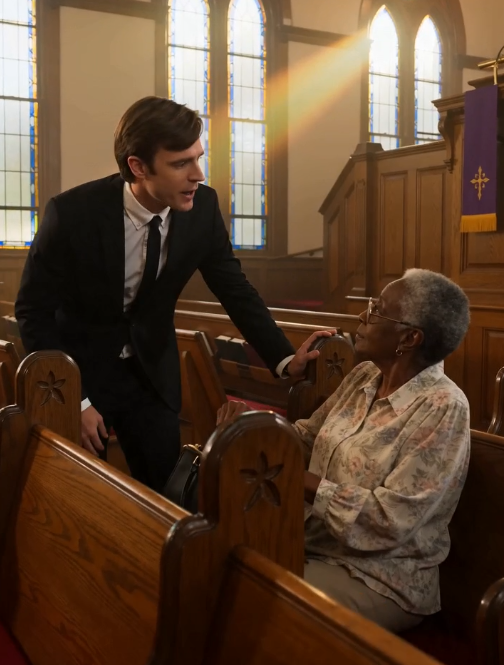
I looked up. Clara was still sitting in the third pew. She wasn’t looking at me with anger anymore. She was looking at me with pity. She knew. She had always known.
“Why are you showing me this?” I whispered. My voice cracked. “I’m a Vance. I work for Sterling Development. I’m here to evict you.”
“Because you’re not your grandfather,” Pastor Miller said. He closed the heavy book and pressed it into my hands. “And because Sterling Development is about to make a very expensive mistake.”
I walked back down the aisle. My polished oxfords clicked against the hardwood floor. Click. Click. Click. The sound echoed off the vaulted ceiling. I stopped in front of Clara’s pew.
She looked up at me. Her hands were resting on her worn leather purse.
“I read it,” I said. My voice was steady. I held out the thick leather book. “The Vance claim is a fraud. The land belongs to the Johnson family.”
Clara didn’t take the book right away. She just looked at my face, searching for the arrogance I had walked in with. It was gone.
“What are you going to do, Mr. Vance?” she asked. Her voice was soft, carrying the weight of eighty-two years of fighting.
I reached into my suit jacket. I pulled out the thick manila folder containing the Sterling Development acquisition contracts. The papers that would have bulldozed this church to build a luxury condo.
I dropped the folder into her lap.
“I’m going to quit,” I said. “And then I’m going to help you sue my family for back rent.”
Clara’s eyes widened. A small, fragile smile touched the corners of her mouth. She opened her leather purse and pulled out a gold fountain pen. She signed the bottom of the top contract, right on the line that transferred the legal defense of the property to my firm.
I turned and walked toward the heavy oak doors. I didn’t look back at the stained glass. I didn’t look at the red velvet pews. I just pushed the doors open and stepped out into the bright Chicago afternoon.
The heavy oak doors clicked shut behind me, leaving only the sound of the church organ starting to play.