She Berated the Teacher All Year FULL STORY
I did not get to stay frozen for long.
The firefighter behind me keyed his radio, said the room was a go, and then everything became hands.
Ms. Driscoll did not come out first. She passed them out first.
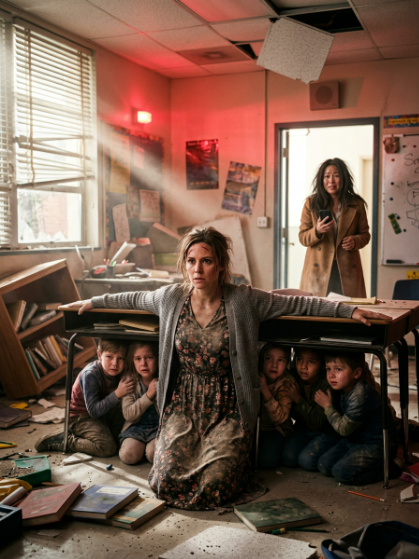
One by one, she guided each child from beneath the desks to the doorway, to me, to the firefighter, calm as a metronome. “This is Dylan, he’s a runner, hold his hand. This is Sofia, she needs her inhaler, it’s in the red bag. Mateo’s next.” She knew every allergy, every fear, every backpack. She handed me other people’s children as though they were the most precious cargo on earth — and to her, plainly, they were.
My son was last, because my son would not let go of her sleeve.
He’s seven. He has had a hard year. His father and I separated in the fall, and he stopped raising his hand in class and started bringing notes home, and I — God help me — decided the problem was the teacher.
I emailed about everything. Not enough homework. Too much “feelings time.” Why was he in a reading group with a specialist, was she labeling my son, who did she think she was.
What I would not hear, in a single one of those emails, was the thing she kept trying to tell me gently at every conference: that my boy wasn’t behind, he was grieving, and that she was giving him a soft place to land while the rest of his world came apart.
“Too soft,” I had called it. To her face, once.
Now “too soft” was on her knees under a cracked ceiling, refusing to leave my grieving son until his hand was safely in mine.
We got out. All nine. A scraped knee and her split forehead were the worst of it — which in a 6.4 is a miracle with a name, and the name was Abby Driscoll.
In the parking lot, while the aftershocks rolled through like passing trucks, my son wouldn’t stop crying. Not from fear. He was crying because Ms. Driscoll was being loaded into an ambulance and he needed to know whether she would be at school tomorrow.
I followed that ambulance. I sat in the ER waiting room of the woman I had spent a year trying to get fired, and I made the first phone call.
To the principal. To withdraw every complaint in my son’s file.
When they let me back into the hospital hallway, I found her sitting up with butterfly bandages over her eyebrow, already asking a nurse whether all of her kids had been picked up by their families. Not whether she was alright. Whether they were. I started to apologize and she waved it off — “Not now, Mrs. Cho, you’re shaking, sit down” — and somehow her being gentle with me, after everything, was the thing that finally broke me open.
It wasn’t enough. Withdrawing cruelty is not the same as undoing it.
So at the next school board meeting — the public one, with the microphone, the same kind of room where I had once stood demanding her head — I got up and said the rest of it out loud. That I had been wrong. That I had aimed my own grief and guilt at a young teacher because she was a safer target than my divorce. That she had protected my child in the most ordinary way for a year, and in the most extraordinary way for ninety seconds, and that I had repaid her with a paper trail.
The board listened. And then they did the thing I should have done months before. They listened to her.
It turned out Ms. Driscoll had been quietly running an under-resourced classroom in a building everyone knew wasn’t up to current seismic code. She had asked, twice, for the retrofit. Both requests had gone into a drawer.
They don’t go into a drawer anymore.
The district funded the retrofit that spring. They wrote a real protocol — the one she’d been improvising with two desks and her own body. And at the end-of-year assembly they gave her a commendation she tried to wave off, because women like her always do.
I was in the audience. I had asked to be. When they read aloud what she’d done, my son stood up on his chair to clap, and I let him, because some rules are foolish in the face of the right moment.
He raises his hand in class again now. He’ll tell you, if you ask, that his teacher is the strongest person he knows.
I used to think strength was the parent who fought the loudest.
I know better now. I learned it in a doorway, in the dust, watching a woman I had wronged count someone else’s children to safety before she would save herself.