Refuses the Deed FULL STORY
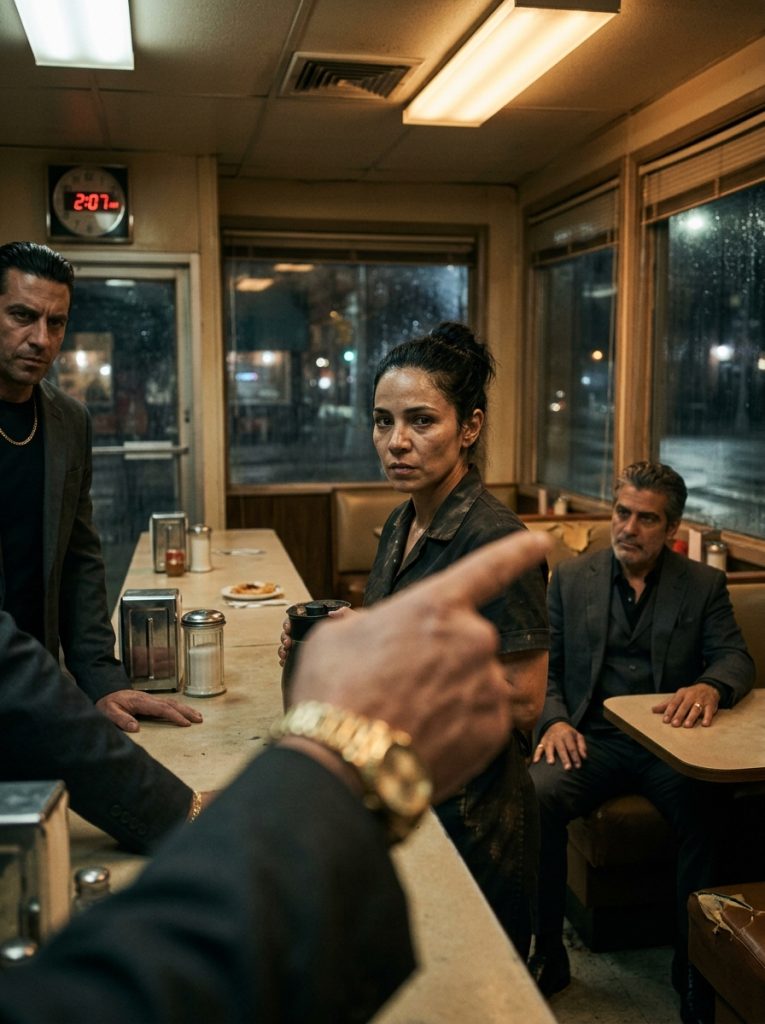
The man in the corner booth didn’t leave when the enforcers did.
He stayed until my shift ended at 6 AM — three and a half hours, nursing the same cup of cold coffee. I didn’t approach him. Something about the way he sat there, perfectly still, warned me that questions wouldn’t be welcome.
When I clocked out, he was gone.
The next seventy-two hours were the longest of my life.
I didn’t tell the kids. How could I? Victor was seventeen and finally talking about college applications. Dani was fifteen, just starting to trust the world again after three failed placements. Isaiah was twelve and still woke up screaming from nightmares about the group home he’d aged out of before I found him.
These were not children who needed to learn that their safety could be revoked by men with gold chains.
I called my landlady and asked for an extension on the rent. She said no.
I called the legal aid clinic in downtown Brooklyn. They said they could see me in six weeks.
I called my sister in Florida — the only family I had left. She didn’t answer.
Thursday night, I sat on my bedroom floor at 2 AM, the deed to the house spread across my knees, and I let myself cry for exactly ten minutes. Then I wiped my face, checked that the kids were asleep, and made a decision.
I would not surrender the deed.
Even if it meant losing everything.
Friday arrived like a held breath.
I sent the kids to school as if nothing was wrong. Victor gave me a strange look — he’d always been perceptive — but I told him it was just work stress. He nodded. He didn’t believe me.
The enforcers came at 7 PM.
I was standing on the front porch, still in my waitress uniform, one hand in my pocket wrapped around my phone with 911 already dialed — just not yet pressed.
The dark sedan pulled up slow. Two doors opened. The same two men. The bigger one cracked his knuckles. The smaller one smiled.
“Last chance, Mrs. Guerrero,” he said. “The deed. Or we come inside.”
“You’re not coming inside my house.”
He laughed. “Lady, you don’t get to decide that.”
He took one step toward the porch.
Headlights flooded the street.
Three black Escalades pulled up in a perfect line behind the sedan. Doors opened in unison. Eight men stepped out — suits, no chains, no smiles. The kind of men who didn’t need to announce themselves.
And from the center vehicle, wearing the same charcoal three-piece suit from the diner, stepped the man from the corner booth.
Dominic Castellano.
The enforcers froze.
“Who the hell are you?” the big one demanded.
Dominic didn’t answer. He walked past them like they were street furniture. Past the sedan. Past the broken concrete of my sidewalk. He stopped at the bottom of my porch steps and looked up at me.
“Mrs. Guerrero,” he said. His voice was quiet. Gravelly. “My name is Dominic Castellano. I believe you stitched up my hand three months ago outside the diner. You didn’t know who I was. You still don’t. But I’ve been watching over you and those children ever since.”
I remembered. A man bleeding in the alley. I’d grabbed the first-aid kit from the kitchen, wrapped his hand tight, told him to go to a hospital. He’d looked at me with something I couldn’t identify and said, “I won’t forget this.”
I’d forgotten.
He hadn’t.
Dominic turned to face the enforcers. He didn’t raise his voice. He didn’t gesture to his men. He simply looked at them — the way a man looks at something he’s already decided to remove from the world.
“The debt Carlos Vega owed your employer no longer exists,” he said. “It has been purchased and retired. You will leave this neighborhood. You will not return. And you will tell anyone who asks that the Guerrero household is under my protection.”
The big one opened his mouth.
Dominic tilted his head one degree.
The mouth closed.
They got in their sedan and drove away. I never saw them again.
I stood on my porch, shaking, one hand still in my pocket, still gripping the phone that no longer mattered.
“Why?” I managed. “I barely helped you. It was a bandage.”
Dominic looked at the house. At the light in the upstairs window — Isaiah’s room. At the basketball in the driveway. At the wind chime Carlos had hung the month before he died.
“You gave me kindness when you had nothing to give,” he said. “You were a stranger who saw a bleeding man and didn’t look away. In my world, that is not a small thing.”
He handed me an envelope.
Inside was a notarized document. The deed to my house — transferred into a trust under the name of someone I’d never heard of. A trust that paid the mortgage in full and could not be touched by creditors, loan sharks, or anyone else.
“The men who held your husband’s debt are gone,” Dominic said. “The loan is closed. The house is yours — truly yours — for as long as you want it.”
I couldn’t speak.
“You’ll never see me again,” he added. “But if anyone ever threatens your family, someone will be watching.”
He turned and walked to his Escalade.
The convoy pulled away.
And I stood on my porch in my stained waitress uniform, holding a piece of paper that meant my children would never have to be afraid again.
I didn’t know then that three weeks later, a scholarship fund would appear in Victor’s name. That Dani’s after-school program would receive an anonymous donation large enough to keep it running for a decade. That Isaiah’s therapist would suddenly and inexplicably begin accepting our insurance.
I never saw Dominic Castellano again.
But every Friday night, when I locked up the diner, I noticed the dark sedan parked across the street — just far enough away to be invisible, just close enough to matter.
And every Friday night, I left a cup of black coffee on the counter.
Just in case.