Ordered to Fetch Coffee FULL STORY
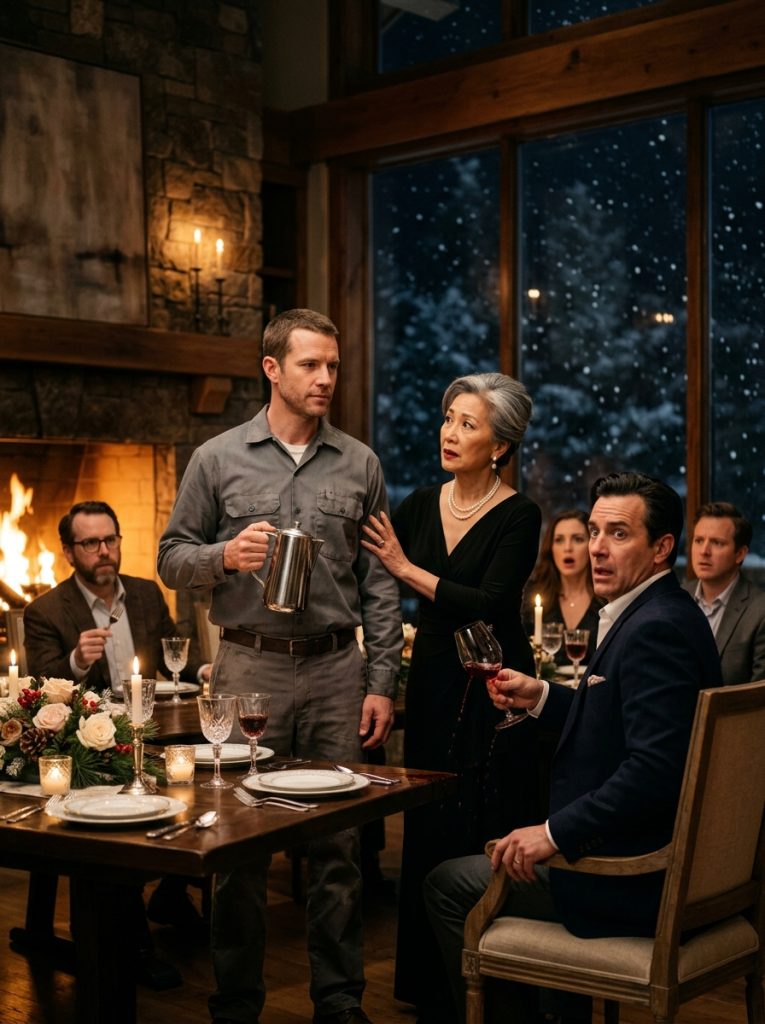
Bradley Thorne’s wine glass tipped and spilled Merlot across the white tablecloth.
He didn’t notice.
He was too busy staring at me like I’d just sprouted a second head.
“Jake Morrow?” he repeated. “Of Morrow Hospitality Group? That’s his company?”
Ms. Chen — Margaret Chen, the lead investor and the woman who’d known me from a real-estate conference in Denver six years earlier — released my arm and turned to face Bradley with an expression that could have frozen the fireplace.
“Mr. Morrow’s group,” she said, “owns seventeen luxury properties across seven states. His portfolio includes the Cliffside Resort in Malibu, the Park Avenue Tower in Manhattan, and — if I’m not mistaken — this very chalet.”
Bradley’s mouth opened but no sound came out.
I set down the coffee pot.
“Ms. Chen is correct,” I said quietly. “I purchased the Aspen Chalet six months ago through a holding company. It was a distressed asset — the previous owners had mismanaged it into near-bankruptcy. I saw potential.”
The three other investors had stopped eating entirely. One of them — a silver-haired man in a gray suit — lowered his fork and stared at me with the expression of a man who was mentally recalculating every assumption he’d made in the last hour.
“Why?” Bradley finally managed. “Why would you be mopping floors if you own the building?”
“Because I wanted to see how my own staff was being managed.”
I unbuttoned the top of my janitor’s uniform. Underneath was a collared shirt. Understated. Expensive. The kind of shirt a man wears when he doesn’t need to prove anything.
“For six months,” I said, “I’ve watched you, Bradley. I’ve watched you treat the housekeeping staff like furniture. I’ve watched you cut corners on maintenance while padding your expense account. I’ve watched you humiliate employees in front of guests and investors alike — because you thought they couldn’t fight back.”
I turned to face the investors.
“The Aspen Chalet is a beautiful property. It deserves management that treats every person who works here — from the head chef to the night janitor — with dignity. I came here tonight to confirm what I already suspected.”
I looked back at Bradley.
“You’re fired.”
“You can’t fire me,” Bradley sputtered. “I have a contract. I have —”
“You have a termination clause,” I said. “Paragraph fourteen. ‘Gross misconduct or behavior that brings the establishment into disrepute.’ Humiliating a staff member in front of investors qualifies. I’ll have HR process the paperwork in the morning.”
Bradley stood there — wine stain spreading across the tablecloth, tie slightly askew, every ounce of his polished authority gone. He looked at the investors for support. None of them met his eyes.
He left without another word.
The room was very quiet.
Ms. Chen — Margaret — was the first to speak.
“Jake,” she said, and her voice had changed. It wasn’t the voice of a business acquaintance anymore. It was something warmer. “Why didn’t you tell anyone?”
“Because I didn’t want special treatment. I wanted to see how the hotel operated when nobody thought the owner was watching.”
“And what did you learn?”
I thought about it. About Tiffany in the kitchen, who’d looked at me with apology when Bradley snapped his fingers. About the dishwashers who’d turned their backs. About the front-desk clerk who’d whispered “good luck” when I walked past with the coffee pot.
“I learned that the people who do the real work in this hotel are invisible,” I said. “And I learned that I never want them to feel that way again.”
The investors stayed for another hour. We talked about the expansion. About the staff. About a new management philosophy that started with respect instead of hierarchy. By the end of the night, Ms. Chen had agreed to increase her investment by thirty percent — on the condition that I personally oversaw the transition.
The next morning, I called an all-staff meeting in the lobby.
A hundred and twenty employees — housekeepers, cooks, servers, maintenance workers, front-desk clerks. Every person who had ever walked past me without noticing.
I stood at the front in the same gray janitor’s uniform I’d worn the night before.
“Some of you know me as the night janitor,” I said. “I’d like to reintroduce myself. My name is Jake Morrow. I own this hotel. And starting today, every single person in this room is getting a raise.”
Tiffany, the head chef, started crying.
The dishwashers looked at each other in disbelief.
And the front-desk clerk who’d whispered “good luck” the night before — her name was Alicia — raised her hand.
“Mr. Morrow,” she said, “does this mean you’re done mopping floors?”
I smiled.
“Old habits,” I said. “But I think I’ll let someone else handle the coffee from now on.”