“One of You People Took My Father’s Money” FULL STORY
The administrator, Ms. Okafor, pulled the records that afternoon. All of them. Greg practically dared her to.
He shouldn’t have.
Because the pension money never touched a single staff pocket. It had been auto-routed for two years straight to an account Greg controlled — set up under a power of attorney he’d had Harold sign during a “confused spell” that the nurses’ notes, it turned out, never actually recorded. There was no confused spell. There was a son with a pen and a father who trusted him.
That month, the deposit failed for one reason: the bank had finally flagged the account for suspicious withdrawals and frozen it.
Greg hadn’t come because his father’s money went missing.
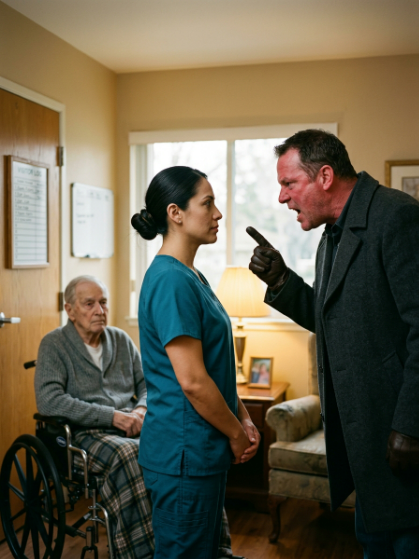
He’d come because his own pipeline had stopped.
I watched it land on him as Ms. Okafor laid the statements on the table. Two years of transfers. His name on every one. The frozen account. The withdrawals that had nothing to do with Harold’s care and everything to do with a boat slip and a leased Mercedes.
“That’s — you can’t prove I knew—” he started.
“Mr. Brennan,” Ms. Okafor said, “I’m required to report this. Today. To Adult Protective Services and to the police. The power of attorney is being challenged as of this hour.”
Greg looked at me then, like I’d done it to him. Like the aide in the teal scrubs had reached into his life and pulled the floor out.
I hadn’t. He’d done all of it himself. I’d just refused to flinch.
And then Ms. Okafor did something I didn’t expect. She turned the visitor log around on the desk and slid it toward Greg.
Two years of pages. Almost every single day, one name signed in.
Mine.
“While you were draining his pension,” she said quietly, “this is who was visiting your father.”
She set down a folder beside it. Receipts I didn’t know anyone had been keeping. The reading glasses. The slippers. The birthday cake from the grocery on Fulton Street. The jazz record. Small amounts, off my aide’s paycheck, spread across two years.
“And this,” she said, “is who was paying for the things you let him go without.”
I felt my face go hot. I had never wanted any of that seen. You don’t do those things to be thanked. You do them because Harold Brennan worked forty years for people who left him by a window, and no one should spend the end of his life invisible.
But Harold had been listening to all of it from his wheelchair. And in that moment, my quiet old man — who I’d watched go silent and small for years — found his voice.
“Get out, Greg,” he said.
Just that. Steady. Final. The voice of a man who’d finally seen the whole picture and didn’t need another second to decide.
Greg got out. The investigation took it from there.
What happened after still sits strangely in me.
Harold asked for a lawyer. A real one, one the facility helped him find. In a long lucid afternoon, clearer than I’d seen him in a year, he revoked Greg’s power of attorney, named me his medical proxy, and rewrote his will.
He left what little the pension hadn’t been bled of — and the small house his children had been so sure was theirs — to me.
I told him no. I told him I didn’t do any of it for that, that it would look wrong, that I didn’t want it.
He took my hand the way Eleanor must have once, and he said, “Marisol. For two years you were the only one who treated me like I was still a person. Let an old man decide who his family was. You don’t get to argue with that.”
So I stopped arguing.
The bittersweet part — the part I carry — is that we didn’t have long.
Harold’s health had been failing under the neglect longer than anyone admitted. He passed that spring, in his sleep, with the jazz record playing low and his hand in mine. Three weeks after he got his voice back.
But here is what I know.
He didn’t die forgotten. The facility held a real service. Staff filled the room — the ones who’d watched me wheel him to the garden, who’d quietly slipped him extra dessert, who knew. Ms. Okafor spoke about what dignity costs and who pays it.
Greg didn’t come to that, either. Some things don’t change.
I kept the jazz record. I kept the visitor log page, the one Ms. Okafor tore out and pressed into my hands after.
And on the hard days, when this work feels like shouting into a building full of people the world set down and walked away from, I look at that page. All those dates. One name, over and over, signed in beside a man who deserved every visit.
His chair by the window is empty now. Somebody else sits there.
I sign in for them too.