One Leaked Photo of Us Shoulder to Shoulder Made Him the Villain by Noon FULL STORY
The board called before we’d even reached the gate.
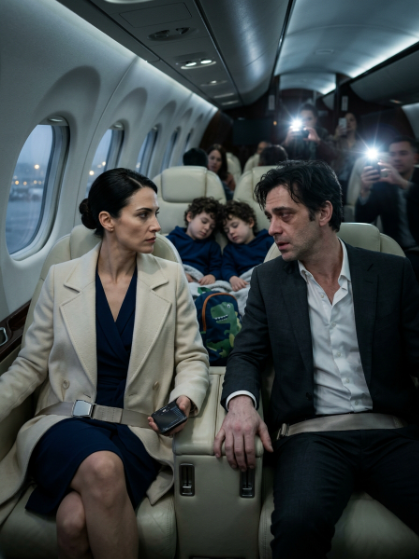
Adrian’s phone buzzed against the armrest, the chairman’s name lighting up over a headline that called him a predator. He stared at it. The twins were still asleep against the window, Theo’s hand fisted in Max’s hoodie the way it had been for the whole descent.
He turned the phone face-down on his knee and let it ring out.
“Aren’t you going to take that,” I said. Not really a question.
“They’re going to ask me to issue a statement,” he said. “About you. About ‘the incident on the flight.’ They’ve wanted me out since I voted against selling the desalination patents to a company that would’ve buried them. This is the lever. A photo and a story that writes itself.” He looked at the boys. “I’m not giving a statement about my children to save a board seat.”
I want to be honest about how strange that sentence was to hear.
Five years ago, Adrian Vos would have given a statement about anything to save anything. The company was the love of his life. I left, in part, because there wasn’t room in it for me — and because of the messages.
He’d found texts on my phone from a man’s name he didn’t recognize, late at night, frequent. He decided what they meant without asking. The man was Dr. Sandoval, a high-risk OB. I was nine weeks pregnant with twins and terrified, and I hadn’t told Adrian yet because every time I tried, he was on a call to Singapore or Berlin or wherever the company needed him more than I did.
By the time he accused me, I’d already decided. A man who’d believe that of me, who’d build a story out of a phone he never asked about — I didn’t want my sons raised inside that. So I let him keep his version. I left, and I let the world assume the billionaire had discarded the wife, because that story kept reporters away from two cribs.
I raised Theo and Max alone, in a town where nobody cared who their father was.
Three weeks ago, Adrian’s mother died. The boys and I weren’t on any list, but I went to the service in the back, because she had been kind to me once, and I brought the boys because they should see where half of them came from even if they never knew the man.
He saw us across the chapel.
He saw their faces. His face, in miniature, twice.
He didn’t make a scene. He found me after, white as paper, and asked one question: “How old are they.”
When I told him, he did the math that ended his version of our marriage. Five years. The timing. The messages from a doctor.
We agreed to talk properly, away from the noise — which is how a clean-energy founder and his environmental-lawyer ex-wife ended up on the same flight home with two five-year-olds, sitting shoulder to shoulder, his head bent toward mine while I told him, quietly, everything he’d gotten wrong, and everything I had too.
That’s the photo.
A stranger four rows back shot a man leaning toward a woman and sold the cruelest possible read of it. The seat with the boys got cropped because cropping is how a lie gets made — you don’t invent, you just cut.
On the tarmac, Adrian called the chairman back.
I heard one side of it. “No, I won’t be issuing that statement. No. Because the woman in the photograph is the mother of my children, and the seat your headline cut off had my sons in it. You can run the company without me for an afternoon. I’m going to carry one of them through baggage claim.”
He hung up.
The board pushed anyway. There was a vote. They had the optics; for about seventy-two hours, they had the narrative too. Then the same instinct I’d used to protect the boys, Adrian used to free them: he gave one interview, to one reporter, and he didn’t talk about the company at all. He talked about being a man who once believed a phone over his wife, and what it cost him, and what it cost her, and that the only thing he was certain of now was that he was done letting other people write the story of his family.
It didn’t save the board seat. He stepped down from the CEO role within the month.
It did something better. The desalination patents he’d protected went to a nonprofit consortium, where the board could never sell them. He kept enough of the company to be comfortable and walked away from the part that had eaten his first marriage alive.
He and I are not back together. I want to be clear about that, because the internet wanted a fairy tale and that’s not what this is. Trust that breaks at nine weeks pregnant doesn’t reset because a man finally does the right thing five years late.
But Theo and Max have a father now. A clumsy, overcorrecting, present father who shows up at the soccer field where nobody photographs him and lets a five-year-old beat him at a game he’s pretending not to try at.
The photo is still out there. People still think they know what it shows.
Two adults, shoulder to shoulder, a man leaning in.
They’ll never know it was the most honest conversation we’d had in six years, or that just out of frame, two little boys were sleeping through the whole thing — the only part of the picture that ever actually mattered.