On the Night They Released Me After Seven Years, No One Was at the Gate FULL STORY
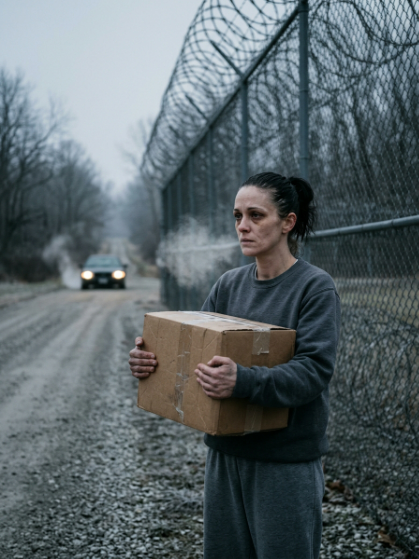
I stood there in the cold with my cardboard box, and I looked at the folder in Diane Foss’s hand, and I felt something I hadn’t let myself feel in seven years.
A choice.
Here’s what she was really offering me. The bank’s old security system had backed up to a separate server nobody ever wiped. On that footage was the loading dock of our family’s warehouse on the night of the fire. And on that footage, at 11:48 p.m., was my sister Robin — not me — carrying a gas can.
It was everything. Seven lost years, handed back as evidence. With that tape my conviction would be vacated. My name cleared. And Robin would go to prison for arson and fraud and for letting her own sister rot in her place.
“You don’t have to decide tonight,” Diane said gently. “But I have to be honest with you, Dawn. If we file this, it doesn’t just free you. It charges her. The same tape that exonerates you convicts her. There’s no version where only the good half happens.”
I thought about my sister.
I thought about her two kids — my niece and nephew — who’d been four and six when I went in and were eleven and thirteen now, who’d grown up while I counted ceiling tiles. I thought about how Robin had visited twice in seven years and cried both times about parking.
And I thought about our mother.
Our mother died in year four. She died believing I’d burned down the family business and stolen the money meant for her retirement. She died ashamed of me. I wasn’t allowed to go to the funeral. I found out she was gone from a chaplain holding a printout.
That’s the wound, if you want to know. Not the seven years — years I can rebuild. It’s that my mother went into the ground thinking her daughter was a liar, when the truth is I went to prison to protect the daughter who actually was one.
People assume I sat in that cell dreaming of revenge. I didn’t. Mostly I dreamed of ordinary things. Rain. A door I could open myself. Coffee in a real cup.
But standing at that gate, holding the tape that could finally make it right — I’ll be honest — for about thirty seconds I wanted Robin to feel every single thing I’d felt. I wanted her to learn what the food tastes like.
Thirty seconds.
Then I thought about those kids again. Eleven and thirteen. Almost exactly the ages Robin and I had been when our father left and I started raising her, because our mother was working three jobs.
I had spent my whole life protecting my little sister. I went to prison protecting her. And the cruel joke is that the habit doesn’t just switch off because she didn’t deserve it. Love isn’t a verdict. It doesn’t care about evidence.
But I was done being a martyr. A martyr protects the guilty by destroying herself, and I had a mother in the ground who deserved a daughter with a clean name, even if she could no longer hear it.
So I made a different choice. A third one — the one Diane hadn’t offered, because she didn’t know it existed.
“File it,” I said. “Clear my name. I want the record fixed. I want it on paper, in a courtroom, that I didn’t do this. My mother’s headstone is going to know the truth, even if she couldn’t.”
“And your sister?”
“The tape tells the truth,” I said. “I won’t lie to protect her anymore — that’s what put me here. But I won’t be the one who hunts her down, either. I’ll testify to exactly what happened. No more, no less. If the truth convicts her, then it’s the truth doing it. Not me. I’m finished carrying her sentence, and I’m finished choosing it for her, too.”
Diane looked at me a long moment, then nodded — like she was seeing something rarer than innocence.
So that’s what we did.
My conviction was vacated eleven weeks later. A judge said the words “actual innocence” in open court, and I felt seven years come loose from my shoulders in a single breath.
Robin was charged. The tape doesn’t lie, and a jury watched her carry the can. She took a plea.
Her kids — my niece and nephew — write to me now. The state placed them with a decent aunt on their father’s side. The first letter from my niece said: Mom told us you did it. We’re sorry we believed her. We found the visitor logs. We know you came to nothing and she came to everything.
I didn’t ask for that. But I wrote back. Of course I wrote back.
I drove out to my mother’s grave the week I got out. I sat in the grass and told her everything. That I was sorry I’d let her die ashamed. That I’d been protecting Robin — which she’d understand, because she spent her whole life protecting us.
And I told her my name was clean now. Keller. The good kind.
I don’t know if the dead can hear. But I left the court document on her headstone with a rock on top so the wind wouldn’t take it, and I like to think the truth soaked down into the ground where she could finally read it.
There was no one at the gate the night they let me out.
But I’ve decided that isn’t the end of the sentence.
There was no one at the gate — so I had to walk out on my own. And it turns out a woman who can walk out of that place on her own two feet, carrying nothing but a box and the truth, doesn’t actually need anyone waiting.
She just needs to know which way is forward.
I’m still learning. But I’m walking. And every step is mine.