On the Night Everyone Else Stopped Waiting FULL STORY
She said my name like a question, and then she couldn’t say anything at all.
I caught her before her knees finished giving out, right there at the top of the porch steps, under that one yellow bulb she’d never let go dark.
My mother is a small woman. She felt smaller than I remembered. She gripped two fistfuls of my dusty uniform and pressed her face into my chest and made a sound I had never heard a person make — not a scream, not a sob, something older than both.
Duke wove between our legs in circles, the only one of us making any noise.
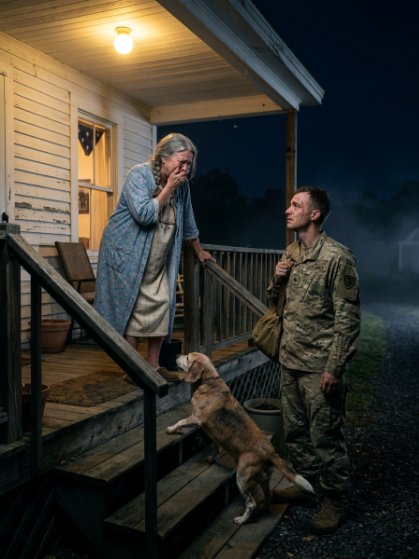
“You’re warm,” she kept whispering into my jacket. “They told me — they gave me a flag, Caleb. They gave me a flag.”
“I know, Mama,” I said. “I know.”
I want to tell you it was all joy. The reunion stories online always end at the doorstep, with the music swelling.
The truth is harder and I think more worth telling.
Inside, while she made coffee with shaking hands at two in the morning because neither of us was going to sleep, I learned what nineteen months does to the people who stay.
My father hadn’t lived to the funeral. His heart, six weeks after the flag came. My mother said it plain, the way grief gets plain after enough of it: “He just didn’t have a reason to keep going, and I did, and the reason was being stubborn about that porch light.”
My older brother had moved to Denver. We’d never been close, and the not-being-close had calcified into silence. He’d told our mother to take the light down. To stop torturing herself. To accept it.
She hadn’t.
The whole town had, gently, in the way small towns do. Casseroles, then condolences, then a slow turning-back toward their own lives. By the time I walked up that road, I was a name on a churchyard stone and a folded flag in a cedar box, and the only person on earth still actively, stubbornly waiting was the woman pouring me coffee.
“How,” she finally asked. “How are you here.”
I told her what I could. That the report had been wrong. That for a long stretch I’d been somewhere with no way to send word, and then somewhere being put back together, in a hospital overseas with a wristband and a long row of other men the world had also misplaced. That the Army had been working to undo a death certificate, which it turns out is much harder to undo than to issue.
I didn’t tell her all of it. Some of it isn’t hers to carry. A son gets to keep some weather to himself.
What I told her was the part that was true all the way down: that on the worst nights, the ones where it would have been easier to stop, the thing I held onto wasn’t a flag or a country or even a face.
It was a porch light.
I didn’t know she’d really kept it on. I just decided to believe she had. I built a whole survival out of a yellow bulb I couldn’t see.
And she’d kept it burning the entire time.
Morning came up gray over the gravel drive. She fell asleep finally around six, sitting up on the couch with her hand fisted in my sleeve like I might dissolve, and I sat there and let her hold on.
The days after were a strange machine of paperwork. A man has to prove he is alive, it turns out, to a great many offices that have already decided he isn’t. I sat across desks from clerks who stared at me like a ghost asking for his own bank account back. My mother came to every appointment. She’d hand them the death certificate and then point at me and say, “Does he look dead to you?” until they fixed it.
My brother flew in. We stood in the kitchen, two grown men who’d forgotten how to talk, and he said, “I told her to take the light down.” His voice broke on it. “I told her to give up. And she didn’t, and she was right, and I — ” He couldn’t finish.
“You were trying to help her stop hurting,” I said. “She just hurt in a different direction.”
We’re not fixed, my brother and me. But we’re talking. That’s new. That’s something the missing months gave us, strangely — a reason too big to keep being silent over.
The porch light’s still there.
My mother offered to take it down now that I’m home, since the waiting’s over. I told her to leave it.
Some nights I sit out there with Duke and a cup of her coffee and watch the moths come to it, and I think about all the people the world quietly stops waiting for. The ones who become a stone and a folded flag.
And I think about how every single one of them deserves one window that refuses to go dark.
Mine did.
I’m sitting under it right now.