My Son Wanted Me Out of His Life Until He Needed What I Owned
PART 3 (FULL STORY)
I reached for the envelope before David could disappear through the patio door.
He stopped.
For a moment, neither of us moved.
“What is that?” I asked.
David looked down at the envelope in my hand.
Then he looked at me.
“Mom, please.”
That single word told me more than any explanation could have.
I turned the envelope over.
There was no return address.
My name was written across the front in the precise handwriting of Eleanor Price, the attorney who had handled my estate planning for nearly fifteen years.
I looked back at my son.
“You brought my lawyer’s paperwork to Christmas?”
David rubbed a hand across his face.
“It isn’t like that.”
“Then tell me what it is.”
He opened his mouth, but no answer came.
Behind him, I could see Zuri standing near the fireplace.
She was watching us.
So was her sister.
And suddenly I understood why David had come outside.
He wasn’t worried about me freezing.
He was worried about what I might find.
I opened the envelope.
Inside were several pages.
The first was a letter from Eleanor.
The second was a copy of a document I recognized immediately.
My power of attorney.
I read the first paragraph twice.
Then I looked at David.
“Why is my name crossed out here?”
He went pale.
“I told you, Mom. We’re trying to make things easier.”
“You changed my power of attorney.”
“No.”
“Then why does this document appoint Zuri?”
He stared at the snow.
I felt something inside me settle.
Not anger.
Not yet.
Something colder.
“You were planning to put me in a facility,” I said.
David swallowed.
“We were going to find somewhere safe.”
“And take control of my finances.”
“That’s not what this is about.”
I held up the papers.
“It is exactly what this is about.”
The patio door opened again.
Zuri stepped outside.
Her expression had changed completely.
The playful Christmas hostess was gone.
“Myrtle, you’re misunderstanding everything.”
I looked at her.
“Then explain it.”
She folded her arms.
“You have Parkinson’s. You live alone. David and I have responsibilities. We can’t spend every day worrying about whether you’re going to fall or forget something.”
“You weren’t worrying about me tonight.”
“That isn’t fair.”
“No,” I said. “The card wasn’t fair.”
Her mouth tightened.
David stepped between us.
“Can we please do this somewhere else?”
I shook my head.
“No.”
I walked back inside.
The room seemed smaller than it had ten minutes earlier.
The children had stopped opening their presents.
One of my granddaughters was holding a silver ribbon in her lap and watching me.
Zuri’s sister looked uncomfortable.
David closed the patio door behind us.
I placed the documents on the dining table.
Then I placed the Christmas card beside them.
“Since everyone was laughing earlier,” I said, “we might as well finish this conversation together.”
Nobody laughed.
I looked at my grandchildren.
“I am not dying.”
Their eyes dropped.
“I have a disease,” I continued. “That is not the same thing.”
David whispered, “Mom.”
I turned toward him.
“You were twelve when your father left.”
His face changed.
“You remember that?”
“I remember everything.”
I told them about the overtime shifts.
The college tuition.
The business loans.
The mortgage payments.
Not because I wanted gratitude.
Because I wanted David to understand what had actually happened.
Every time he had fallen, I had helped him stand.
But the moment my hands began to shake, he had decided I was the one who needed to be removed.
Zuri interrupted.
“You’re making this sound much worse than it is.”
I picked up the card.
“Your words made it pretty clear.”
Then I noticed something I had missed earlier.
The inside of the card contained another handwritten message.
Not from Zuri.
Not from David.
I recognized the handwriting immediately.
It was my granddaughter Lily’s.
I looked at her.
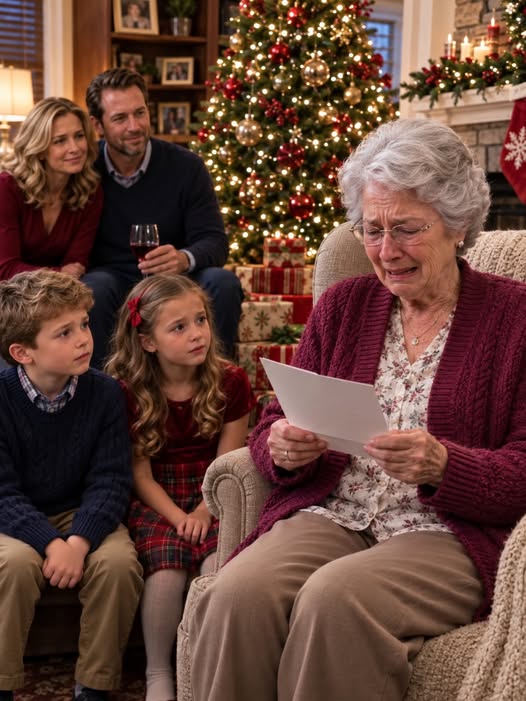
She began crying.
“I’m sorry, Grandma.”
David turned sharply.
“Lily.”
She flinched.
“I didn’t know they were going to read it.”
Zuri’s face hardened.
“What are you talking about?”
Lily wiped her cheek.
“You told Dad to give Grandma the card because you wanted her to understand that she couldn’t stay here anymore.”
The room went still.
I looked at David.
He didn’t deny it.
Lily continued.
“You said Grandma’s house would be easier to manage if she moved into assisted living.”
My fingers tightened around the card.
“And what did you mean by manage?”
Lily looked at her father.
“He said the house could be sold.”
There it was.
The part they had carefully avoided saying aloud.
My home.
The house I had bought after Harold left.
The house where David had grown up.
The house that had appreciated enormously over the years.
I looked at my son.
“You weren’t trying to protect me.”
He closed his eyes.
“We have debt.”
The admission came so quietly that for a second I barely heard it.
Zuri stepped closer.
“David’s business is struggling again.”
“Again?”
He looked ashamed.
I almost felt sorry for him.
Almost.
“How much?”
He didn’t answer.
“How much, David?”
“Enough.”
I waited.
Finally he said, “Almost two hundred thousand.”
I nodded slowly.
“And you thought my house would solve it.”
Zuri spoke before David could.
“We thought you would want to help your family.”
I looked at her.
“You didn’t ask.”
“You would have said no.”
“Yes.”
That answer seemed to surprise her.
I folded the Christmas card carefully.
Then I tore it in half.
The sound was surprisingly small.
“I am not giving you my house.”
David’s eyes lifted.
“I didn’t say—”
“You didn’t have to.”
I gathered the documents from the table.
“I am also revoking the power of attorney.”
His face drained of color.
“Mom, please.”
“No.”
“I made a mistake.”
“You made a plan.”
He looked at me with the same expression I had seen when he was twelve years old and knew he had done something wrong.
But he wasn’t twelve anymore.
He was a grown man who had made a calculated decision.
“I thought you were going to leave us with nothing,” he said.
I stared at him.
“You were already trying to take everything while I was still alive.”
Zuri began crying.
Not dramatically.
Just quietly.
For the first time that night, I believed her tears might be real.
But they didn’t change what had happened.
I told them I would contact Eleanor in the morning.
I told David that if he needed financial advice, I would listen.
But I would not rescue his business.
Not again.
I left shortly before midnight.
The snow had started falling harder.
David followed me to the porch.
“Mom.”
I turned.
He stood there without his coat, shivering in the doorway.
“Can I come see you tomorrow?”
I studied his face.
“Why?”
He looked down.
“Because you’re my mother.”
I wanted to believe him.
Maybe some part of me always would.
But love didn’t require me to ignore what he had done.
“Tomorrow,” I said, “you can come if you’re ready to tell me the truth.”
He nodded.
I walked to my car.
Before getting inside, I looked back at the house.
Through the window, my granddaughter Lily was standing beside the Christmas tree.
The crystal angel above her caught the light and shimmered softly.
I remembered being a young mother, standing beneath that same angel while David opened his first Christmas present.
I had spent decades believing that keeping a family together meant absorbing every disappointment myself.
That night, I finally understood the difference between forgiveness and surrender.
I could forgive my son someday.
I could love him.
I could even help him find a way out of the debt he had created.
But I would not hand him the keys to my life just because he was afraid of losing his own.
I drove home through the snow.
The next morning, Eleanor met me at my kitchen table.
We reviewed every document.
By noon, the power of attorney had been formally revoked, my finances were secured, and my estate plan was updated so that no one could use my diagnosis to make decisions for me without my consent.
David came that afternoon.
Alone.
He looked exhausted.
There was no Zuri.
No laughter.
No Christmas card.
Just my son sitting across from me with both hands wrapped around a cup of coffee.
He told me the truth.
The business had been failing for months.
He had hidden the losses from me because he was ashamed.
Zuri had pushed him to sell the house.
He had agreed.
And when my diagnosis came, they convinced themselves that they were being practical.
I listened until he finished.
Then I told him something I should have said years earlier.
“Being my son doesn’t mean you get to own me.”
He cried.
I didn’t.
Not because I didn’t love him.
Because for the first time, I wasn’t afraid that saying no would make him leave.
We didn’t fix everything that day.
Some things shouldn’t be fixed in one conversation.
David began working with a financial counselor.
Zuri and I did not become friends.
But she eventually apologized without excuses.
Lily came to visit me every Sunday.
She helped me decorate the tree the following Christmas.
She placed the crystal angel at the top herself.
My hands still shook sometimes.
Some mornings were harder than others.
But I remained in my home.
I kept driving.
I kept cooking.
I kept managing my own life.
And every December, when the snow covered the porch railing outside my kitchen window, I remembered that Christmas card.
I never kept the card itself.
But I kept the envelope.
Not as a reminder of cruelty.
As a reminder of the moment I stopped confusing being needed with being loved.
And the crystal angel stayed where it had always belonged, shining quietly above the tree.