My Siblings and I Fought Over Who’d Get Stuck With Mom FULL STORY
“When your father died,” Mom began, “you all decided the money was gone because one of you took it. You’ve spent ten years each one of you certain it was one of the others.”
Nobody at that table breathed.
“It wasn’t any of you,” she said. “It was us. Your father and me. We spent it. On you.”
Then she told us the truth she’d been carrying since the funeral.
She told us about the year Marcus nearly lost his house. That second mortgage none of us ever knew about — it wasn’t on Marcus’s home. It was a loan Dad took out on theirs, quietly, to cover Marcus’s, so his oldest son would never have to sit his kids down and tell them they were moving.
Marcus’s mouth fell open. “That was— you said you refinanced for the roof.”
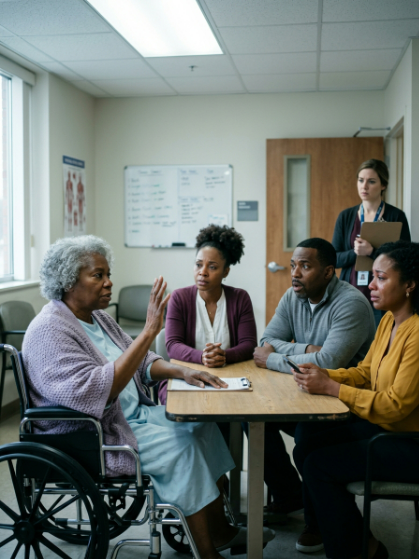
“There was no roof,” Mom said.
She told us about Renee. That “trip to find herself” the rest of us rolled our eyes about when she was twenty-six — that was ninety days in a treatment center two states away, paid for in cash so it would never show up on a record, never follow her, never become the thing this family whispered about at holidays.
Renee made a sound like the air had been knocked out of her.
And then Mom looked at me. Dana. The responsible one. The one who got nothing and never quite let anyone forget it.
“Who do you think co-signed your business loan, Dana? Who do you think quietly covered the three months you couldn’t make payroll your first year?”
I had spent my whole adult life believing I’d done it all alone. That was my entire identity. The child who needed nothing from anyone.
“You didn’t do it alone,” Mom said, almost gently. “You just never once asked where the cushion came from.”
Each of us had been carried, at our lowest. And each of us had been sworn to secrecy, because our parents understood something the three of us never had.
A family can survive being helped. What it cannot always survive is knowing the others were helped too — and keeping score.
So they let each of us believe we were the one who got nothing. It was the only way not one of us would ever feel like the charity case. The favoritism we’d all resented for a decade was love, handed out in the dark so it wouldn’t cost us our pride.
And the money was “gone” because they had given all of it to us. Dad died still working a part-time job at seventy-one to refill a well the three of us had quietly drained, never knowing the others were drinking from it too.
Mom never told us. She let us blame each other for ten years rather than let a single one of her children feel like a burden.
“So here is what I actually want,” she said, before any of us could find a word. “I do not want to be ‘taken in.’ I am not a debt to be assigned. I have my own money — yes, still; your father and I were not fools — and I have already chosen a place. Glenmeadow, out by the lake. My sister Faye is there. I’ll have my own apartment, my own door, and you will all visit because you want to, not because you lost a vote in a hospital conference room.”
Marcus put his face in his hands.
Renee was crying without making any sound at all.
I reached across that table — the first time in years I’d reached toward either of them on purpose — and I took my brother’s hand on one side and my sister’s hand on the other, and for one long minute the three of us just held on, while our mother watched us with the face of someone seeing a thing she’d waited a very long time to see.
Mom lives at Glenmeadow now. She does water aerobics with Aunt Faye and complains bitterly about the coffee.
We take turns visiting. Not on a schedule. Not out of obligation. Marcus brings his kids. Renee brings lunch she pretends she didn’t cook herself. I bring the gossip.
The three of us talk now. It isn’t always easy. Ten years of frost doesn’t thaw in one afternoon in a hospital. But we don’t keep score anymore.
Mom cured us of that.
She spent a decade letting us think the worst of each other, just to protect us from the weight of a kindness.
The day she finally told the truth, she didn’t only give us our mother back.
She gave us back each other.