My Name Filled Every Line of the Chore Chart FULL STORY
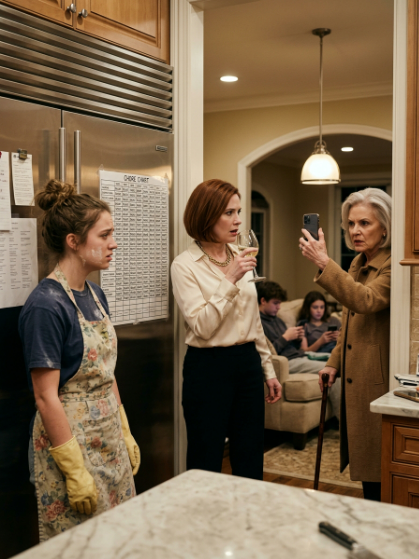
My grandmother took eleven photographs before she said a single word.
The chore chart. The fridge. Me in my gloves. Denise on her barstool with her wine going warm in her hand. Her two kids on the couch who didn’t even glance up.
Then she slid the phone into her coat pocket, turned to me, and said, “Hailey, get your coat. You and I are going to dinner.”
Denise found her voice. “Eleanor, what a surprise! Hailey just loves to pitch in, she’s such a—”
“I heard you the first time,” my grandmother said, not unkindly — the way you talk to a child repeating a lie they’ve started to believe themselves. “We’ll talk later. Hailey. Coat.”
No adult had taken me anywhere wanting nothing from me in two years. I almost didn’t know how to sit in the passenger seat.
At the diner she ordered me a milkshake like I was nine, and then she told me the things Denise had made certain I never heard.
My father did not leave everything to his wife.
He left the house, and a trust, to me. All of it earmarked — college, my care, the roof over my head — with Denise named as trustee, which meant she was supposed to manage that money for my benefit until I was grown.
“For your benefit,” my grandmother repeated, and her jaw went hard. “Not for a kitchen renovation. Not for her son’s car. For you.”
I didn’t know a word of it. Why would I? I was seventeen when he died. They handed me an apron and a speech about how we all had to tighten our belts, and I believed it, because grief makes you so easy to fool.
“And you,” I said. “She told me you didn’t want—”
“She told me you needed space,” Eleanor said. “That you blamed the family. That you’d asked us not to call.” Her voice finally cracked. “I sat by a phone for two years, Hailey, honoring a wish you never once made.”
We both cried into a basket of diner fries. It would have been funny if it hadn’t cost us so much.
That night Denise was waiting at the door with a fresh glass of wine and a new script. “Eleanor, I think there’s been a real misunderstanding here. Hailey’s a teenager, you know how dramatic they—” My grandmother held up one hand, the way she used to quiet a whole room of her own children, and said, “I took photographs, Denise. Save the performance for someone who didn’t.” Then she kissed the top of my head, told me to lock my door, and drove home to start making calls.
My grandmother is not a woman who makes a scene. She is a woman who makes appointments.
She was, it turned out, named in my father’s documents too — as the protector of the trust, a role Denise had conveniently never mentioned, with the standing to review the accounts and remove a trustee who abused the job.
Monday morning she was in the estate lawyer’s office with her eleven photographs and two years of statements she’d requested as her right.
The statements told the whole story without raising their voice. My father’s careful provision, drained a little at a time into things that were never mine. A “household account” that funded everyone’s life and billed its labor to a single name.
It never reached a shouting courtroom. People like Denise fold quietly once the paperwork is on the table, because paper doesn’t get rattled and paper doesn’t forget.
She was removed as trustee. A neutral fiduciary stepped in. She was ordered to account for what she had spent and to repay what she couldn’t justify. The college fund my father built was rebuilt, dollar for dollar, out of her share of things.
And my grandmother changed her own will that same week — not that she announced it like a threat. She simply told me, over another milkshake, that everything she had would come to me, and that she would rather give me her time while she was alive than make me wait for an envelope.
I moved into her spare room that fall. It has a window seat, and a door that locks, and no chart on it.
The first night, she handed me a small screwdriver and a little brass plate with my name engraved on it, and told me to hang it wherever I liked.
I put it on my own door.
The apron is in a donation bag. The gloves are back under the sink, where gloves belong.
And on Sundays now, when we cook, there is no chart deciding who has to.
We both just stand at the counter, because we want to.