My Mother Locked My Dying Father Away Until I Heard His Phone Ring
PART 3 (FULL STORY)
The service tunnel opened into the vast, roaring expanse of the university arena, the bright stage lights cutting through the cavernous space. Ten thousand family members, professors, and graduating seniors filled the tiered seating, their collective applause echoing off the high steel rafters like a rolling wave of thunder.
I pushed my father’s transport wheelchair straight through the student marshals’ checkpoint. A faculty advisor stepped forward, her clipboard raised as if to question the hospital gown, the plastic slippers, and the portable oxygen tank, but when she saw the gold honor cord draped over my black gown and the fierce, tearful pride shining in my father’s eyes, her hand slowly dropped to her side. Without uttering a single objection, she parted the velvet stanchions and waved us directly onto the main arena floor.
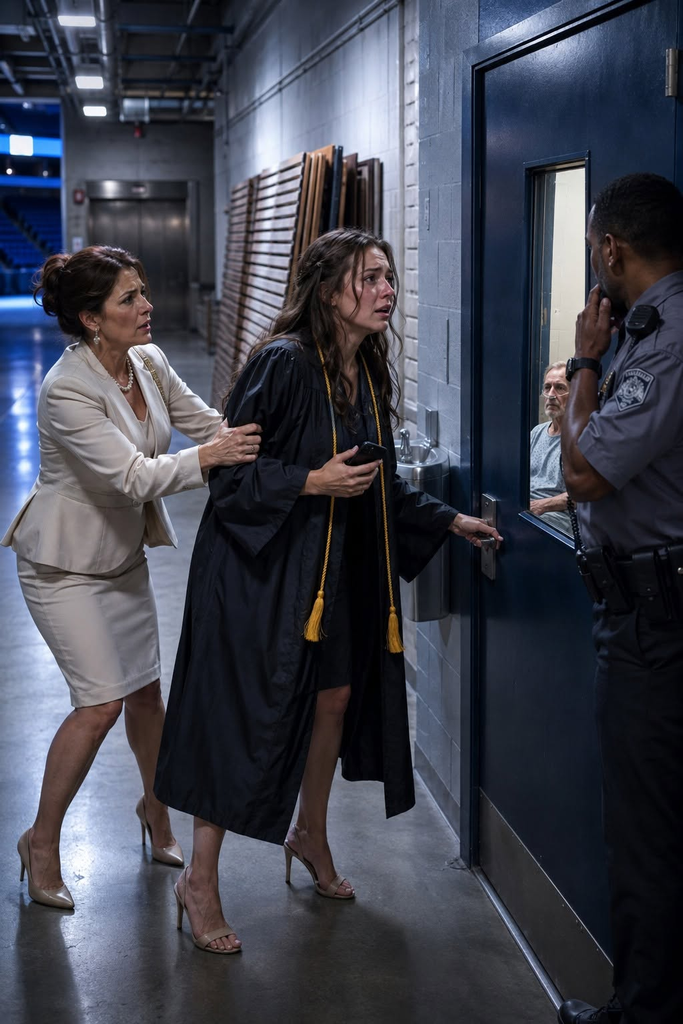
Behind us, Mum stood at the threshold of the service tunnel, her face pale with bitter, helpless humiliation. She clutched her designer leather handbag tightly against her stomach, watching the scene unfold from the shadows of the doorway, unable to step into the light she had tried so desperately to police and control.
The processional line slowed, and my classmate Mariah turned around from three rows ahead. When she saw Dad sitting upright in his wheelchair, his oxygen cannula neatly adjusted, tears welled in her eyes. She reached out with both hands and gently squeezed his frail shoulder.
“He made it, Claire,” Mariah whispered, wiping a tear from her cheek.
“He promised me he would,” I replied, feeling a warmth rise in my chest that no cold corridor could ever extinguish.
Up on the commencement stage, the Dean of Biological Sciences stepped to the microphone. The names of the honors graduates began echoing across the arena, each announcement met with joyous cheers and air horns from the upper decks.
Dad looked up at me from the wheelchair. His hands gripped the plastic armrests, his breathing slow and measured beneath the steady hiss of the oxygen tank, but the exhaustion that had plagued his body for seven long weeks had completely vanished from his eyes. His gaze was bright, sharp, and unmistakably alive.
“Claire,” he whispered, his voice trembling with quiet, unshakeable emotion. “Help me stand.”
“Dad, you don’t have to walk,” I told him gently, leaning down so my forehead brushed against his. “You’re already here. You kept your promise. You did it.”
“I practiced in our kitchen, sweetheart,” he said, his chin lifting with that familiar, stubborn resolve that cancer had never been able to take from him. “Eleven steps. I’m walking my daughter to that stage on my own two feet.”
I locked the wheels of the transport chair, stepped around to face him, and took his weathered hands firmly into mine.
Dad planted his feet onto the wooden floorboards of the arena, drawing in a deep, deliberate breath of oxygen through his cannula. His knees trembled beneath his pajama trousers, but as he pulled himself upward, his spine straightened. I hooked my left arm securely under his right elbow, bracing his weight against my side and matching my stride to his.
“Summa Cum Laude,” the dean announced over the arena sound system. “Claire Elizabeth Evans.”
The moment my name rang through the auditorium, the arena seemed to pause in breathless stillness.
Dad took his first step forward.
One.
His weight leaned heavily into my arm, but his footing was steady and deliberate.
Two. Three.
The graduating students in the surrounding rows stopped talking, turning their heads to watch the young woman in the gold honor cord walking step-by-step with a father in a hospital gown and oxygen tubes.
Four. Five.
By the fifth step, Dad’s breathing became shallow, his chest rising and falling beneath his thin flannel shirt. He paused for half a second, his fingers tightening like iron around my forearm, and looked up at the thousands of people looking down from the stadium tiers.
Six. Seven.
A professor two rows ahead began to clap. Then an entire section of faculty members rose to their feet.
Eight. Nine. Ten.
“See?” Dad whispered, a radiant, triumphant smile spreading across his pale face as the applause cascaded down from the rafters like an avalanche. “I told you… the arena is easier when people are clapping.”
Eleven.
With his eleventh step, Dad brought us directly to the foot of the stage ramp.
The university president, Dr. Hawthorne, stopped reading from his podium. He set his papers down on the wooden rostrum, stepped off the stage platform, and walked down the ramp to meet us directly on the arena floor.
With tears glistening in his eyes, Dr. Hawthorne handed me my leather diploma case, turned toward my father, and took his frail hand in a warm, two-handed grasp.
“Sir,” Dr. Hawthorne said, his voice carrying clearly through his lapel microphone to all ten thousand people in the building, “in thirty years of commencement ceremonies, I have never seen a greater demonstration of love, courage, and parental devotion. It is an absolute honor to welcome you to this university.”
The entire arena exploded into a thunderous, standing ovation. Ten thousand people cheered, whistled, and stamped their feet against the concrete risers, the sound reverberating through the floorboards like pure, unrestrained lightning.
Dad stood tall beside me, his arm wrapped tightly around my shoulders, his eyes shining with tears of pure joy as he looked out at the roaring crowd.
When the ceremony concluded, Mum hurried over through the thinning crowd, forcing a tense, performative smile onto her face as several university trustees, professors, and extended family members approached to congratulate us.
“Wasn’t that wonderful?” Mum said, her voice high and desperately eager to claim credit. “We were so determined to make sure his medical condition didn’t hold Claire back from her moment.”
I turned to look at my mother, seeing with absolute clarity the shallow vanity of a woman who cared more about appearances and social comfort than the dying husband who had loved her for thirty years.
“You locked him in a dark choir room and told him his own daughter was ashamed of him,” I said, my voice low, clear, and unyielding in front of the surrounding relatives. “You will never speak for him again. And after today, you will never control another moment of my life.”
Mum froze, her face draining of color as my aunts, uncles, and cousins turned away from her in visible disgust. Without another word, they walked over to surround Dad, offering him tears of love and admiration.
A dedicated university medical transport, arranged personally by Dean Abernathy, drove Dad and me back to our home in complete comfort and dignity.
For the next two weeks, our living room was filled with an extraordinary, quiet peace. Dad sat in his favorite recliner by the sunny front window, the golden morning light washing over him as he held the framed photograph taken on the arena floor—me in my black gown and gold honor cord, holding my diploma, with my arm wrapped securely around the father who had walked across the world to see me succeed.
Fourteen days after my graduation, Dad fell asleep in his recliner and passed away peacefully, his hand resting inside mine, a serene, untroubled smile resting upon his face.
Six months later, I sat at my new desk in the university’s graduate research laboratory. The afternoon was quiet, filled with the soft hum of medical instruments and the steady ticking of the wall clock.
On the corner of my desk rested the framed photograph from that unforgettable morning. Draped reverently over the dark wood frame was the gold honor cord my father had ordered for me—the cord he had made me wear over my sweatshirt in our small kitchen.
I reached out and touched the soft braided gold, feeling the memory of his hand on my arm, the roar of the cheering arena, and the eleven steps of a father whose love was stronger than death itself.