My Mother Dismissed Me As A Desk Clerk Until The Base Guard Saluted
PART 3 (FULL STORY)
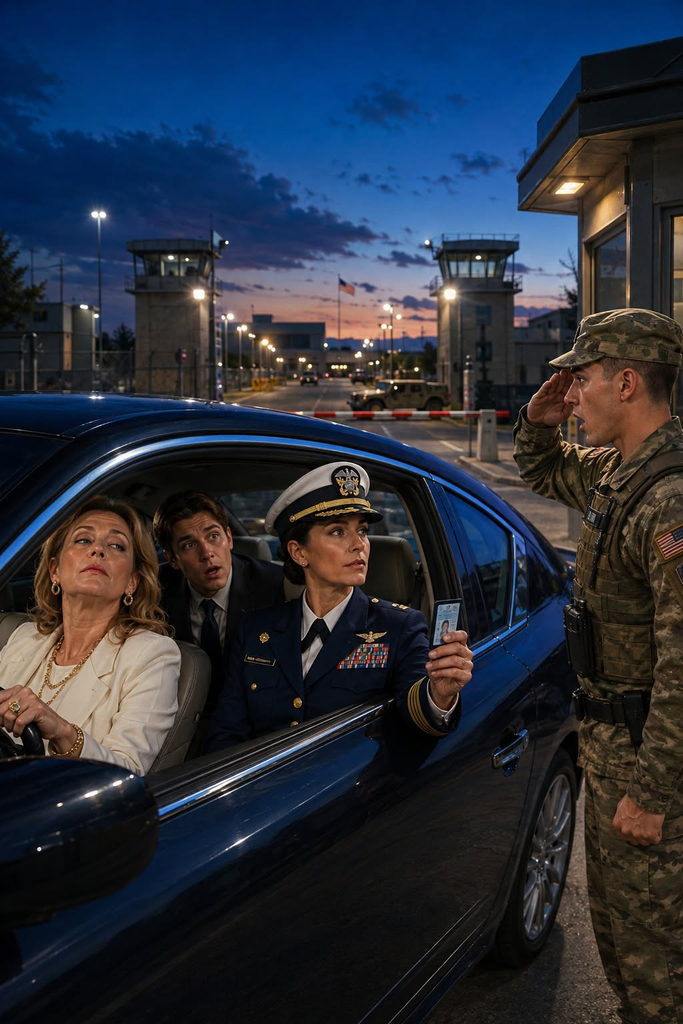
The main security gate fell into a paralyzed, electric silence as the piercing headlights of three Naval Security cruisers and a polished executive command vehicle swept across our windshield. Captain Miller, the commanding officer of Naval Station Norfolk, stepped out into the cool evening mist, his service dress white uniform gleaming under the high-intensity base floodlights.
He marched with crisp, rhythmic military precision to the passenger side of our vehicle, snapped his heels together with a sharp thud, and executed a flawless, rigid salute.
“Good evening, Admiral Ross,” Captain Miller announced in a clear, resonant voice that reverberated against the concrete walls of the security guardhouse. “Naval Station Norfolk is profoundly honored by your arrival. The fleet command staff, international naval attachés, and twelve hundred invited dignitaries are fully assembled in the grand auditorium awaiting your keynote address.”
Beside me behind the steering wheel, Vivian’s hands dropped entirely from the leather. Her mouth opened, but no sound emerged. The smug, condescending sneer that had defined her expression for thirty years completely shattered, replaced by a pale, hollow mask of absolute, suffocating shock.
In the back seat, Derek choked on his breath, clutching the front seat back in frantic confusion. “Wait… Captain, you have made an enormous mistake! That’s my sister, Eleanor! She’s an office clerk who types reports! She doesn’t command anything in the Navy!”
Captain Miller did not even blink. He slowly turned his head, looking through the open rear window at Derek with cold, steely military discipline. “Sir, you are speaking to the Commander of the United States Naval Surface Fleet. You will address her with appropriate dignity and respect.”
My flag aide, Lieutenant Commander Harris, stepped forward from the command sedan and opened my passenger door, holding out my white service cover adorned with intricate gold oak leaves across the visor.
“Your ceremonial uniform is prepared in the flag quarters, Admiral,” Harris said with crisp professionalism.
I stepped out of the vehicle onto the rain-dampened asphalt. I paused for a single, quiet second, looking through the open window at my mother and brother, who sat immobilized by their own disbelief.
“Captain Miller,” I said calmly, “please ensure Mrs. Ross and my brother are escorted to the general guest section in the rear of the auditorium.”
“Right away, ma’am,” Captain Miller replied with a respectful nod.
Two armed naval security officers politely but firmly directed Vivian and Derek out of the vehicle and into an official guest transport van, while my executive security detail escorted me through the priority gates directly to headquarters.
Twenty minutes later, I stood in the quiet private anteroom beside the main stage of the base auditorium, dressed in my Service Dress White uniform. Two polished silver stars gleamed on each shoulder board, and four dense rows of decorations—including the Defense Superior Service Medal, the Legion of Merit, and the Meritorious Service Medal—rested squarely over my left breast.
Through the heavy stage curtains, I could see the vast, packed auditorium. Twelve hundred naval officers, foreign attachés, shipyard directors, and civic leaders filled every row. In the very back row of the balcony, surrounded by junior enlisted sailors, sat Vivian and Derek, looking utterly small, pale, and bewildered in the monumental hall.
The master of ceremonies stepped to the podium, his voice booming through the sound system.
“Ladies and gentlemen, distinguished guests, please rise for the Commander of the United States Naval Surface Fleet, Rear Admiral Eleanor Ross.”
The entire twelve-hundred-person auditorium rose to their feet as one single body, the thunderous sound of applause and a standing ovation echoing against the high vaulted steel rafters of the arena.
I walked onto the center of the stage, keeping my chin level and my stride steady. I looked out over the sea of white and blue uniforms, feeling no anger, no bitterness, and no need for revenge.
Thirty years earlier, when my acceptance letter from the United States Naval Academy had arrived in our modest mailbox, Vivian had torn the envelope in half across the kitchen counter, declaring that military service was an embarrassment and that only Derek deserved family pride and a college fund.
I hadn’t cried. I had carefully taped the pieces of the letter together, walked three miles through the rain to the local recruiting station, contacted my congressional sponsor, and boarded a bus to Annapolis with fifty dollars in my pocket.
While Derek spent three decades squandering family inheritances on failed business ventures, abandoning jobs, and living off our mother’s flattery, I had earned a master’s degree in naval architecture from MIT, commanded two guided-missile destroyers in the Persian Gulf, and led an entire carrier strike group across the Pacific.
I stood behind the podium and delivered my keynote address, speaking on the quiet power of personal discipline, the beauty of unseen service, and the timeless truth that real leadership never needs to boast or demand plastic trophies.
When the formal ceremony concluded, I walked backstage toward the flag reception lounge.
Vivian and Derek rushed past the security stanchions, desperate to reach me before the crowd gathered.
“Eleanor! Eleanor, darling!” Vivian called out, her voice dripping with artificial sweetness and desperate flattery. “Oh, my brilliant, beautiful girl! I always told everyone in our family that you were destined for greatness! Derek was just saying how proud our family is of you!”
Derek nodded eagerly, smoothing his designer jacket with trembling hands. “Eleanor, look, I’m launching a maritime defense logistics consulting firm. With your four-star influence and connections, we could secure government defense contracts tomorrow. We’re family—we should help each other succeed!”
I stopped, turning slowly to look at the two people who had spent my entire life treating me like a ghost in my own home.
“For thirty years,” I said, my voice steady, quiet, and unshakeable as steel, “you made sure I knew I was invisible to you. You threw away my father’s funeral cards, tore up my academy acceptance letter, and mocked my uniform at the front gate tonight.”
Vivian’s artificial smile froze on her lips.
“I built this career with my own hands, my own sweat, and my own honor,” I continued. “I don’t need your approval. And you will never use my stars to feed your greed or bail out your failures.”
I turned to Lieutenant Commander Harris. “Please arrange a commercial taxi to take Mrs. Ross and Mr. Ross back to their hotel.”
“Aye, aye, Admiral,” Harris acknowledged with a crisp nod.
I turned and walked into the warm reception room, leaving Vivian and Derek standing in the empty hallway, entirely cut off from the world of honor they had tried to exploit.
Six months later, I stood on the bridge wing of a newly commissioned Arleigh Burke-class guided-missile destroyer as the golden morning sun crested over the open Atlantic.
The powerful warship sliced gracefully through the deep blue waves, the cool salt spray misting against my uniform as the American flag snapped crisply in the ocean wind above.
I reached into my pocket, touching the small silver challenge coin engraved with the silhouette of a guided-missile destroyer—a quiet tribute to the ten-year-old girl who had built a model in a dusty garage with burned fingers and an unbreakable dream.
I smiled softly, breathing in the clean sea air as the sun bathed the ship’s steel deck in warm, golden light. I had never needed their praise to find my path. The ocean was vast, the horizon was clear, and my life belonged entirely to me.