My Husband Left Believing the Baby Couldn’t Be His FULL STORY
Daniel reached the doorway the same moment Dr. Hale found his voice.
“Sir, you can’t—” Beatrice started, stepping toward him.
“Let him in,” I heard myself say.
I don’t know why. Seven months of silence and a packed bag, and the first word out of me was let him in. Maybe because of the way he looked through that glass. Not like a man who’d left. Like a man who’d been running toward something for hours.
He came in dripping melted snow onto the floor and stopped at the foot of the bed, staring at the bundle in my arms like it might disappear.
Dr. Hale closed the door behind him and leaned against it, glasses still in his hand.
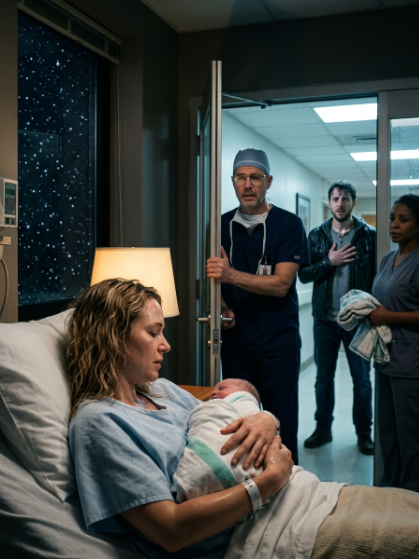
“Both of you need to hear this,” he said. “And I need to say it once, plainly, because I should have said it two years ago and I let an administrator talk me out of it.”
Daniel’s eyes went to him. “Who are you?”
“I ran the andrology lab at Crawford Fertility,” Dr. Hale said. “I left when I couldn’t stand what the place had become. I do obstetrics now. I delivered your daughter forty minutes ago, Mr. Lund, and when I read your wife’s chart I recognized your name, because yours was one of the cases that made me quit.”
The room felt very small.
“In the spring two years ago,” he went on, “Crawford ran a batch of male fertility panels. A tech mislabeled a tray. Two samples got swapped — yours, Mr. Lund, and another patient’s. The result you were given, the one that said you could never father a child, was never yours. It belonged to a stranger. I caught it three weeks later in an audit. I flagged it. The clinic had already lost one lawsuit. They told me the error was ‘not material to patient care’ and they buried it. I reported it to the state. Nothing happened. I have never stopped being ashamed of how little I could make happen.”
Daniel sat down. Not in a chair. On the edge of the bed, like his legs just stopped.
“I’m not infertile,” he said.
“You were never infertile,” Dr. Hale said. “You read a slip of paper that belonged to someone you never met, and you built your whole life around it.”
I watched my husband understand what that meant.
It meant that when I told him I was pregnant, and swore on everything that I had never touched another man, and he looked at me like I was lying — he wasn’t crazy. He was wrong. There’s a difference, and the difference was a mislabeled tray in a lab two years before our daughter was born.
“Tess.” He turned to me. His face had come apart. “I called you a liar. I packed a bag. I missed — all of it. The appointments. The kicks. Tonight.” His voice broke on tonight. “I believed a piece of paper over you.”
I had a whole speech, somewhere in the seven months. About how an apology doesn’t un-miss a single 3 a.m. About how I went through the scariest, most miraculous thing of my life alone because he chose a lab result over his own wife’s word.
I didn’t give the speech.
Our daughter chose that moment to wake up and make the small furious sound newborns make, and Daniel looked at her, and I watched twenty-three years of the man I married collapse into one question he was terrified to ask.
“Can I—?”
I put her in his arms.
He cried like Dr. Hale wasn’t standing there. Like the snow wasn’t falling. Like the last seven months were a fever he was finally sweating out.
I’m not going to pretend a baby and a doctor’s confession stitched us back together that night. They didn’t. Trust doesn’t come back the way it leaves. It leaves in an afternoon. It comes back in a thousand ordinary mornings.
But here is what we did.
Dr. Hale gave us a written statement, signed, dated, naming the clinic and the error and his report to the state. He didn’t have to. He said he’d been waiting two years for a reason to put it on paper that someone would actually use.
We used it. Not for money, in the end — though the lawyer said we’d win. We used it to force Crawford to notify the other patient. Somewhere out there was a man who’d been told he was fertile when he wasn’t, building his own wrong life around the other half of that swapped tray. He deserved the truth too. The clinic fought it. We didn’t stop. It closed its doors within the year, and good.
Daniel moved back in slowly. First the couch. Then the early mornings, because he refused to miss another one. He keeps the doctor’s statement in the drawer of the nursery, not as a weapon, but as the thing that explains the worst year of our marriage in a way neither of us could.
Our daughter’s name is Grace.
Not because we forgave easily. We didn’t.
Because grace is the word for getting something back you were sure was gone for good — a marriage, a father, the truth — and choosing, with both hands, to hold it anyway.
The snow stopped before sunrise. Daniel was still in the chair by the bed, Grace asleep on his chest, watching her breathe like he’d never seen a more impossible thing.
He had spent two years believing he could never have this.
It was a lie the whole time.
And the man who’d run the lab made sure we finally got to hear the truth out loud.