My Husband Became an Organ Donor Before His Doctor Revealed His Secret Promise
PART 3 (FULL STORY)
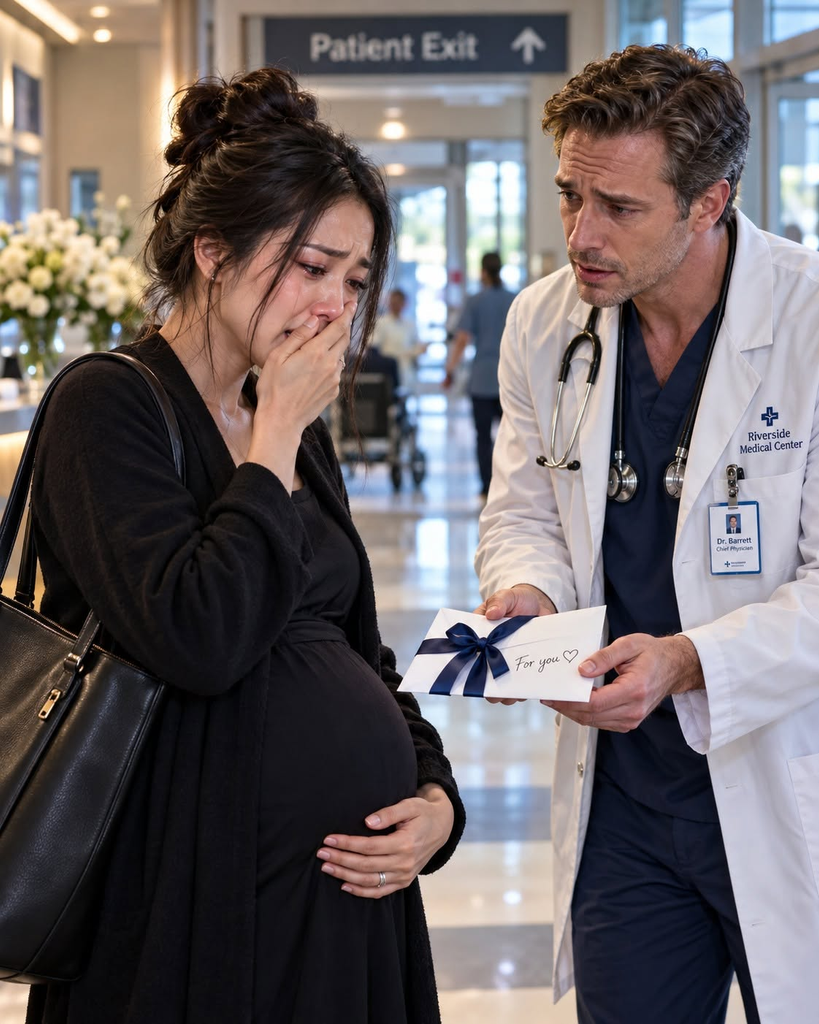
I stood in the sunlit corridor of St. Jude Memorial Hospital, clutching the plush bunny against my chest while Liam’s recorded heartbeat pulsed through the small speaker. The rhythmic thump against my fingers felt impossibly alive, vibrating through the fabric and straight into the belly where our daughter stirred in response. Dr. Barrett stood beside me with red-rimmed eyes, handing over a heavy leather-bound binder and a velvet pouch containing two encrypted archival flash drives.
“During those private afternoon sessions when you stepped out to rest, Liam asked me to connect him with the hospital’s biomedical audio technicians,” Dr. Barrett explained softly, guiding me to a quiet seating alcove away from the main thoroughfare. “He spent hours recording high-definition acoustic tracks of his own heartbeat during his final stable week. He said that since he wouldn’t be there to hold his daughter when she had nightmares or cried during the night, he wanted to make sure she could always hear the rhythm that loved her first.”
Dr. Barrett opened the leather binder to reveal pages upon pages of Liam’s distinct, sloping handwriting. Liam had written eighteen comprehensive letters, one for each birthday from age one to eighteen. There were handwritten bedtime stories, life advice on handling first heartbreaks, instructions on how to build a treehouse, humorous reflections on how he first fell in love with me at an autumn farmers market, and an emotional letter dedicated entirely to her future wedding day. He had even spent his remaining energy filming short video messages on the memory drive, smiling through his fatigue to tell our daughter how proud he was of her before she had taken her very first breath.
Three weeks later, on a crisp October morning, I went into labor. In the quiet delivery room, with only the nurse and my mother beside me, I gave birth to a healthy, six-pound baby girl with Liam’s dark hazel eyes and thick brown curls. I named her Maya Grace. When the nurses placed her shivering on my bare chest and her newborn cries filled the room, my trembling fingers reached for the little plush bunny on the bedside table. I pressed its paw.
The deep, steady sound of Liam’s heartbeat resonated softly in the quiet room, followed by his gentle whisper: “I’m right here, sweet girl.” In less than five seconds, Maya’s crying ceased. She turned her tiny face toward the sound, her breathing synchronizing with the familiar rhythm she had listened to for nine months in the womb, and fell peacefully asleep against my skin.
In the months that followed, Liam’s presence filled our home through the gifts he had left behind. Every evening before putting Maya to bed, I played one of his recorded lullabies. On her first birthday, we sat together on the living room rug while I opened Liam’s letter for Year One. He wrote about the joy of seeing her crawl, reminding me to let her eat the frosting with both hands, and promised that every warm breeze we felt on our faces was him checking in on us.
When Maya turned fifteen months old, an envelope arrived in the mail from the regional organ donor network. It contained an anonymous letter from the recipient of Liam’s heart. Her name was Sarah Jenkins, a thirty-nine-year-old middle school science teacher and mother of three boys from Portland. Sarah wrote with raw, overwhelming gratitude, explaining that she had been in acute end-stage cardiomyopathy, given less than forty-eight hours to live when the hospital received word of an emergency donor match.
“Your husband’s final gift did not just save one life,” Sarah wrote. “He ensured that three little boys still have their mother to pack their lunches, read them books, and tuck them in at night. Every morning when I wake up and feel this strong, selfless heart beating inside my chest, I whisper a prayer of thanks for the man who chose to give life in his final hour.”
After exchanging letters through the donor coordinator for another six months, Sarah and I agreed to meet at a quiet botanical garden overlooking Puget Sound. It was a clear Sunday afternoon in late spring. Maya was nearly two years old, walking with steady little steps and clutching her favorite plush bunny by its ear.
When Sarah walked down the stone garden path accompanied by her husband and three young sons, she stopped several feet away, overcome with emotion. She didn’t offer empty platitudes or awkward small talk. She simply knelt down on the grass to Maya’s eye level, her eyes shining with tears.
“Hello, little Maya,” Sarah whispered gently. “You have your father’s beautiful eyes.”
Sarah looked up at me and asked if she could share something with us. She took my hand and gently guided my palm beneath the lapel of her linen cardigan, pressing it directly against the left side of her chest.
Beneath my fingers, a strong, rhythmic pulse thudded with undeniable vigor. It was the exact cadence I had rested my head against for three years of marriage. It was the heartbeat that had comforted me on difficult days, the rhythm that had made promises in the dark, and the life force that had refused to fade into nothingness.
I knelt beside Sarah, bringing Maya close between us. “Maya,” I whispered, keeping my voice steady through the warmth in my throat. “Touch right here.”
Maya placed her tiny, soft palm over Sarah’s heart. The little girl tilted her head, her hazel eyes widening with quiet recognition. She pressed the paw of her plush bunny, listening to the recorded heartbeat from the speaker, and then looked directly at Sarah’s chest, smiling as if she understood the miracle that connected them all. Sarah wrapped her arms around both of us, her sons stepping in close, creating a circle of gratitude and living memory under the blooming cherry blossom trees.
That evening, back on our porch at home, Maya fell asleep in my lap on the wooden swing as the sun dipped below the horizon, painting the sky in deep shades of rose and amber. The cool evening breeze rustled the wind chimes Liam had hung four summers ago.
I looked down at our daughter, sleeping peacefully with one small hand resting over her toy bunny, and looked out across the quiet neighborhood. Liam had not been able to stay, but he had never truly left. He lived on in the laughter of three boys in Oregon, in the vibrant health of a devoted mother, in eighteen years of wisdom waiting on our bookshelf, and in the bright, fearless eyes of the little girl sleeping safely in my arms.