My Husband Auctioned Me Off Until A Billionaire Exposed His Thirty-Year Deception
PART 3 (FULL STORY)
The heavy frosted-glass doors of the boardroom rattled on their hinges as Harold pushed his way past the executive receptionists. His silk tie was crooked, his hair disheveled from the morning wind, and his face was flushed with frantic, suffocating rage.
“Anastasia!” Harold shouted, pointing a shaking finger at me. “Get away from that table right now! You have no business being in this building! We are going home!”
Two tall, broad-shouldered security officers stepped into the doorway behind Harold, their hands resting loosely at their sides. They didn’t touch him, but their presence made the room shrink. Owen Rodgers didn’t flinch. He remained seated at the head of the long mahogany table, calmly taking a sip of black coffee before setting his porcelain cup down without making a sound.
“Sit down, Mr. Prescott,” Owen said, his deep voice carrying the unshakeable weight of absolute authority. “Or you can spend the next twenty minutes handcuffed in the lobby while the state police arrive. The choice is entirely yours.”
Harold looked between the security guards, Owen’s impassive face, and the thick leather portfolio resting in front of me. He pulled at his collar, his chest heaving as he sank into an empty leather armchair at the far end of the table.
“This is harassment,” Harold muttered, trying desperately to summon his usual polished boardroom tone. “You walked into my private foundation gala uninvited, made a spectacle of my wife, and now you’re attempting to extort my family. Whatever nonsense you think you’ve dug up is completely baseless.”
Owen opened the front cover of the vintage leather portfolio, sliding a series of notarized, yellowed parchment documents across the polished wood toward me.
“Thirty years ago,” Owen began, his eyes fixed on mine with profound gentleness, “your father, Arthur Robbins, was the principal founder of Robbins Industrial and one of the most visionary philanthropists in this state. When he learned his heart was failing, he established the Robbins Family Endowment—an initial capital fund of seventy million dollars designed to support medical research and university scholarships.”
Owen tapped a faded signature on the second page. “Your father appointed my mentor’s legal firm to oversee the trust until you turned twenty-five, with specific instructions that the assets were to remain solely in your name, untouchable by any future spouse.”
Tears blurred my vision as I traced my father’s familiar, bold handwriting across the bottom of the page. Memories of my father—his quiet laughter, his calloused hands, the gentle way he used to encourage my studies—flooded back into my mind.
“When Arthur passed away,” Owen continued, turning his gaze to Harold, “Anastasia was twenty-two, grieving, and entirely alone in the world. Harold Prescott was a junior probate clerk assigned to process the initial estate inventory. Harold realized that Anastasia had no surviving relatives to guide her. He deliberately concealed the existence of the seventy-million-dollar endowment, telling her that her father’s businesses had collapsed into debt.”
I turned my head to look at Harold. He was gripping the armrests of his chair so tightly his knuckles were bloodless.
“You told me my father died bankrupt,” I whispered, every syllable trembling with the weight of twenty-seven years of betrayal. “You told me the bank took our family home. You told me I had nothing.”
“I took care of you!” Harold blurted out, his voice cracking. “You were helpless! You didn’t understand finance! I gave you a home! I gave you a name!”
“You gave her your name so you could steal hers,” Owen said coldly. “Within six months of your marriage, Harold, you forged a power-of-attorney transfer using a fraudulent notary stamp, liquidated the Robbins Endowment, and transferred the entire principal into a newly created shell entity: the Prescott Foundation.”
Owen’s chief legal counsel, Margaret Vance, placed a stack of modern audit filings beside the historical deeds.
“For twenty-seven years,” Margaret stated, “Harold Prescott drew millions in management fees, private dividends, and luxury perks from that stolen endowment. He used your father’s wealth to buy the estate in the hills, the private club memberships, and the luxury vehicles. And to ensure you never asked questions about the foundation’s origins, he systematically undermined your confidence, making you believe you were an unexciting, dependent burden who owed him everything.”
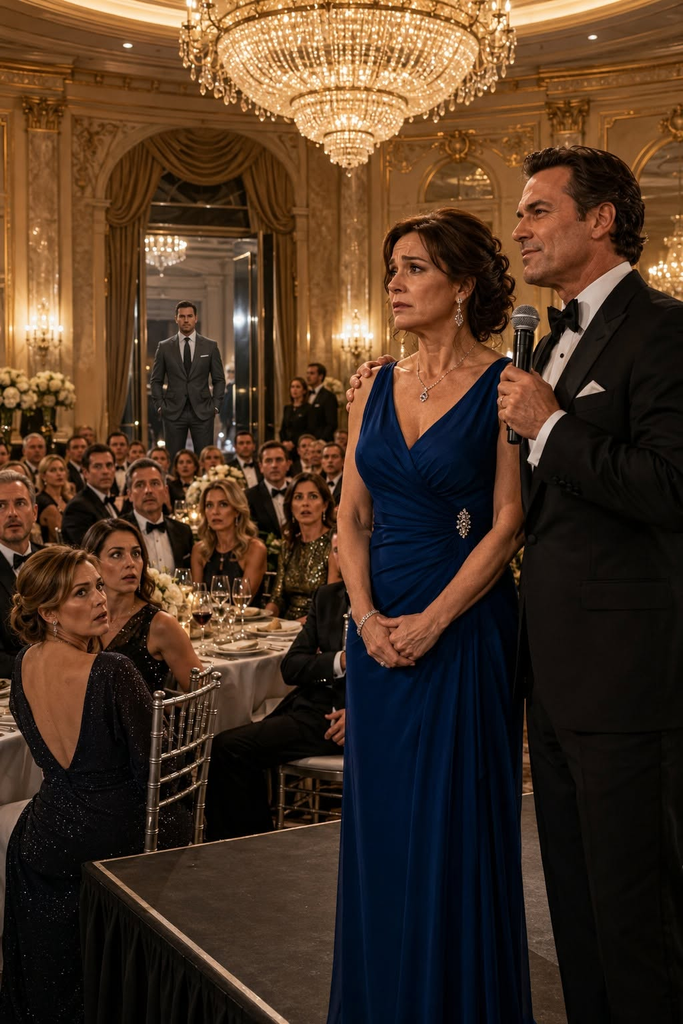
The puzzle of my entire adult life snapped into sharp, devastating focus. The constant jokes about my lack of ambition. The reminders that I was boring. The casual cruelty at dinner parties. The mock auction where he offered me for twenty dollars in front of three hundred people.
It had never been teasing. It had never been thoughtlessness. It was a calculated, lifelong campaign to keep me so broken, so grateful, and so small that I would never look at the foundation’s original founding ledgers.
“The statute of limitations has run out!” Harold snarled, his face contorted in desperate fury. “That was thirty years ago! The Prescott Foundation is a registered legal entity under my sole direction! You can’t touch a single dollar!”
Owen leaned forward, his gaze hardening to steel. “The statute of limitations on grand larceny and probate forgery resets with every fraudulent tax return you filed under penalty of perjury, Harold. For twenty-seven years, you filed federal 990 forms falsely certifying that the foundation’s seed assets were personal gifts rather than a stolen family trust.”
Owen signaled his assistant, who placed a signed court order on the table.
“Two hours ago,” Owen said, “the State Attorney General’s Special Prosecutions Division secured an emergency injunction freezing every bank account, property deed, and investment vehicle tied to the Prescott Foundation and Harold Prescott personally. A grand jury has been empaneled to issue formal indictments for felony fraud, money laundering, and tax evasion.”
Harold’s breath hitched in his throat. He looked at the court order, then at Owen, and finally at me. For the first time in twenty-seven years, there was no condescension in his eyes. There was only the hollow, pathetic terror of a con artist whose game had reached its end.
“Anastasia…” Harold stammered, sliding forward onto the edge of his chair and reaching toward me with trembling hands. “Please. Think about our life together. Think about the years we’ve spent. We can settle this privately. I’ll make you co-chair of the board. I’ll give you whatever you want. Don’t destroy me.”
I looked at the man who had stood beneath glittering chandeliers the night before and asked a room full of strangers who would give twenty dollars for his worthless wife.
“You didn’t build a life with me, Harold,” I said, my voice clear, steady, and free of fear. “You built a prison and made me manage the maintenance. My father gave me an inheritance to change the world. You used it to buy an audience to laugh at me. It’s over.”
I took the fountain pen Margaret offered and signed the formal restitution petition, reclaiming my father’s endowment in the name of Anastasia Robbins.
The two security guards stepped forward, opening the boardroom doors as two plainclothes investigators from the state bureau walked in to escort Harold into custody. Harold didn’t utter another word. He slumped between the officers, his head hanging low, as they led him toward the elevators.
Over the next eight months, the Prescott empire dissolved under the weight of the legal audit. Harold was convicted on multiple federal fraud charges and sentenced to ten years in prison, with every asset acquired through the stolen endowment seized for full restitution. The wealthy socialites who had laughed at his jokes at the gala scrambled to issue public apologies, desperate to distance themselves from his disgraced name.
With the guidance of Owen Rodgers and his foundation team, I legally restored my maiden name and restructured the organization as the Arthur Robbins Memorial Foundation.
Nearly a year after that fateful gala, I hosted the inaugural Robbins Foundation Gala in the grand rotunda of the city’s fine arts museum. Four hundred community leaders, researchers, scholarship recipients, and philanthropists filled the magnificent hall, surrounded by towering marble columns and warm, golden candlelight.
I stood at the podium in an elegant emerald gown, looking out at the room. Owen sat at the center table, raising his glass to me with a warm, respectful smile.
When I finished presenting the foundation’s new twenty-million-dollar medical endowment, the entire room rose to their feet, filling the rotunda with thunderous, heartfelt applause.
I stepped back from the microphone, feeling the cool weight of my father’s antique watch against my wrist. For twenty-seven years, I had swallowed my voice to keep someone else comfortable. But standing beneath the lights, surrounded by the work I had built with my own hands and my father’s enduring legacy, I knew I would never let anyone put a price on my worth again.