My Half-Siblings Wanted to Sell Dad’s House Before I Found His Secret Box
PART 3 (FULL STORY)
The wooden stairs creaked beneath the familiar weight of footsteps as Derek and Amber stepped into the basement workshop. The air smelled of aged sawdust, cedar shavings, and the faint metallic tang of old motor oil. Derek carried a black leather portfolio filled with comparative market analyses and printed agent agreements, his expression tightened into the familiar mask of professional efficiency he used whenever life felt overwhelming. Amber walked half a step behind him, clutching her phone and a legal notepad filled with scribbled debt calculations.
“Sophie, we didn’t mean to sneak up on you,” Derek began, his voice soft but guarded as his eyes swept over the pegboard where Dad’s tools hung in their neat marker outlines. “We saw your car in the driveway. The listing agent called twice this afternoon. If we get the photographer in here by Tuesday, we can hit the weekend open-house market before interest rates bump again.” He stopped mid-sentence, his gaze dropping to the open wooden box on the workbench and the wet tracks on my cheeks.
I didn’t argue. I didn’t reach for excuses or plead for more time. I simply picked up Dad’s letter and the county document, extending them across the worn workbench toward my brother. “Read it, Derek,” I whispered, my voice rough with emotion. “Read what Dad left before we sign anything.”
Derek hesitated, then took the aged parchment. Amber stepped up beside his shoulder, her brow furrowing as she recognized our father’s deliberate, block-letter carpenter’s script. Under the dim glow of the single overhead bulb, Derek began reading aloud, his voice dropping into a quiet murmur that filled the silence of the cellar: “To my children. If you are standing in my shop together, it means my race is finished, and the noise of the world is telling you to turn this ground into cash. But before you call an auctioneer, you need to know how these four walls were kept standing.”
A quiet tremor entered Derek’s voice as he turned the page: “Twenty years ago, when Sophie’s mother took half our savings and moved to Arizona, the bank prepared to foreclose on this property. I was thirty-eight years old, working forty hours a week framing houses in the rain and taking forty hours of commercial janitorial shifts at night just to pay off the second mortgage so Sophie would never wake up without a home. And when Karen was diagnosed with cancer years later, I remortgaged the lumber yard and borrowed against my own pension so Derek and Amber would never know the fear of poverty. I never told you because a father’s job is to absorb the storm, not pass the umbrella.”
Amber let out a strangled gasp, her hands flying to her mouth as tears welled in her eyes. Derek’s knuckles turned white against the paper as he reached the final paragraph: “Three years ago, the county water authority approached me to purchase a permanent conservation easement along the rear creek. I agreed to the sale on one condition: that the two hundred thousand dollars be placed into an irrevocable escrow trust, released only upon my death. Amber, one hundred thousand is yours to erase every dollar of your graduate school debt. Derek, one hundred thousand is yours to launch the logistics firm you’ve dreamed of building. Do not sell this house out of desperation. If Sophie wants to keep the red door, let her keep our home.”
The paper fluttered slightly in Derek’s shaking fingers. The young man who had spent two weeks talking about cap rates, timelines, and market comps suddenly looked like a lost boy standing in his father’s boots. His knees gave out, and he sat down heavily on an upturned wooden crate, dropping his face into his palms as deep, racking sobs broke through his chest. Amber sank onto the cold concrete beside my chair, burying her face into my lap, weeping with an overwhelming mixture of grief, relief, and profound shame.
“We didn’t know, Sophie,” Amber sobbed, clutching my hand as if we were seven years old again. “I was so terrified of the debt. I couldn’t breathe under the payments, and I looked at this house like a lifeline. I never thought about what Dad gave up to keep it. I’m so sorry.” I stroked her hair, feeling the heavy, invisible walls that had kept us separated as half-siblings crumble into dust. “You don’t have to apologize, Amber,” I said softly. “Dad did this because he loved you. He loved all of us.”
Derek lifted his head, his eyes red and swollen. Without saying a word, he reached into his leather portfolio, pulled out the listing agreements and the agent contracts, and tore them cleanly in half. He tossed the scraps into the metal scrap bin beside the workbench. “The house isn’t for sale,” Derek said, his voice raw but unshakeable. “Dad built this place for you, Sophie. You took care of him every single day while Amber and I were off living our lives. This home belongs to you.”
Two days later, we sat together in Gerald Marsh’s downtown law office. With Gerald looking on with a proud, knowing smile, Derek and Amber signed the quitclaim deeds, formally transferring full title of the colonial property to my name alone. In return, Gerald processed the release of the county escrow funds, distributing one hundred thousand dollars to pay off Amber’s federal education loans and one hundred thousand dollars into Derek’s commercial business account. For the first time in our adult lives, the financial anxiety that had shadowed our family was completely extinguished.
Over the next twelve months, the gray colonial with the bright red door transformed from a monument of grief into a living sanctuary of connection. We spent our weekends working on the house together. Derek used his organizational precision to sand and stain the original oak floors, while Amber painted the kitchen cabinets and planted a sprawling perennial garden along the creek bank where my childhood shoe had once vanished. I cooked large family dinners in the kitchen, serving homemade beef stew and fresh bread while the old rooster tiles caught the afternoon light.
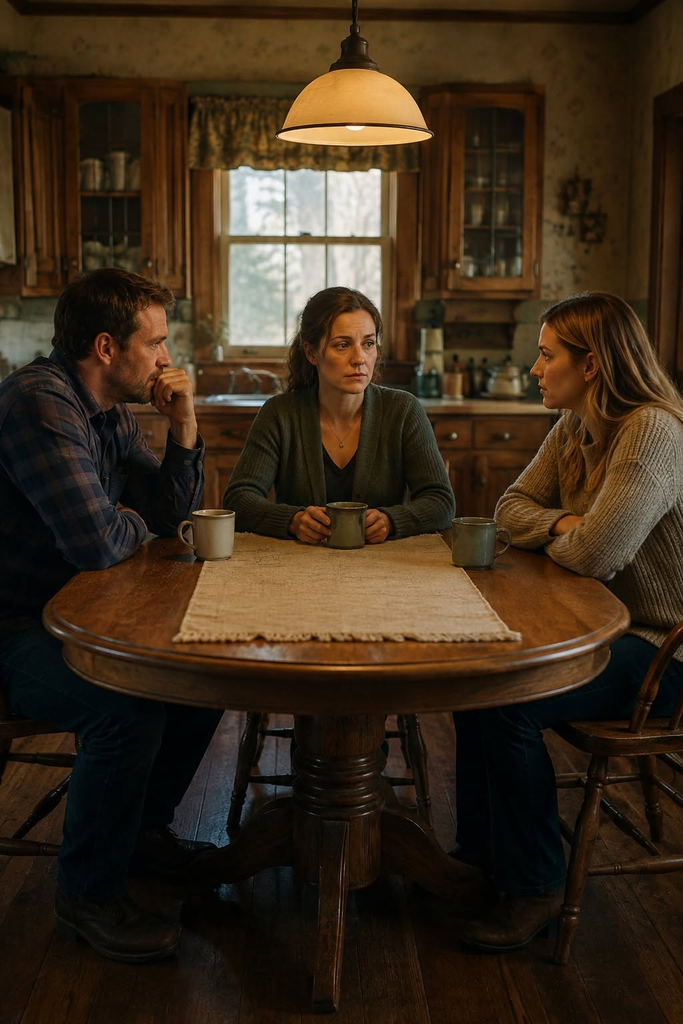
On a crisp, golden Saturday evening in late October, the air smelled of chimney smoke, fallen maple leaves, and damp earth. Sophie, Derek, and Amber sat around the heavy oak dining table that Dad had built thirty years ago, laughing over old family photographs while Derek shared the news of his company’s first major client contract. Outside, the bright red front door stood sturdy against the autumn chill, its brass knocker gleaming in the twilight. Downstairs on the pegboard, Raymond Calloway’s tools rested inside their neat black outlines—not forgotten, not abandoned, but quietly watching over the three children who had finally learned to be a family.