My Father Walked Out When I Was Nine FULL STORY
He told me to read the first page before I threw him out.
So I did.
I stood behind my own counter in my apron, rain coming down the windows, and I read the cover letter from a lawyer in Clayton, and then I read the next page, and then I had to sit down on a red vinyl stool because my legs stopped working.
It wasn’t a trick. It wasn’t a loan request. It wasn’t a man crawling back to be taken care of.
It was a deed. To a building. The building my diner sits in — the one I’d been renting for nine years from a holding company I’d never met, watching the rent creep up every spring, certain I’d lose the place eventually.
He’d owned it the whole time.
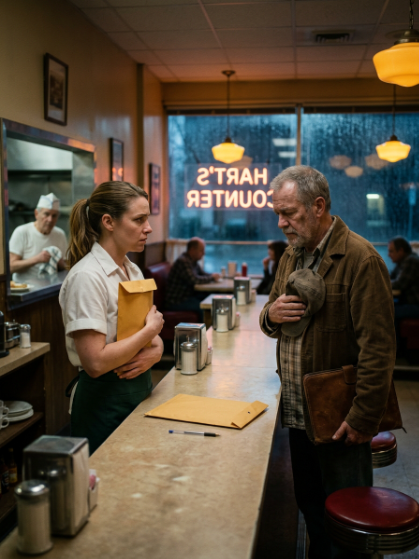
He’d bought it, quietly, eleven years ago. Set up the holding company so I’d never know the landlord was him. Kept the rent low enough that I survived and high enough that I’d never suspect charity.
The rest of the envelope was the rest of him. A modest savings account. A truck. A storage unit. Signed over, all of it, to Naomi Hart.
“Why,” I said again. It was the only word I had.
And Eddie, bless him, turned the grill off in the back so the diner went quiet enough for my father to finally talk.
Here is the thing my mother took to her grave.
My father didn’t leave us for another woman, or a bottle, or a highway, the way I’d built it in my head for twenty-four years. When I was nine, he was diagnosed with something in his blood — a slow, ugly genetic thing, the kind that runs in families. The doctors gave him a few years. And he believed, with the bad information of that time, that the cleanest thing he could do for a little girl was disappear before she had to watch him waste away, and leave her with a mother who could remarry, rebuild, give me a normal childhood without a dying man in the next room.
So he left. He let me hate him. He decided my hating him was a smaller wound than my watching him die.
He was wrong. I know that. Sitting on that stool, I wanted to shake him for how wrong he was, for how many birthdays his “kindness” cost me.
But the diagnosis, it turned out, was half right. The disease was real. It just moved slower than anyone predicted. He got years he never expected. He used them to work, and to quietly watch over the daughter he’d given up the right to know — including buying the roof over the business I’d built without him.
“Your mother knew,” he said. “I wrote to her. She thought it was better you grew up angry at a villain than scared for a sick man. We made that choice together. It was the wrong one. I’m not here to tell you it wasn’t.”
“You could have written to me,” I said. “Any time in twenty-four years. A letter.”
“I know.”
“A birthday card.”
“I know, Naomi.”
He didn’t defend it. That’s the only reason I kept listening. A man who’d come to perform his innocence I’d have thrown into the rain. He just sat there and let it be as bad as it was.
The slow thing in his blood had finally come to collect. That was why now. Months, the doctor in Clayton had said. He’d put his affairs in a manila envelope and driven to the one place he had no right to walk into, to give back what little he could before he couldn’t.
“I don’t want the building,” I said.
“It’s already done,” he said. “It’s yours whether you want me or not. Those are two different questions.” He stood, and picked his hat up off the counter. “I only came to answer the first one. You never have to answer the second.”
He walked to the door.
And I heard myself say, “Sit down. You haven’t eaten.”
He turned around.
“Eddie still makes the best patty melt in south St. Louis,” I said, and my voice cracked all the way through it. “You’re not signing your whole life over to me and then walking out into the rain on an empty stomach. Sit.”
He sat.
I made him coffee. Eddie fired the grill back up without being asked.
We didn’t fix twenty-four years over a patty melt. You can’t. But he came back the next week. And the week after.
He’s got months, the doctor says. Maybe a few more than that; he’s beaten the math before.
I’m going to spend them learning the man instead of the villain.
The deed’s in a drawer now. The diner’s mine, free and clear, the way it turns out it nearly always was.
But that’s not the thing he gave back that I’ll keep.
It’s the patty melt, every Thursday, in the second booth from the door, with a man I’m only now finding out I had.